Senate Passes DEATH BETS Act Banning War and Death Contracts
The Senate passed Sen. Adam Schiff's DEATH BETS Act by voice vote on Nov. 19, moving to ban prediction market contracts on war, assassination and death after Polymarket insider trading concerns. The House must act before Jan. 3, 2027.
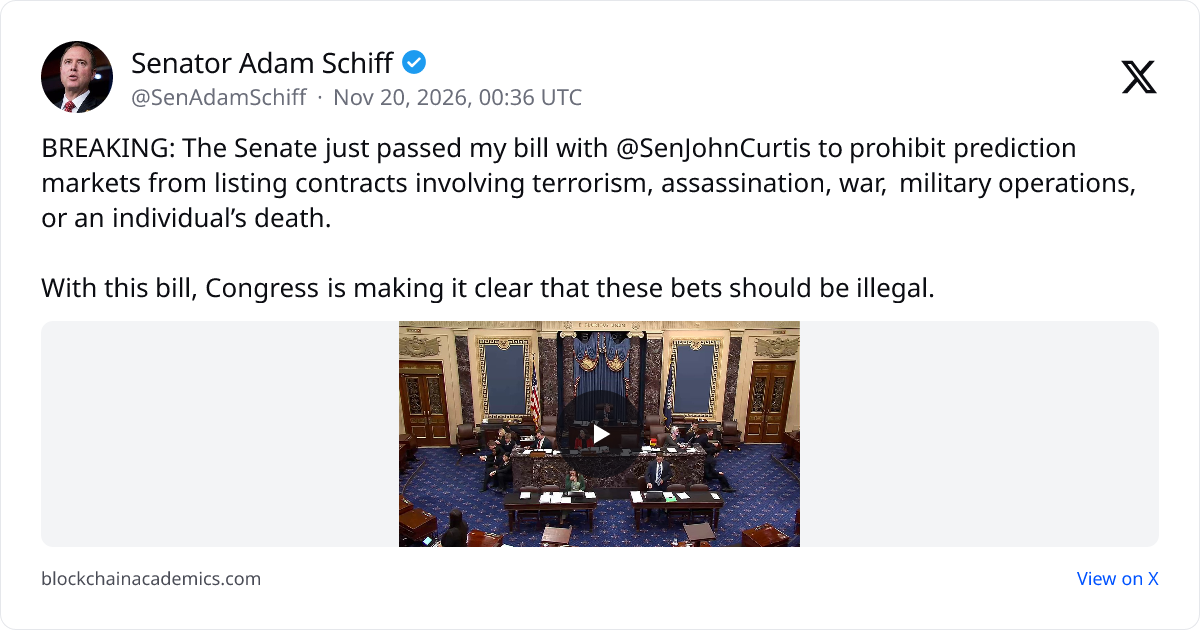
Federally registered exchanges would be barred from listing or clearing contracts on terrorism, assassination, war, U.S. military operations, or any contract reasonably expected to resolve mainly on a person's death, under a bipartisan bill the US Senate passed by voice vote on Nov. 19.
The DEATH BETS Act is not yet law. It now goes to the House, which must act before the 119th Congress ends on January 3, 2027. If the House approves it, the bill would still need President Trump's signature.
The acronym stands for the Discouraging Exploitative Assassination, Tragedy, and Harm Betting in Event Trading Systems Act. Sen. Adam Schiff (D-Calif.) sponsored it with Sen. John Curtis (R-Utah) as co-sponsor, and it was introduced in March 2026. Schiff announced the passage in a post on X.
What the bill changes
The legislation amends the Commodity Exchange Act, the federal law that governs futures markets, to bar CFTC-registered exchanges from handling the covered contracts. The Commodity Futures Trading Commission already has discretion to block some of these contracts. The bill replaces that discretion with a statutory ban. The vote followed an amendment adopted by unanimous consent, and the text gives the CFTC authority to identify similar activities that would fall under the prohibition. The full text is on congress.gov.
The insider trading motive
Schiff has framed the bill around insider trading. He said such contracts create "rampant opportunities for insider trading" and are offered "with no regard for national security and, in far too many cases, even basic morality."
The trigger was reported trading on Polymarket around US strikes on Iran. On-chain analytics firm Bubblemaps found that six wallets made about $1.2 million betting on the timing of the strikes, though other reports put the figure at roughly $1 million. Several of the wagers were reportedly placed hours before the first reported explosions in Tehran.
A crowded jurisdiction fight
The vote landed amid a wider contest over who regulates prediction markets. It came one day after the Fourth Circuit, in KalshiEX v. Martin, let Maryland apply its sports-wagering rules to Kalshi. That leaves the Fourth, Sixth and Ninth Circuits against Kalshi on the state sports question, with the Third still on its side.
The states are pressing on several fronts. Utah sued Kalshi in October, the 11th state to take legal action against prediction markets. The CFTC, for its part, has sued Arizona, Connecticut and Illinois, and on Nov. 13 sued Arkansas, days after Arkansas Attorney General Tim Griffin sued Kalshi on Nov. 4. CFTC Chairman Michael Selig has said the agency will defend its sole jurisdiction.
What it means
The bill targets a narrow category of contract, not the sports markets at the center of the circuit court fight. That makes it a different kind of intervention: rather than courts deciding which referee gets to blow the whistle, state or federal, Congress is redrawing the boundaries of the field itself, declaring certain events off-limits no matter who supervises the exchange. For platforms like Polymarket and Kalshi, the practical question is whether the House takes the bill up in the weeks left before the session ends. The Senate has struggled to move other crypto legislation, as in the 49-51 cloture failure on the CLARITY Act, though passage by voice vote suggests this bill drew no recorded opposition.