Wagyu XMR1 Wrapped Monero Falls 99% After $13M Hack
XMR1, Wagyu's wrapped Monero on Hyperliquid, lost more than 99% after an attacker drained the deployer wallet and sold about 364,000 tokens for $13.5 million. The founder blames a breach at host 1984.hosting and promises personal refunds, but onchain data cannot confirm the key theft or the...
For roughly half an hour on Friday, a token meant to stand in for Monero on Hyperliquid stopped standing in for anything at all. XMR1, the wrapped Monero issued by cross-chain swap service Wagyu, lost more than 99% of its value after an attacker drained the deployer wallet and sold about 364,000 tokens to 388 buyers for $13.5 million, according to onchain data firm Bitquery.
The token fell from about $500 to around $1, with some trading data putting the low at $0.65. Native Monero was not affected, and Wagyu's site showed the service as temporarily unavailable.
The mechanics explain why the damage stayed contained to the wrapper. Monero is a privacy coin that hides senders, receivers and amounts, and because it runs on its own blockchain it cannot trade natively on Hyperliquid. Wagyu bridges that gap: users deposit Monero and receive XMR1, which they can later redeem. Whoever controls the token on the Hyperliquid side therefore controls the IOU, not the coins behind it.
Lookonchain first flagged on X that an attacker had received 5.2 million XMR1 from the deployer wallet and sold a portion.
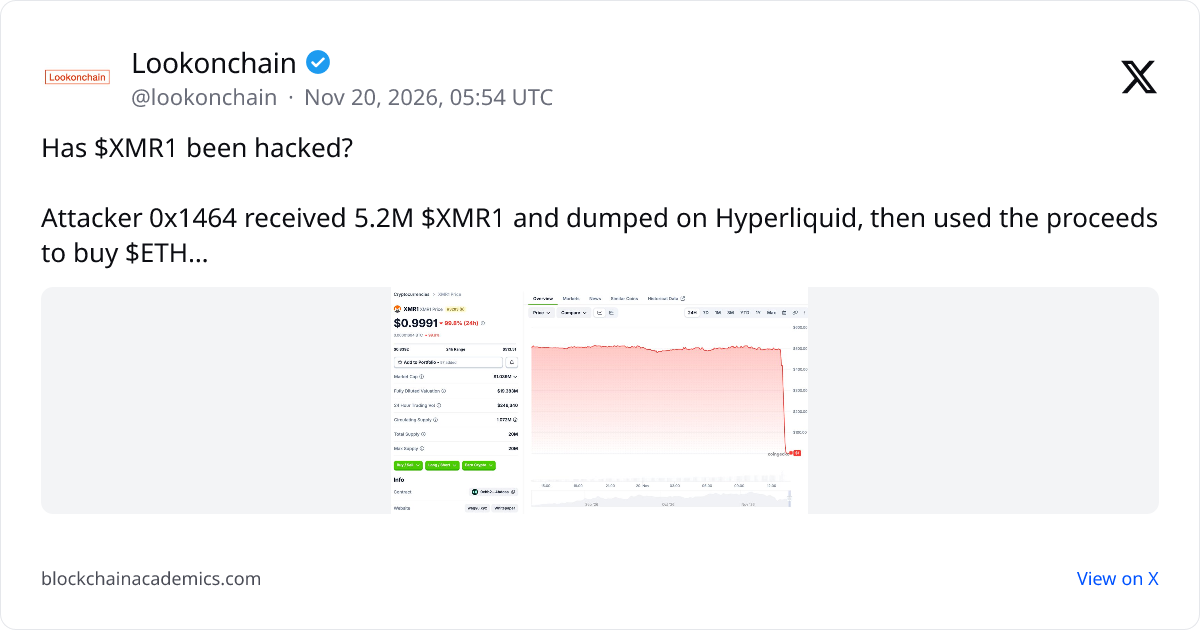
Bitquery traced the sequence. The deployer account sent 5.2 million XMR1 to a newly created account early Friday, and that account sold its tokens and converted the proceeds to ETH. At Bitquery's last check, about 7,350 ETH sat in three wallets; Lookonchain put the haul at nearly 7,500 ETH, bought on Hyperliquid after the sale. The attacker's account received its first funds from Tornado Cash minutes before it was set up.
Founder blames a web host
Wagyu's pseudonymous founder, PerpetualCow, blamed a breach at Icelandic hosting provider 1984.hosting. He said the deployer key sat on an old server he had deleted, though the provider apparently kept the data.
"The XMR1 deployer key was held on an OLD server on there that I DELETED, but somehow the logs/files were still kept,"
PerpetualCow, Wagyu founder
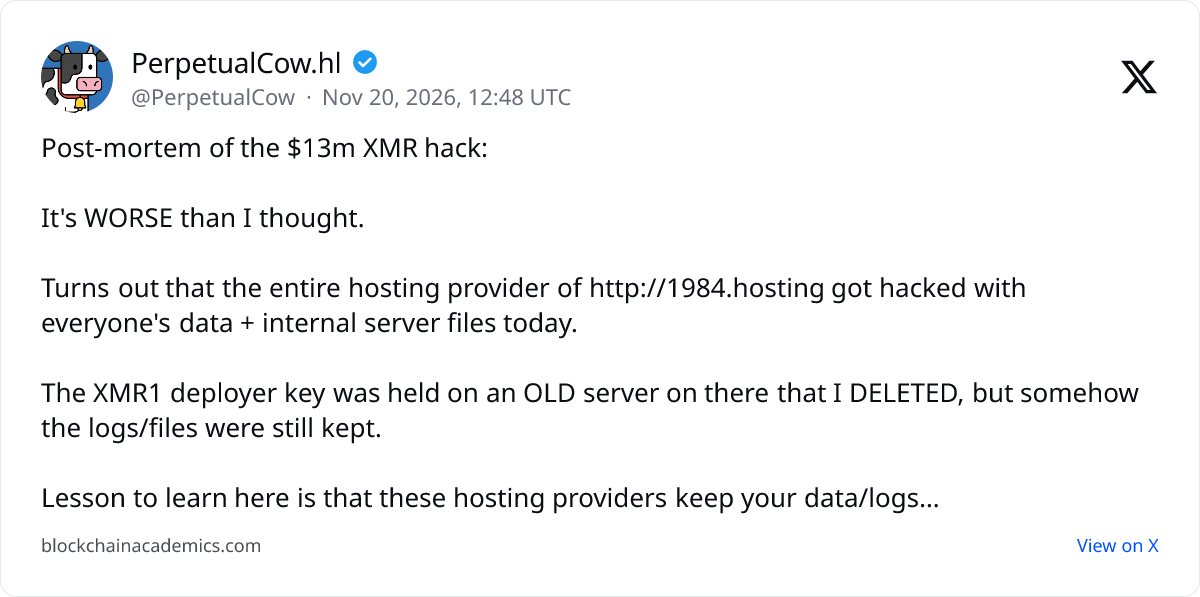
In a joint statement with Iceland's CERT-IS, reported by DV, 1984 ehf. said it had suffered an extensive and serious cyberattack, could not rule out that more systems were affected, and had temporarily shut down all services. The statement did not mention Wagyu or say whether customer data was taken.
That leaves the founder's account unverified. A cyberattack on the host does not by itself confirm that attackers reached the retained keys, and Bitquery said onchain data alone cannot show whether the deployer key was stolen. Nor can it see how much Monero backs the remaining XMR1, because the Monero side of the bridge is not visible.
Refund pledge, no timetable
PerpetualCow promised to make victims whole.
"Everyone who lost money due to this will be refunded by me personally and Wagyu will re-launch at a later stage,"
PerpetualCow, Wagyu founder
No relaunch date was given. The same deployer account still controls nearly all of ZEC1, Wagyu's Zcash token.
What it means
A wrapped token is a claim check: it is only as sound as the custody and key management behind the asset it says it represents. Here, control of a single deployer account appears to have been enough to move millions of tokens and dump them into the market, while the Monero reserves meant to back the rest cannot be audited from the chain. It is the same trust question that runs through cross-chain assets generally, from small bridges to moves like BitGo's $7.4B shift of wrapped Bitcoin to Chainlink CCIP.
Wagyu has been in the news before. It disclosed a separate data leak in October, saying then that funds were unaffected. Earlier this month it also surfaced in ZachXBT's tracing of a suspected $106 million theft from an unnamed European entity, where some of the funds were converted to Monero through the service.