Grvt Launches Stable Funding Perps on Seven Commodity Markets
Grvt's Stable Funding Perps price funding off market makers' traditional financing costs instead of the perp premium. Gold, silver and WTI lead seven commodity markets, with zero trading fees but spreads, triple weekend charges and positions you can't close while markets are shut.
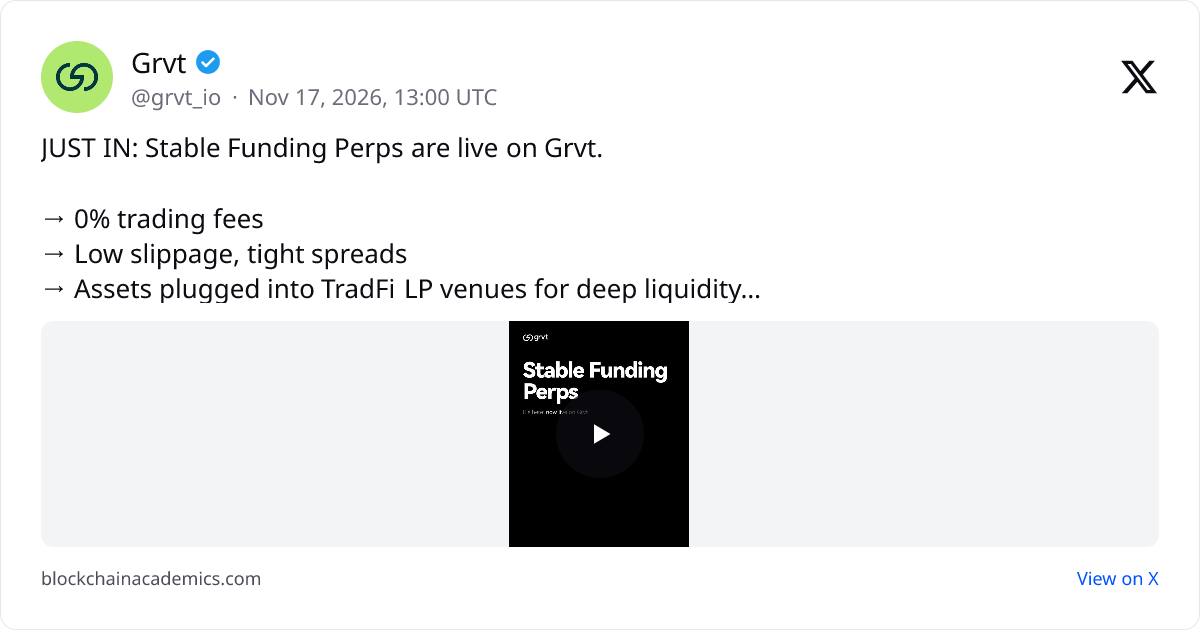
Forget the perp premium. On Grvt's new Stable Funding Perps (SFP), the funding you pay on a leveraged gold or crude position is set by what market makers pay to finance it in traditional finance, plus a platform markup. The self-custodial derivatives exchange rolled the product out on Nov. 17 across seven commodity markets.
Grvt said in a post on X that gold, silver and WTI crude are the initial alpha. Its product guide lists four more: platinum, palladium, Brent crude and natural gas.
How the funding works
Classic perps move funding between longs and shorts every one, four or eight hours, based on the perp's premium or discount to the index. SFP drops that. Approved market makers submit separate long and short rates built from their traditional-finance cost of funds plus the platform markup. Both sides can pay at once, and a trader can pay or receive depending on the rates.
Funding settles once per weekday at market close. Weekend financing arrives as a triple charge on Wednesday for metals and Friday for energy, and weekday holidays are still chargeable. Makers can update the indicative rate during the day, but the closing snapshot rate applies to the whole position.
Close before the snapshot and you skip that day's funding.
Contracts settle in USDC, have no expiry and deliver no physical commodity. Trading runs on request-for-quote, with market-maker quotes instead of an order book. Makers hedge in traditional markets, including through contract-for-difference providers.
"If market makers can hedge more efficiently in established markets, they can pass those efficiencies on through better pricing and deeper liquidity."
Hong Yea, Grvt CEO
Yea also said: "We don't believe every onchain market needs to recreate liquidity that already exists elsewhere."
What it costs
Grvt charges no trading fee and adds no spread of its own. That is not the same as free. Traders still eat the gap between market makers' buy and sell quotes, plus funding, and borrowed balances accrue hourly interest. The contracts require multi-asset margin mode and USDC. Maximum leverage is 20x on gold and WTI and 10x on silver, per the product guide.
"Stable" also does not mean fixed. Makers can shift the indicative rate intraday and the closing snapshot governs the whole position, so the number you see at entry is not guaranteed.
The bigger risk for leveraged traders is the clock. Most contracts trade about 23 hours a day, five days a week, following the CME Globex calendar and holidays. Positions cannot be closed or reduced while a market is shut, so margin can erode and trigger liquidation before a trader can get out. That is a real change from Grvt's existing traditional-asset perps, which trade around the clock.
The initial rollout also carries larger minimum trade sizes. Grvt plans 24/7 availability and smaller minimums over time.
Why Grvt is doing this
In a June survey of 134 traders run by Grvt, 56% said they skipped or closed a perp position because funding was unpredictable. SFP is pitched squarely at that complaint. Grvt already lists classic perps on gold, silver and Brent oil, so this adds a second funding model rather than a new asset class.
The roadmap is bigger. Grvt plans to extend SFPs to stocks and other real-world assets, targeting more than 100 markets including equities. The RWA pitch has tailwinds: Standard Chartered said on Monday the RWA market, currently about $45 billion, could reach $2 trillion by the end of 2028.
For traders, the practical question is whether market-maker-set financing beats premium-based funding once spreads and closed-market risk are counted. That only gets answered with live flow, and the larger minimum sizes will limit who can test it early.