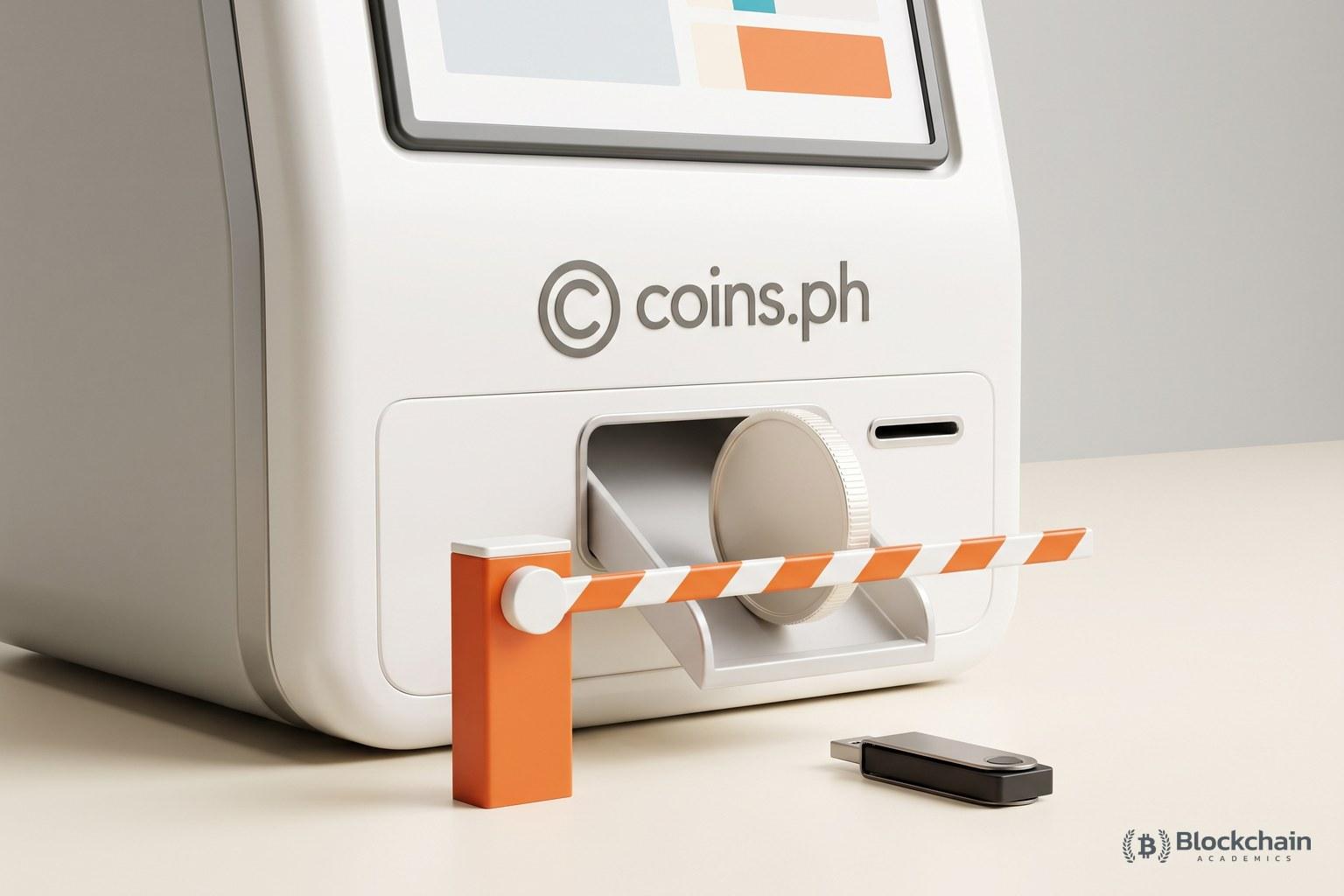
Coins.ph Blocks Transfers to Private Wallets Under BSP Travel Rule
Coins.ph, with roughly 18.6 million users, has stopped transfers to and from self-custody wallets. Under the BSP Travel Rule, every transfer now needs full counterparty details, with no minimum threshold.
For a large share of Philippine crypto users, the private wallet option is gone. Coins.ph, a platform serving roughly 18.6 million users, has stopped letting customers move crypto to or from self-custody wallets, and external transfers can now go only to accounts on other regulated exchanges. The policy took effect on November 19, 2026, and was updated on November 21.
The company says it is complying with the Travel Rule of the Bangko Sentral ng Pilipinas (BSP), the country's central bank, as set out in Circular 1108. Self-custody wallets are the digital vaults where users hold their own keys rather than trusting a company to hold them. Under the new rules, Coins.ph no longer accepts deposits from them or sends withdrawals to them.
What users must now provide
Every permitted transfer now carries paperwork, in or out, much as a bank wire travels with the names of its sender and recipient. Users must supply the counterparty's full name, wallet address, platform or exchange, wallet type, and the purpose of the transaction.
There is no minimum threshold. A transfer worth a few pesos gets the same treatment as a large one.
Enforcement is mechanical: deposits from non-compliant sources will be sent back, minus network fees, and withdrawals to non-compliant wallets will fail.
Remittances survive, with a detour
Remittances still work inside the platform. Users abroad can convert local currency to USDT, then to pesos, without leaving Coins.ph. The change bites anyone who used a personal wallet as a waypoint between a foreign exchange and Coins.ph, because that route must now pass through a regulated venue instead.
The regulatory push stems from money laundering and terrorist financing concerns, and the BSP has tightened compliance requirements for virtual asset service providers. This is also not the first time Coins.ph has narrowed what users can do. The platform previously shut down its dedicated Web3 wallet feature, and in late September 2026, restrictions were observed on inflows tied to DCPay, the Coins.ph e-wallet arm, because of BSP oversight.
The cost to users
The trade-offs are practical. Each extra hop through a compliant exchange can mean another network fee, and returned deposits lose their network fees along the way. Per-transaction data requirements turn casual transfers into small compliance exercises. The restriction may raise compliance burdens and transaction costs, at the expense of user autonomy and financial privacy.
Context
The move shows how a Travel Rule can reshape product design once a regulator ties compliance to specific counterparties. Coins.ph has also been building out payments, having expanded QR payments to Bitcoin and Ethereum across 700,000 Philippine merchants. Remitting within a regulated perimeter remains available, but moving assets out to a wallet the user controls does not. For a platform of this size, the line between custody-friendly and compliance-first is now drawn at the exchange's edge.