
Chainflip Vault Drained of $4.86M, FLIP Falls 34%
An attacker emptied Chainflip's Ethereum vault of about $4.86 million in ETH and stablecoins, apparently using a valid signature from the protocol's own signing key, then laundered it through Tornado Cash. The protocol is in full safe mode and FLIP fell about 34%.
Chainflip's Ethereum vault sat empty within minutes on Saturday, Nov. 21. An attacker took about $4.86 million in ETH and stablecoins and sent it to Tornado Cash, apparently using a valid signature from the cross-chain DEX's own signing key. The exploit hit at 2:10 a.m. ET, and the protocol has since gone into full safe mode.
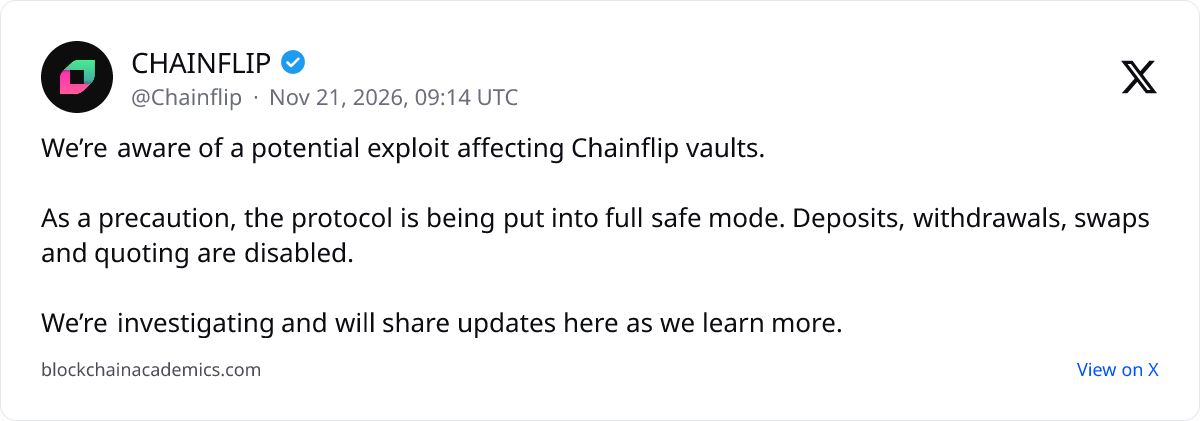
Chainflip confirmed the incident on X, first saying it was "aware of a potential exploit affecting Chainflip vaults." It then announced a freeze:
"As a precaution, the protocol is being put into full safe mode. Deposits, withdrawals, swaps and quoting are disabled."
Chainflip, on X
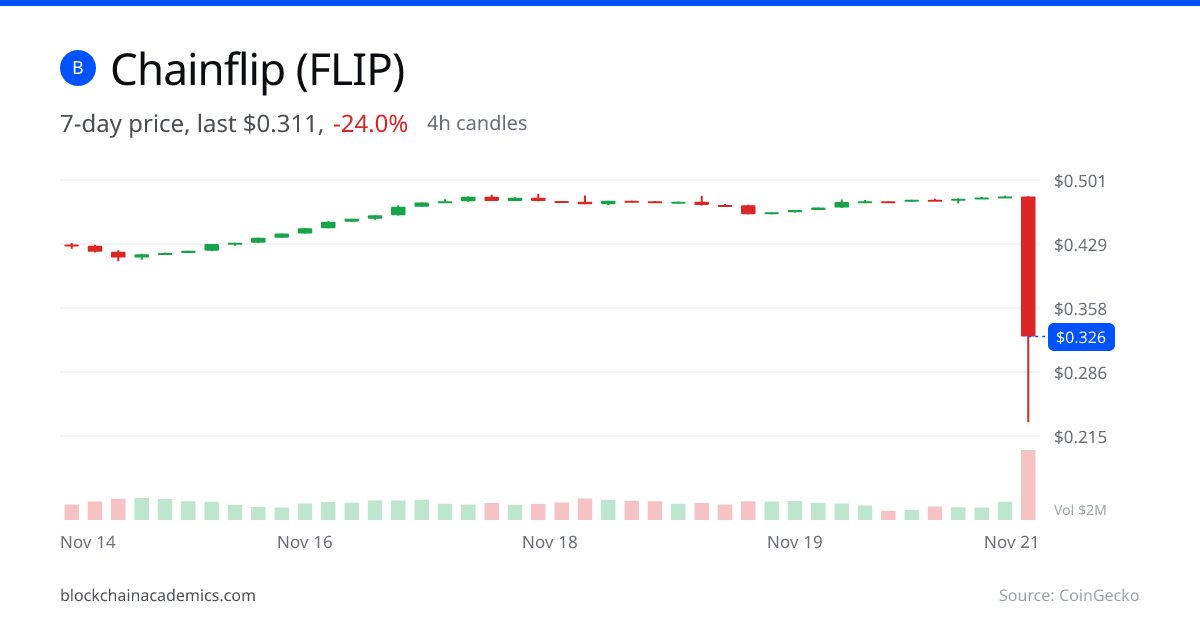
FLIP, the protocol's token, fell about 34% after the exploit. Its market cap dropped from about $41.6 million to $27.1 million in the hours that followed.
What was taken
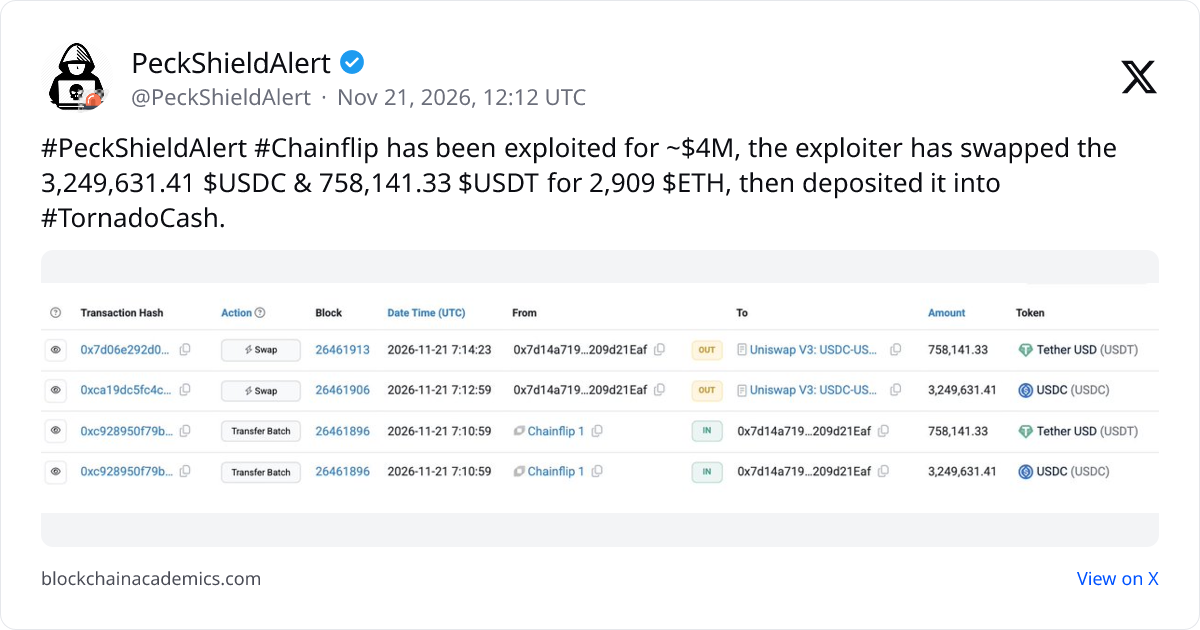
Decurity's Defimon Alerts bot first flagged the drain: 520.2 ETH, 3.25M USDC and 758K USDT. PeckShield wrote on X that the exploiter swapped 3,249,631.41 USDC and 758,141.33 USDT for 2,909 ETH and deposited it into Tornado Cash. Lookonchain posted a similar tally, putting the swapped total at 2,910 ETH.
According to AMLBot, the attacker used a fresh wallet, and "the laundering was executed with high-speed automation." The stablecoins moved too quickly for Circle and Tether to freeze them, and the whole operation took under 10 minutes.
A signing key, not a contract bug
Defimon's alert said the attacker apparently obtained the validator network's aggregate signing key rather than exploiting a smart contract flaw. Think of it as a vault that opens only when enough keyholders turn their keys together: here, 100 of 150 validators must sign, and the combined key rotates every three days. The last rotation was Nov. 18 at 4:53 p.m. ET.
Bitquery's analysis points the same direction. The attacker's transaction carried a 39-digit nonce, against roughly 315,000 for other transactions, and was the only one of 299,677 signatures since 2023 to break the count. That suggests a valid signature was produced outside the normal system. Bitquery also noted the key changed about 1 hour 45 minutes after the theft, but cautioned that no conclusions can be drawn from timing alone.
The key compromise remains an inference. Chainflip has not said how the attacker obtained a valid signature.
What is still unknown
Vaults on Bitcoin and Solana were apparently unaffected. About two hours after the pause, a Bitcoin transaction moved nearly 10.5 BTC from a previous Chainflip vault address to a new one. Its purpose is unconfirmed, and security firms have not reported it.
Chainflip has not said whether it will reimburse victims.
This is not the protocol's first exploit. On Sept. 12, an attacker abused a flaw in how Tron transaction memos were processed to double-process six Tron withdrawals, and validators later voted to reimburse affected liquidity providers from the protocol's surplus funds. That earlier case was a processing bug in the code. This one, if the signing-key theory holds, targets the trust assumption behind threshold signing itself, where safety depends on the validator set keeping its key material secure. The story is still developing and will be updated as Chainflip confirms details.