
Chainalysis: AI Proxy Payments From Suspected China Wallets Up 55%
Chainalysis research shows payments from potentially China-linked wallets to AI proxy services ran 55% above baseline in the three days after U.S. frontier model releases. The firm cautions the data cannot prove the payments were for model distillation.
Every time a U.S. lab releases a frontier model, a set of crypto wallets starts paying for access to it. Chainalysis found that wallets it identified as potentially China-linked paid AI proxy services 55% more than usual in the three days after those releases, according to research the firm published November 10 and highlighted again on November 21.
The firm surveyed 100 AI proxy services and found that 40% accepted cryptocurrency, mainly stablecoins. These services resell access to models such as Claude, ChatGPT and Gemini through intermediary accounts, often at a discount, and users buy credits or top up balances rather than holding a direct subscription.
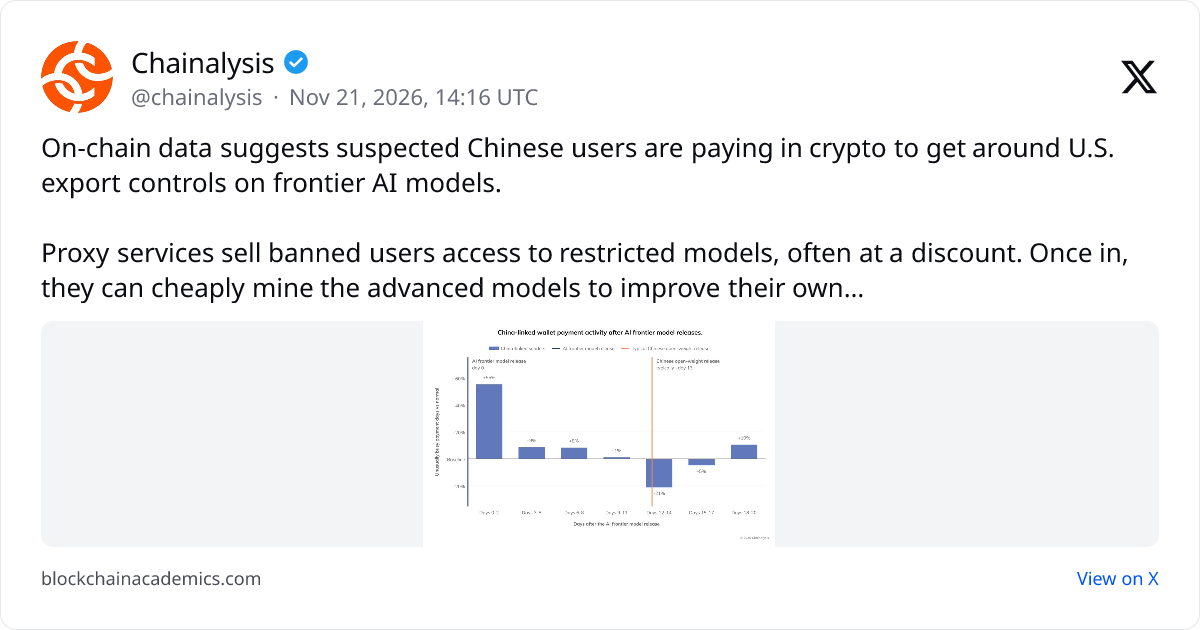
Chainalysis said in a post on X that suspected Chinese users pay in crypto to reach restricted U.S. AI models through such services. The pattern it describes is a pulse that fades. Payments ran 55% above baseline in the first three days after a release, then 7% and 8% above over the next six days. Activity dropped 21% below baseline on days 12 to 14 and recovered to 10% above on days 18 to 20.
The shape resembles a tide pulled by each launch: a surge, an ebb below the waterline, then a partial return. That early surge exceeded the pattern across all wallets paying these services, which suggests the China-linked group reacts to launches more sharply than the broader customer base. The firm was careful about what that proves, though. Aggregate transaction data, it said, cannot establish whether payments were intended for model distillation, the practice of mining a stronger model's outputs to improve one's own. The wallets are also only potentially China-linked, not confirmed.
The distillation backdrop
The report points to Anthropic's accusation that DeepSeek, Moonshot and MiniMax used 24,000 fraudulent accounts, routed through proxy services, to extract capabilities from Claude. Chainalysis says the payment surge may reflect distillation but cannot establish what caused it.
Wallet concentrations appeared in China, Japan, Hong Kong, Singapore and South Korea. Many providers collect crypto through custodial payment processors. The supply chain described in the research runs through access suppliers, brokers and payment processors, with some processors obscuring stablecoin flows by routing them through third-party channels.
Why it matters
Export controls were meant to keep frontier American models out of reach. What the data sketches instead is a middleman economy, with stablecoins serving as a key payment rail for the users those controls were meant to exclude.
That rail was already busy. An October 2026 Chainalysis report recorded $104.1 billion in self-custodied stablecoin transfers from China-linked wallets across 18.1 million transactions between July 2025 and June 2026, despite domestic trading restrictions.
The AI proxy trade is a specific slice of that larger flow, and a revealing one, because its rhythm tracks product launches in another country. Still, the evidence so far is correlation in timing, not proof of intent.