BTCS Sells ETH Below Cost to Manage $64.1M Aave Loan
Ethereum treasury firm BTCS sold ETH below its cost basis to manage a $64.1 million Aave loan backed by 46,676 ETH. The figures imply a liquidation price near $1,717 as ETH trades around $1,935, though BTCS reports no liquidations.
BTCS, the Nasdaq-listed Ethereum treasury firm, sold ETH for less than it originally paid in order to manage its borrowing on Aave. Its November 12 quarterly filing with the SEC shows $64.1 million in Aave debt backed by 46,676 ETH as of November 9.
The filing, which BTCS submitted to the SEC as a 10-Q, is blunt about the trades.
"Sales of ETH were executed at prices below their original cost basis,"
BTCS, quarterly filing
It is far less specific about the details. The company did not say how much ETH it sold for the Aave loan, at what price, or on what dates. Nor did it say how much of its losses came from those sales.
Collateral, health factor and the liquidation line
At an ETH price of $2,127 on November 9, the pledged ETH was worth about $99.3 million, roughly 155% of the debt including accrued interest. Applying Aave's generally 80% liquidation threshold for ETH, the figures imply a health factor of about 1.24 and a liquidation price near $1,717 per ETH. That estimate assumes the loan, collateral and protocol parameters stay unchanged. Health factor is Aave's running gauge of how safe a loan is; if it drops too far, the protocol can sell the collateral automatically.
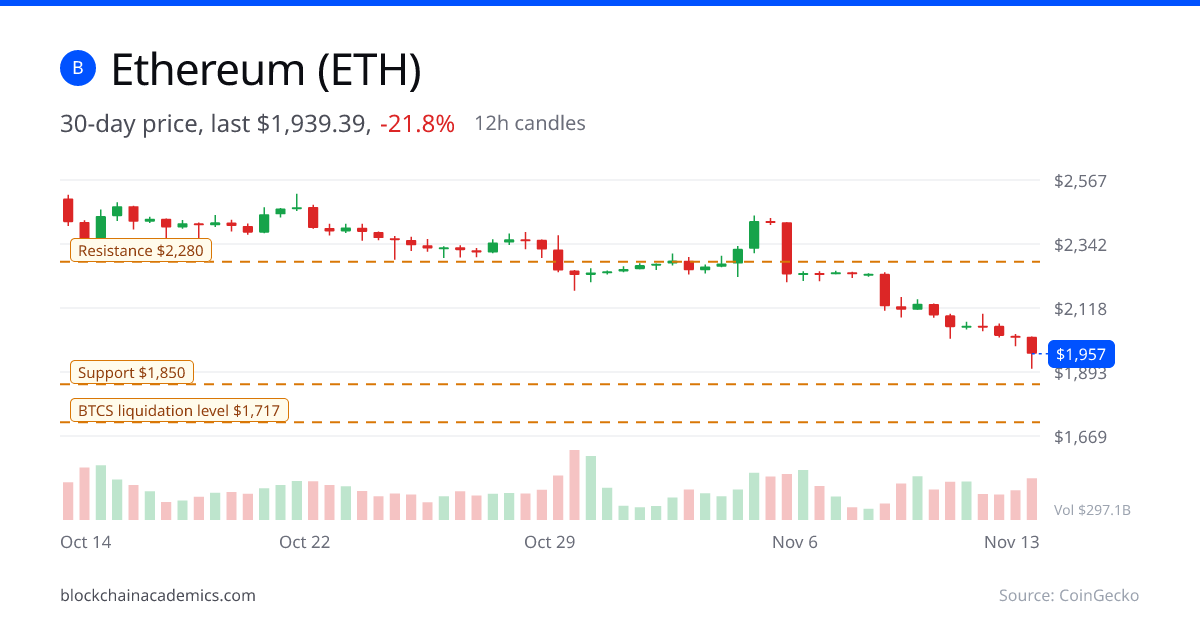
The estimate matters because ETH has been sliding toward that line. On November 13 ETH traded between roughly $1,932 and $1,940, down about 4% to 5.6% over 24 hours depending on the price feed, about 13% on the week and about 22% on the month. At $1,932, it sat only about 11% above the estimated liquidation level.
Losses, but no liquidations
BTCS booked about $30.6 million in realized digital asset losses over the first nine months of 2026. They came from ETH sales to manage borrowing and from accounting losses on moving ETH into liquidity pools. Its net loss for the period was about $49.5 million, against a $52.2 million profit a year earlier.
The sales were the company's own collateral management, not forced liquidations. In the filing, BTCS says it
"has not experienced any full or partial liquidation events"
in its DeFi borrowings through November 11. Selling collateral on your own schedule is a different thing from having the protocol sell it for you, much as trimming a mortgage voluntarily differs from foreclosure, though both lock in losses when ETH trades below what was paid for it.
The scale of the borrowing explains why the management matters. Between January 1, 2025 and November 11, 2026, BTCS borrowed about $152.4 million in stablecoins, mainly USDT and GHO, through Aave and repaid about $89.4 million. Variable rates on November 9 were about 6.54% for USDT and 4.5% for GHO.
Liquidity and the market backdrop
The broader balance sheet looks sturdier than the collateral math alone suggests. BTCS held about $463,000 in cash at September 30, but reported about $142.6 million in cash, stablecoins and liquid digital assets on November 9. Total debt was about $82 million: the $64.1 million Aave position plus $17.9 million in convertible notes. The company expects its resources and financing to support operations for at least 12 months.
The chart offers less comfort. ETH trades below its 50-day moving average near $2,320 and below its 200-day average. RSI sits near 25, an oversold reading that often precedes a bounce without marking a bottom. Support sits near $1,850, with resistance near $2,280 and $2,400.
For treasury companies, the episode shows the structural cost of funding ETH holdings with on-chain leverage: when prices fall, the borrower must add collateral, repay debt or sell, and other firms borrowing against ETH face the same arithmetic. BTCS had accumulated 55,788 ETH by July 2025 using equity, convertible debt and DeFi borrowing. Its position is now a visible test of how much cushion that financing mix leaves when ETH drops.