
Groma Launches First Permissioned Asset Pool on Uniswap v4
Uniswap now hosts its first permissioned asset: Groma's GRO-USDC pool on Base lets accredited, allowlisted investors buy and redeem tokenized REIT equity at net asset value, with compliance enforced by the Permissioned Pools Hook.
Uniswap's automated market maker, built on the premise that anyone can swap anything, now hosts a pool where not everyone gets in. Groma launched a GromaCoin (GRO)-USDC pool on Uniswap v4 on Base on November 5, letting verified investors buy and redeem tokenized real estate equity directly with the Groma Real Estate Trust. Uniswap announced the integration the same day, saying that for the first time "a permissioned asset is live on the Uniswap AMM."
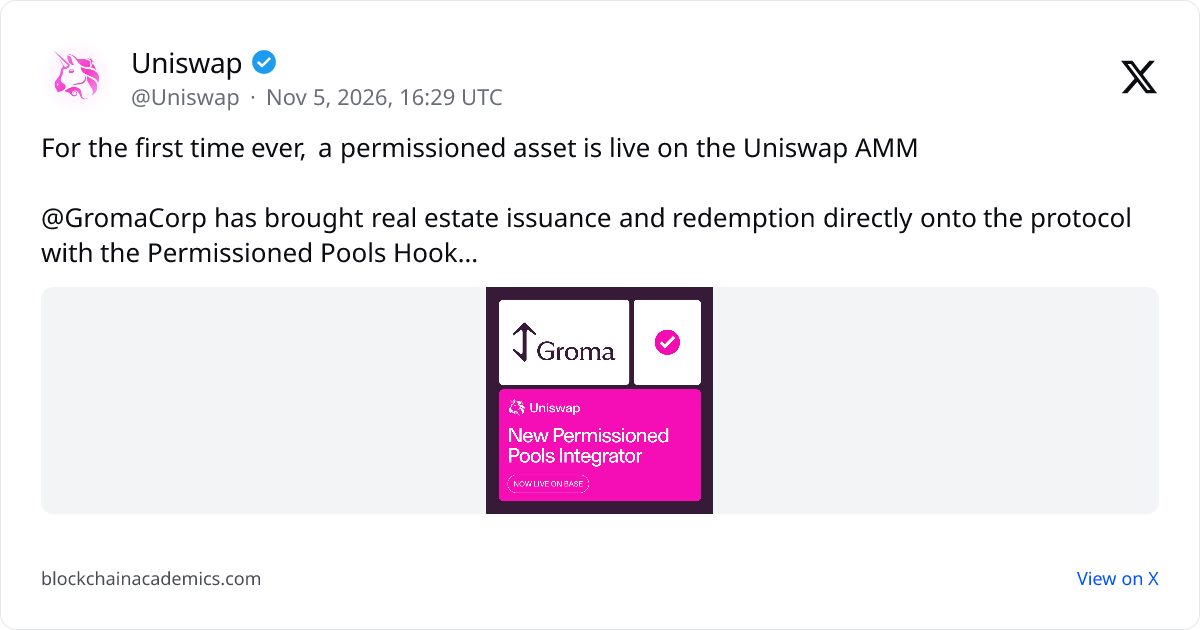
Groma announced the GRO-USDC pool from its @GromaCorp account on X.
Each GRO represents an equity stake in the trust, a US-regulated real estate investment trust that owns and operates a portfolio of multifamily residential properties concentrated in Greater Boston and Providence. The token itself is an ERC-3643 security token issued on Base, a standard that embeds investor eligibility rules at the token level so transfers to unapproved wallets can be blocked. The trust holds 125 to over 150 income-producing properties, pays quarterly dividends at a current yield around 3.74%, and has assets nearing $95 million.
How the pool works
The pool relies on Uniswap's Permissioned Pools Hook, which bolts eligibility checks onto the automated market maker. Issuance and eligible redemptions happen at net asset value (NAV) rather than at a price set by supply and demand, the mechanism that governs conventional Uniswap pools. For real estate equity, that distinction carries real weight: investors transact with the trust at its own valuation instead of having to find a buyer in a secondary market.
According to Uniswap documentation, the hook checks permissions on every swap and again before a liquidity position is created, with separate flags for trading and liquidity provision. The restricted token never enters Uniswap v4's shared pool-management contract. An approved adapter holds the asset while the pool trades a virtual representation of it, and liquidity-position NFTs are non-transferable.
Open venue, closed door
Think of it as a members-only entrance built into a public marketplace. Groma's investment site labels purchases as available to accredited investors only, and its whitepaper says wallets must be allowlisted after identity and anti-money-laundering checks.
The issuer deploys the eligibility-checker contract, and the issuer-controlled adapter can change that checker, approve or revoke access contracts, and pause swapping. The integration, in other words, changes the transaction channel rather than the requirement for investor approval, and the issuer keeps meaningful control over who trades and when.
Uniswap introduced the Permissioned Pools standard on July 23, 2026, giving asset issuers a way to run managed allowlists and execute compliance checks directly onchain. GRO is the first asset to use it.
Lending and limits
Groma has also partnered with Birch Hill and Morpho so holders can borrow USDC against GRO, with supply caps starting at $5 million, a figure that suggests a cautious rollout. The accredited-only restriction, for its part, naturally caps how deep the pool can become. And the underlying value rests on multifamily properties in two metro areas, with the usual real estate risks that come with that concentration.
What it means
The launch is a test of whether regulated assets can use public DeFi liquidity infrastructure without breaking compliance requirements. Where projects such as the LiquidAcre and Uphold infrastructure partnership build tokenized real estate rails of their own, Groma's pool places an equity token inside Uniswap's standard v4 architecture, with the compliance logic living in a hook. Whether other issuers follow will depend on how comfortable they are with the adapter's pause and checker controls, and on how much liquidity a gated pool can attract.