IRIS to Launch Borrowing at Fixed Rates on SparkLend Nov. 10
IRIS plans to go live Nov. 10 with fixed-rate loans that settle on SparkLend. Solvers compete via off-chain RFQ to quote fixed terms, backed by bonds that absorb floating-rate swings. Borrowers still face collateral liquidation and owe full-term interest.
Fixed-rate borrowing is coming to SparkLend liquidity. IRIS, a fixed-rate lending protocol, plans to go live on Nov. 10 with loans that settle on SparkLend, letting borrowers pick an exact loan duration instead of a standardized term. The team announced the date on Monday, Nov. 9.
"IRIS goes live tomorrow."
IRIS, protocol announcement
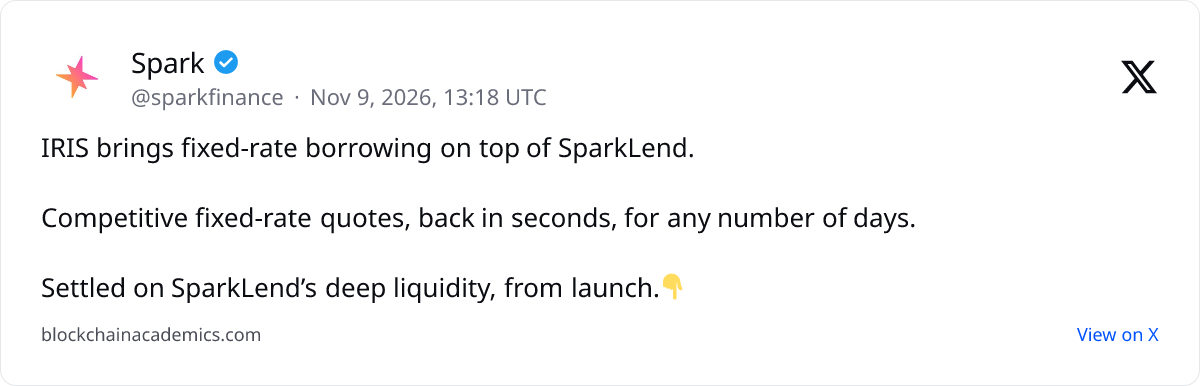
Spark confirmed the integration in a post on X, saying: "IRIS brings fixed-rate borrowing on top of SparkLend."
One date caveat: a second report puts the launch in mid-November. This article follows IRIS's own announcement, which points to Nov. 10. That same report says quotes can lock terms for anywhere from one to 90 days.
How the quoting works
Borrowers specify collateral, loan size, duration and a maximum acceptable rate. That last number is a ceiling: if no solver can beat it, no deal happens.
Solvers, effectively market makers for interest rates, compete through a request-for-quote (RFQ) process to offer fixed terms. There are no preset term pools to draw from. The RFQ layer runs off-chain, and each signed quote is backed by a bond.
Per IRIS documentation, settlement opens an isolated account per loan, posts collateral, borrows from the venue, posts the solver bond and delivers funds in a single transaction.
Where the risk sits
The solver keeps the spread when the venue's floating cost runs below the fixed rate. When floating costs run higher, the solver's bond covers the gap. A solver can refinance across venues the borrower has approved without changing the fixed rate, though the new venue's liquidation rules then apply.
The fixed rate is not unconditional. If accumulated floating costs erode the bond enough, anyone can liquidate it, the fixed rate ends and the borrower takes on the venue's floating rate. That liquidation does not itself take the borrower's collateral.
Borrowers still face collateral liquidation under the venue's rules. They also commit to the full term's interest: repaying early returns collateral sooner but does not cut the agreed interest. Solvers carry their own exposure, since bonds are at risk if their rate forecasts miss. And because the RFQ component is off-chain, users depend on the quoting infrastructure working smoothly.
Scope at launch
IRIS's supported-market documentation lists six pairs on Ethereum: USDC or USDT borrowing against cbBTC, WBTC or wstETH. SparkLend and Aave V3 are listed for all six, Morpho Blue for five. The announcement itself does not add further integrations.
Why SparkLend
The venue has depth. SparkLend TVL stood at about $4.66 billion as of Nov. 9, according to reported figures, with outstanding borrows near $2.64 billion, up 47% over the preceding three months. Rising borrow demand gives a fixed-rate layer something to work with, because borrowing directly from SparkLend carries a rate that keeps changing.
For traders, the practical question is pricing. Whether solvers quote tightly enough against SparkLend's variable rate will decide whether borrowers use the product or just use the venue directly.