

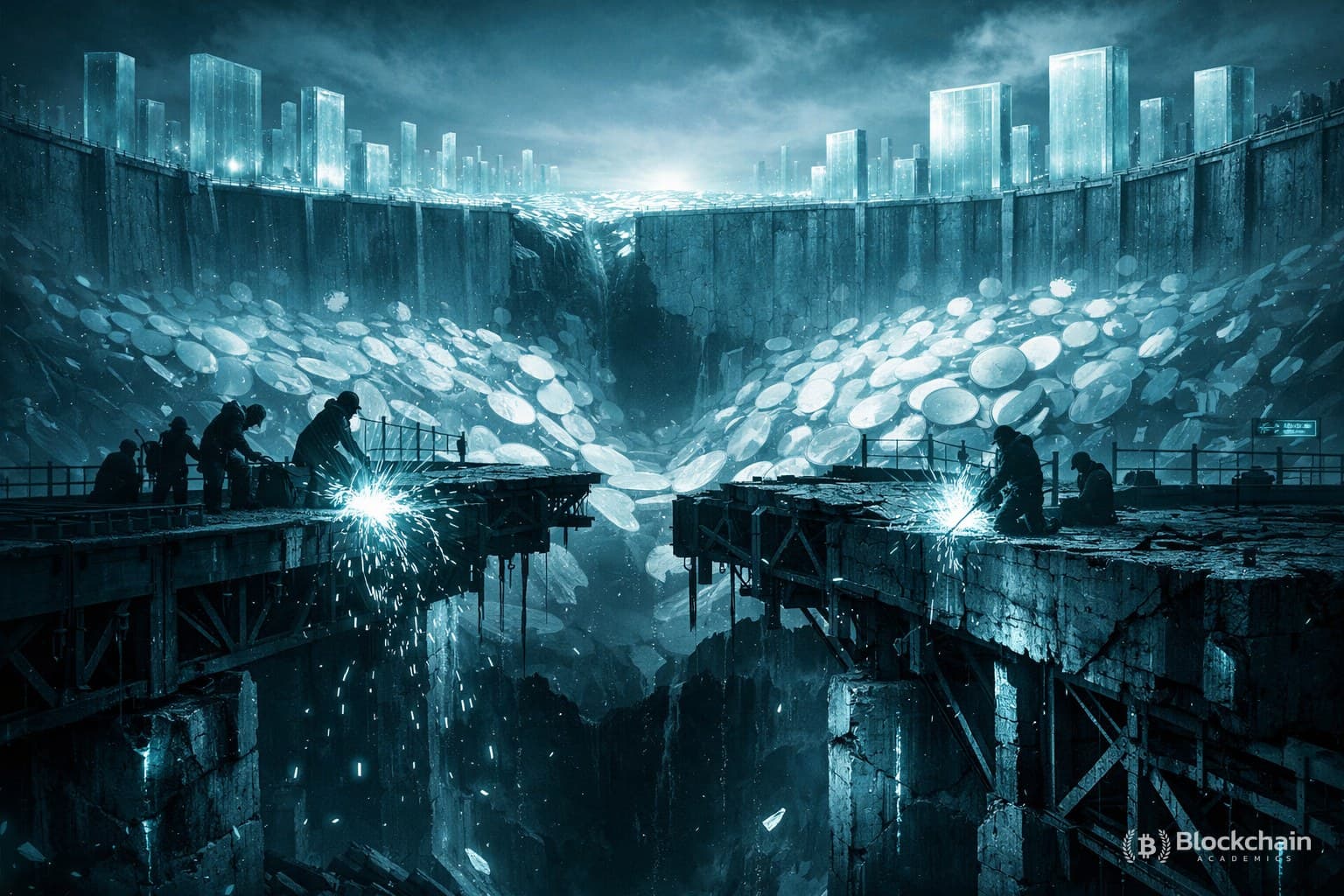
Tokenized Real-World Assets in 2026: Why the Path to $100B Runs Through Infrastructure, Not Capital
BlackRock's August 2026 launch of the BSTBL and BRSRV tokenized money market funds marks the largest institutional commitment to blockchain-based asset settlement in history, but the proof-of-concept era ending does not mean institutional-grade infrastructure has arrived. Three unresolved bottlenecks (settlement finality without legal enforceability, custody fragmentation across incompatible providers, and systemic oracle concentration risk) constrain every current deployment to single-jurisdiction, single-rail architectures. This report examines each bottleneck, assesses the competitive landscape across BlackRock, Dinari, and Shinhan Bank, and identifies the regulatory and technical catalysts that will determine whether RWA tokenization crosses $100B or remains a controlled niche.
Category: Markets | Published: August 18, 2026 | Tier: Institutional Deep Dive
Executive Summary
The tokenized real-world asset sector has crossed a threshold that matters: institutional capital is no longer studying the technology from a distance. BlackRock's August 2026 launch of its BSTBL and BRSRV tokenized money market funds marks the largest institutional commitment to blockchain-based asset settlement in history. Dinari's simultaneous partnership with Circle brings tokenized equity trading to US retail investors on USDC rails. Shinhan Bank's KRW-denominated fund tokenization demonstrates that Asian regulators are prepared to grant operational approvals, not just sandbox licenses. The proof-of-concept era is over.
What has replaced it is not yet a functioning institutional market. It is a collection of carefully controlled deployments, each operating within deliberately narrow parameters: single stablecoin rails, single-jurisdiction regulatory approvals, proprietary settlement layers. BlackRock's funds are constrained to Ethereum and selected Layer 2 networks. Dinari's equity platform settles exclusively in USDC. Shinhan's tokenized fund cannot clear cross-border. These constraints are not accidental engineering choices. They reflect three unresolved infrastructure problems that no amount of institutional capital can paper over: settlement finality guarantees that fall short of institutional T+0 expectations, custody fragmentation across providers with no common auditing standard, and oracle concentration risk that places systemic exposure on a single data provider.
The urgency is real. Enterprise blockchain spending reached $19.3 billion annually as of April 2026, a 340% increase from 2023 levels, indicating that distributed ledger infrastructure is becoming embedded in institutional operations regardless of crypto market cycles. The stablecoin market has scaled to $150+ billion in combined market cap, with USDC processing $8 to $12 billion in daily settlement volume across 200+ institutional integrations. The demand side is forming. The supply side, specifically the infrastructure required to support $100B+ deployments with institutional-grade reliability guarantees, is not. This report examines each bottleneck in turn, assesses the competitive landscape, and identifies the specific catalysts that will determine whether RWA tokenization becomes a mainstream settlement rail or a permanent niche.
Core finding: Institutional capital is necessary but not sufficient. The $100B threshold requires solving settlement finality, custody standardization, and oracle reliability before allocators will commit at scale. The 12-to-18-month window ahead is the critical proving period.
Market Context
The RWA tokenization market has moved through three distinct phases since 2020. The experimentation phase (2020–2022) produced tokenized gold from Paxos and Tether, early DeFi protocol integrations, and sub-$1 billion in total volumes, with no institutional custody standards and no regulatory framework. The regulatory clarity phase (2023–2024) delivered the EU's MiCA regulation, effective January 2024, establishing the first coherent compliance architecture for institutional deployments. The current institutional deployment phase, which began in earnest in 2025 and accelerated sharply through mid-2026, is characterized by named institutions committing real capital to live platforms.
The macro backdrop reinforces the structural case. Traditional equity settlement operates on T+2 rails in most jurisdictions, a standard that has not materially changed in decades. Institutional investors operating across time zones and asset classes increasingly view T+2 as a competitive disadvantage relative to the 24/7 programmable settlement that blockchain infrastructure theoretically offers. The $19.3 billion in annual enterprise blockchain spending documented in April 2026 reflects this pressure: corporations are not funding distributed ledger projects out of crypto enthusiasm. They are funding them because settlement efficiency has become a cost center.
Against this backdrop, the stablecoin infrastructure underpinning RWA settlement has reached genuine scale. USDC's $8 to $12 billion in daily settlement volume and 200+ institutional integrations make it the de facto settlement rail for institutional blockchain transactions in the US and EU. USDT's $120+ billion market cap and 60%+ share of total stablecoin volume make it the dominant global settlement asset, particularly in Asian markets. The total stablecoin market at $150+ billion represents a functional, if imperfect, institutional payment layer. The question is whether the asset tokenization infrastructure built on top of that layer can meet institutional standards.
The Three Infrastructure Bottlenecks
1. Settlement Finality: The T+0 Gap
Blockchain settlement finality is the most technically precise of the three bottlenecks, and the most frequently misrepresented in institutional discussions. Most public blockchains achieve probabilistic finality: a transaction is considered settled once enough subsequent blocks have been added to make reversal computationally prohibitive. On Ethereum mainnet, this takes approximately 12 to 15 minutes under normal network conditions. On Layer 2 networks using optimistic rollup architecture (Arbitrum, Optimism), transactions achieve soft finality within seconds but are subject to a 7-day challenge window during which fraud proofs can theoretically reverse state. ZK-rollup networks (zkSync, StarkNet, Polygon zkEVM) achieve cryptographic finality faster (typically within minutes of proof generation and verification on mainnet) but at significantly higher computational cost.
For institutional investors, none of these timelines meet the standard. The specific requirement is not T+2 versus T+1 versus T+0. It is deterministic, legally enforceable settlement finality within a defined window, with no possibility of reversal. Traditional securities settlement achieves this through central counterparty clearing (CCP) guarantees backed by regulatory capital requirements. Blockchain settlement, regardless of technical finality, currently lacks an equivalent legal guarantee structure. BlackRock's decision to deploy on Ethereum and Layer 2 networks simultaneously suggests the firm is comfortable with the technical finality characteristics of current infrastructure, but the legal finality framework remains unresolved.
The practical consequence is visible in how current deployments are structured. Dinari's tokenized equity platform uses USDC settlement, which effectively means Circle acts as the counterparty guarantee for settlement finality. Shinhan Bank's KRW fund tokenization operates within a domestic regulatory sandbox where the Korean Financial Services Commission provides implicit settlement backing. These are not blockchain settlement finality solutions. They are traditional institutional guarantees applied to blockchain transaction records. The distinction matters enormously for scaling: if institutional settlement finality requires a traditional financial institution as backstop, the cost structure and counterparty concentration of blockchain-based settlement may not differ meaningfully from existing infrastructure.
The path to genuine blockchain settlement finality runs through two parallel developments. First, ZK-rollup technology needs to reach the cost efficiency and throughput thresholds required for institutional-scale transaction volumes. Current ZK-proof generation costs make high-frequency institutional settlement economically unviable at scale. Second, legal frameworks need to explicitly recognize blockchain transaction records as legally final settlement, equivalent to CCP-cleared trades. The SEC's pending RWA framework, expected in Q4 2026 to Q1 2027, is the next critical regulatory milestone.
2. Custody Fragmentation: The Audit Gap
Institutional custody of tokenized assets presents a structural problem that is more organizational than technical. The technical capability to custody digital assets exists across multiple providers: Coinbase Custody, Fidelity Digital Assets, Circle, and Tether each operate institutional-grade custody infrastructure with varying degrees of regulatory oversight and insurance coverage. The problem is that these providers operate independently, with incompatible reporting standards, divergent audit methodologies, and no common real-time verification protocol.
For a traditional institutional investor, custody auditing is a well-defined process: custodians report holdings in standardized formats, subject to regular third-party audit, with regulatory capital requirements that backstop custody losses. For tokenized assets spread across multiple chains and custody providers, no equivalent standard exists. An institutional portfolio holding BlackRock's BSTBL fund (Ethereum/L2 custody), Dinari tokenized equities (Circle custody), and tokenized gold (Tether custody) would face three separate custody relationships, three separate audit processes, and three separate risk frameworks with no consolidated view.
This fragmentation creates two specific institutional risks. The first is operational risk: reconciling positions across custody providers introduces the same type of manual process and error surface that blockchain settlement is supposed to eliminate. The second is concentration risk at the provider level: if Coinbase Custody experiences a regulatory enforcement action or security incident, the institutional investor has no automatic failover mechanism. The DePIN economics data from August 2026 is instructive here: the 50 to 85% decline in operator profitability across decentralized infrastructure networks demonstrates that infrastructure providers dependent on token-subsidized economics are financially fragile. Custody providers that rely on token economics for operational sustainability present a version of this same risk.
The custody standardization solution that institutional investors require has three components: a common reporting standard across providers (analogous to SWIFT messaging standards in traditional finance), real-time custody verification accessible to institutional compliance teams, and regulatory backstop in the form of mandatory insurance or capital requirements. None of these exist at industry scale today. The most likely path to standardization is an industry consortium led by the largest custodians, potentially catalyzed by regulatory mandate from the OCC or SEC. Timeline estimates for this consortium to produce actionable standards range from Q3 2026 to Q2 2027.
3. Oracle Concentration: The Systemic Risk No One Is Pricing
The oracle problem in RWA tokenization is the least discussed of the three bottlenecks and potentially the most dangerous. Oracles are the data feeds that provide blockchain smart contracts with real-world price information. They are the mechanism by which a tokenized bond knows its current yield, a tokenized equity knows its current price, and a tokenized real estate fund knows its current NAV. Without reliable, tamper-resistant oracle data, smart contract logic governing tokenized asset settlements, margin calls, and distributions cannot function correctly.
Chainlink currently dominates oracle infrastructure across virtually every major RWA platform. This concentration is not irrational: Chainlink has the most extensive node network, the longest track record, and the deepest integration across blockchain infrastructure. But it creates a systemic risk that scales directly with RWA adoption. At $10 billion in tokenized assets, a Chainlink failure is a significant incident. At $100 billion, it is a systemic event. At $1 trillion, it is a financial stability concern.
No industry-standard multi-oracle redundancy framework currently exists for RWA platforms. Individual platforms implement their own redundancy measures with varying degrees of rigor, but there is no minimum standard, no mandatory fallback protocol, and no oracle failure insurance product available at institutional scale. The specific failure scenario that risk managers should model is not a complete Chainlink outage (which would be immediately visible) but a stale or manipulated price feed for a specific asset class that triggers incorrect smart contract execution across multiple platforms simultaneously. This scenario does not require a Chainlink network failure. It requires only that a specific data feed be compromised or delayed, a far more plausible event.
The mitigation framework requires three elements: mandatory minimum redundancy across at least three independent oracle providers for any RWA platform with $1B+ in assets, standardized oracle failure protocols with automatic fallback to secondary providers, and oracle reliability SLAs with contractual penalties. The oracle insurance market (which would allow RWA platforms to hedge oracle failure risk) does not yet exist in any meaningful form. Building it is a prerequisite for institutional-scale deployment.
Competitive Landscape
Institutional Deployments: Current State
Platform | Asset Class | Settlement Rail | Jurisdiction | AUM / Volume | Status |
|---|---|---|---|---|---|
BlackRock BSTBL/BRSRV | Money Market Funds | Ethereum + L2 | US, Singapore, EU (planned) | Launch stage | Live, August 2026 |
Dinari | Tokenized Equities | USDC (Circle) | US retail | Not disclosed | Live, August 2026 |
Shinhan Bank | KRW Fund | Domestic chain | Korea | Not disclosed | Pilot, 2026 |
Tether (XAUT) | Tokenized Gold | USDT rails | Global | Portion of $300B+ stablecoin ecosystem | Live |
Circle (USDC) | Settlement Infrastructure | Multi-chain | US, EU | $8–12B daily volume | Live |
BlackRock's deployment is the most strategically significant, not because of its current AUM (which remains at launch stage), but because of what it signals about institutional risk appetite for blockchain settlement infrastructure. The decision to deploy on both Ethereum mainnet and Layer 2 networks simultaneously indicates that BlackRock's risk and compliance teams have cleared the technical finality question to their internal standards, even if the legal finality framework remains incomplete. The fund's limitation to money market assets is deliberate: money market instruments have the most stable and verifiable NAV, minimizing oracle risk, and the shortest duration, minimizing settlement finality exposure.
Dinari's Circle partnership represents a different strategic bet. By building on USDC settlement infrastructure rather than proprietary blockchain rails, Dinari has effectively outsourced the settlement finality and custody problems to Circle. The trade-off is dependency: Dinari's platform reliability is directly tied to Circle's operational and regulatory status. This is a rational trade-off for a platform at pilot stage, but it creates a ceiling on institutional adoption. Large institutional investors will not accept a custody and settlement chain that runs through a single stablecoin issuer without additional guarantees.
Shinhan Bank's KRW tokenization is the most instructive case study for regulatory strategy. By operating within a domestic regulatory sandbox with explicit FSC approval, Shinhan has achieved the legal finality and custody clarity that other platforms lack. However, this comes at the cost of complete geographic confinement. The KRW denomination and domestic-only settlement mean that Shinhan's tokenization infrastructure cannot serve cross-border institutional investors. It is a proof of regulatory concept, not a scalable market infrastructure.
Data and Metrics
Stablecoin Settlement Infrastructure (October 2026)
- USDC daily settlement volume: $8–12 billion
- USDC institutional integrations: 200+
- USDT market cap: $184 billion
- USDT stablecoin market share: 59%
- Total stablecoin market cap: $314 billion
Institutional RWA Deployment Scale
- BlackRock total AUM: $10.7 trillion
- RWA funds as percentage of BlackRock AUM: 0.5–2%
- Enterprise blockchain annual spending (April 2026): $19.3 billion
- Enterprise blockchain spending growth from 2023: 340%
Infrastructure Health Indicators
- DePIN operator profitability decline from peak: 50–85%
- Helium quarterly node churn (2023): 2–3%
- Helium quarterly node churn (2026): 8–12%
- Hardware payback period shift: 6–12 months (2023) to 18–36 months (2026)
Note on DePIN indicators: The DePIN profitability deterioration is a leading indicator worth monitoring for RWA infrastructure specifically. Oracle networks, data providers, and decentralized custody infrastructure that rely on token emissions to subsidize operations face the same economic pressure currently destroying DePIN operator margins. If oracle node operators become unprofitable, network reliability degrades before any visible failure event occurs.
Regulatory Fragmentation: The Jurisdiction Problem
The three major regulatory frameworks governing RWA tokenization in 2026 are materially incompatible in ways that matter for cross-border institutional deployment.
The US framework is split between the SEC (securities tokens, tokenized equities and bonds) and the CFTC (commodity tokens, tokenized gold and certain derivatives). The SEC's framework for securities tokens remains incomplete. The result is that a tokenized stock (Dinari's core product) occupies regulatory ambiguity that forces platform operators into conservative legal interpretations, limiting product scope and investor access.
The EU's MiCA framework, effective January 2024, provides the most comprehensive RWA tokenization regulation currently in force. MiCA's asset-referenced token (ART) and e-money token (EMT) categories cover most stablecoin use cases, and its broader digital asset provisions address tokenized securities through interaction with existing MiFID II requirements. The framework is compliance-intensive, but it provides the legal certainty that institutional investors require. BlackRock's planned EU expansion for its tokenized funds is predicated on MiCA compliance.
Asian jurisdictions present a fragmented picture. Korea's approach, exemplified by Shinhan Bank's regulatory sandbox, provides domestic clarity but no cross-border framework. Singapore's MAS has been proactive in establishing digital asset regulatory guidance through Project Guardian and related initiatives, making Singapore a preferred jurisdiction for Asian institutional RWA deployments. Hong Kong's SFC has issued tokenized securities guidance, but enforcement consistency remains uncertain following political and regulatory changes since 2020.
The practical consequence of this fragmentation is that every institutional RWA platform currently operates in single-jurisdiction mode. BlackRock's funds are approved in the US and Singapore, with EU planned. Dinari is US-only. Shinhan is Korea-only. A cross-border institutional investor seeking to hold tokenized assets across US, EU, and Asian markets faces a compliance architecture that does not exist. Building it requires either regulatory harmonization (a multi-year diplomatic process) or regulatory arbitrage, which creates its own institutional risk.
The most realistic near-term path is mutual recognition agreements between major jurisdictions, analogous to the EU-US regulatory cooperation frameworks that exist for traditional securities. An IOSCO-led working group on RWA tokenization standards would be the appropriate vehicle. No such formal working group has been announced as of August 2026, but the institutional pressure from BlackRock and other major asset managers creates political incentive for regulators to act.
Risk Assessment
Risk | Severity | Probability | Primary Exposure |
|---|---|---|---|
Oracle concentration failure (Chainlink) | Critical | Medium | All RWA platforms with $1B+ assets |
Custody breach at major provider | Critical | Low–Medium | Institutional RWA holders |
Settlement finality legal challenge | High | Medium | Cross-border institutional deployments |
Regulatory enforcement (SEC securities classification) | High | Medium | Tokenized equity platforms (Dinari) |
USDT depegging or regulatory action | High | Low–Medium | All USDT-settled RWA platforms |
Cross-chain fragmentation persists | High | High | Institutional multi-chain portfolios |
DePIN-style oracle economics deterioration | Medium | Medium | Oracle node operators, data feeds |
Institutional demand fails to materialize | Medium | Low | Entire RWA sector |
Oracle concentration (Critical): The absence of mandatory multi-oracle redundancy standards means every RWA platform with significant assets is carrying unpriced systemic risk. A stale or manipulated Chainlink feed for a specific asset class could trigger incorrect smart contract executions across multiple platforms simultaneously. This risk scales directly with AUM and has no current industry-standard mitigation.
Regulatory enforcement (High): The SEC's classification of tokenized equities as securities subjects platforms like Dinari to broker-dealer registration requirements, custody rules, and investor protection standards that significantly constrain business model flexibility. The SEC's pending comprehensive RWA framework could resolve this ambiguity constructively or impose requirements that make tokenized equity platforms economically unviable.
Cross-chain fragmentation (High, High Probability): This is the highest-probability risk in the table. Current institutional deployments show no evidence of cross-chain interoperability investment. BlackRock's Ethereum/L2 deployment, Dinari's USDC rails, and Shinhan's domestic chain operate as isolated systems. Without interoperability protocols, the RWA market will remain a collection of siloed deployments rather than unified settlement infrastructure.
Outlook and Recommendations
3-to-6 Month Forward View
The August 2026 institutional launches from BlackRock and Dinari will generate significant data over the next 90 days. Trading volumes, settlement incident rates, and custody audit results from these deployments will be the most important empirical inputs for assessing RWA infrastructure readiness. If BlackRock's tokenized money market funds reach $5–10 billion in AUM within 90 days of launch without material settlement or custody incidents, it will substantially validate the current infrastructure stack and accelerate institutional interest.
The SEC's RWA framework, expected Q4 2026 to Q1 2027, is the single highest-impact regulatory event in the near-term calendar. A framework that provides clear securities classification guidance and establishes custody standards would unlock institutional equity and bond tokenization at scale. A framework that imposes traditional broker-dealer requirements without modification for blockchain settlement characteristics would significantly constrain the sector.
Bull Case (65–70% Probability)
BlackRock's deployment succeeds operationally, attracting $20–50 billion in AUM within 12 months and demonstrating that current Ethereum/L2 infrastructure is sufficient for institutional money market settlement. The SEC releases a constructive RWA framework in Q1 2027 that provides securities classification clarity and modified custody standards for blockchain-based assets. An industry consortium (likely led by Coinbase Custody and Fidelity Digital Assets) announces a multi-chain custody standardization initiative in Q1 2027. Oracle redundancy mandates emerge from institutional pressure rather than regulatory requirement, with major RWA platforms voluntarily adopting three-provider minimum standards by mid-2027. Dinari's tokenized equity platform reaches $500 million in daily volume by Q2 2027, validating retail demand. Combined, these developments create the conditions for $200–400 billion in tokenized assets by end of 2027.
Bear Case (25–30% Probability)
Settlement incidents or custody complications in the BlackRock or Dinari deployments in the first 90 days trigger institutional risk reassessment and slow adoption momentum. The SEC's RWA framework imposes traditional broker-dealer requirements that make tokenized equity platforms economically unviable, confining RWA tokenization to money market and government bond instruments. Oracle standardization fails to emerge from voluntary industry action, and a significant oracle incident at a mid-sized RWA platform damages institutional confidence. Cross-chain fragmentation persists, preventing the emergence of unified market infrastructure. RWA tokenization remains a $50–100 billion niche by 2030, concentrated in money market instruments on proprietary institutional networks.
Actionable Takeaways
For institutional investors: The BlackRock BSTBL/BRSRV funds are the appropriate institutional entry point for RWA exposure in 2026. Money market tokenization carries the lowest oracle risk (stable NAV), the most established regulatory framework, and the most credible custody infrastructure. Avoid tokenized equity platforms until SEC classification clarity emerges. Maintain custody diversification requirements: no single custody provider should hold more than 40% of tokenized asset positions.
For builders and protocol developers: The custody standardization gap is the highest-value problem to solve for institutional adoption. A protocol that provides real-time, cross-provider custody verification with standardized reporting will attract institutional integration faster than any new asset tokenization feature. Oracle redundancy infrastructure (specifically multi-provider aggregation with automatic failback) is the second-highest-value build.
For traders: Settlement finality improvements on ZK-rollup networks represent the most asymmetric opportunity in RWA infrastructure. Protocols that achieve legally recognized sub-second settlement finality before regulatory frameworks require it will capture significant institutional integration contracts. Monitor Polygon zkEVM and StarkNet throughput and cost metrics as leading indicators.
For regulators and policy audiences: The mutual recognition agreement framework between US, EU, and Singapore regulators is the critical path item for cross-border institutional RWA adoption. IOSCO coordination on minimum oracle reliability standards and custody audit requirements would address the two most acute systemic risks without requiring domestic legislative action.
The RWA tokenization sector has earned its inflection point narrative. BlackRock's commitment alone represents a structural shift in how the world's largest asset manager thinks about settlement infrastructure. But inflection points are not endpoints. The $100 billion threshold requires solving problems that institutional capital cannot simply overwhelm: deterministic settlement finality with legal enforceability, consolidated custody with real-time audit standards, and oracle redundancy that eliminates single-provider systemic risk. Each of these problems has a known solution path. None has been solved at institutional scale. The next 18 months will determine which institutions and protocols close those gaps first. That determination will shape the RWA market structure for the decade that follows.