
Tether CEO Ardoino Disputes Senate Report on USDT Freezes Tied to Iran
A Senate subcommittee report says Tether lagged in freezing wallets tied to Iran and its proxies. CEO Paolo Ardoino counters that Tether freezes addresses weeks before designations and credits it with a 94% drop in Iran-linked stablecoin volumes.
Tether CEO Paolo Ardoino has publicly rejected a US Senate subcommittee report that accuses the stablecoin issuer of being slow to freeze wallets tied to Iran and its proxies. He argues the company typically acts weeks before official sanctions designations, not after them.
His response on X targets "Tethered to Terrorism," a report dated September 28 from Sen. Richard Blumenthal and the minority staff of the Permanent Subcommittee on Investigations.
What the report alleges
The staff analyzed 846 wallets that were sanctioned or targeted for seizure by the Treasury's Office of Foreign Assets Control (OFAC) or by Israel's National Bureau for Counter Terror Financing (NBCTF). According to the report, 84% of them transacted exclusively or nearly exclusively in USDT.
It cites several cases. After the NBCTF designated 39 wallets linked to a Hezbollah money launderer in June 2023, Tether froze only five for months, the report says. It blocked the other 34 in March 2024, shortly before OFAC sanctioned the launderer. More than $34.6 million in USDT left those wallets after the seizure notice was published.
Three wallets tied to Modex Exchange Company, a brokerage the report links to funding Iran's central bank, took in $575 million in USDT between April and June 2025 without being blacklisted. The report also says Babak Zanjani posted Central Bank of Iran wallet addresses on X in December 2025, and that Tether had not blacklisted them as of September.
Investigators acknowledged some Tether responses to sanctions but characterized the efforts as inconsistent.
Ardoino's rebuttal
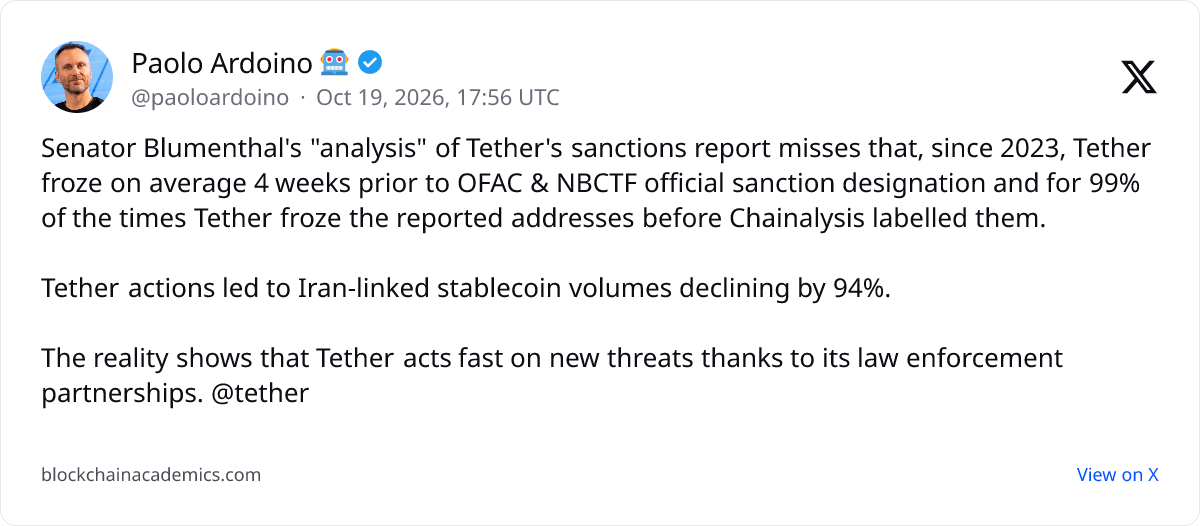
Ardoino put the word "analysis" in quotation marks when describing Blumenthal's work. He said that since 2023 Tether has frozen reported addresses an average of four weeks before formal OFAC and NBCTF designations, and that in 99% of cases it acted before blockchain analytics firm Chainalysis labeled them. He credited Tether's actions, together with law enforcement partnerships, for a 94% decline in Iran-linked stablecoin volumes.
In a September 28 response, Tether said it helped US authorities freeze nearly $550 million in Iran-linked USDT this year. That total includes more than $344 million across two Central Bank of Iran-tied addresses in April, an action that preceded formal US sanctions listing by one day, and over $130 million across four wallets in July.
Tether also said it froze more than $22 million across over 40 Israeli NBCTF referrals. Overall, it says it has helped freeze more than $4.9 billion, including over $2.4 billion tied to US authorities.
Two different yardsticks
The two sides are measuring different things. The report focuses on the lag between designation and freeze, and on funds that moved in the interim. Tether points to freezes that preceded designations and to aggregate volume declines. The four-week average and the 99% Chainalysis figure are Ardoino's own claims, and neither side's numbers directly answer the other's.
The dispute lands as congressional scrutiny of Tether builds. Blumenthal launched a formal probe into Tether's relationship with Cantor Fitzgerald earlier this month. Separately, terror attack victims have sued to seize $344 million in frozen IRGC-linked USDT from the issuer. For stablecoin issuers, the question is shifting from whether they freeze funds to how quickly they do it, and who judges the timing.