Judge Acquits Peraire-Bueno Brothers in $25M Ethereum MEV Case
A Manhattan federal judge cleared the Peraire-Bueno brothers of wire fraud and money laundering conspiracy over the April 2023 MEV-Boost exploit, ruling prosecutors failed to prove a material misrepresentation. The decision ends the case after a 2025 mistrial.
A Manhattan federal judge has acquitted Anton and James Peraire-Bueno of all charges tied to a $25 million Ethereum MEV exploit, closing the case without a retrial. U.S. District Judge Jessica Clarke granted the MIT-educated brothers' motion for a judgment of acquittal on Monday, November 16, clearing them of wire fraud, conspiracy to commit wire fraud and conspiracy to commit money laundering, according to her ruling.
The decisive point was a missing element. Clarke found prosecutors had not shown the brothers made a material misrepresentation, which wire fraud requires. The money laundering count fell with it, because it relied on proceeds of the alleged wire fraud.
What prosecutors alleged
The case turned on Ethereum's transaction ordering system and maximal extractable value (MEV). Prosecutors said that in April 2023 the brothers exploited a flaw in MEV-Boost software to lure sandwich-trading bots, taking $25 million in about 12 seconds.
As described in the ruling, the brothers placed bait transactions to attract specific bots. They then exploited a bug in a relay's code to see the bots' bundled trades before a block was committed, and swapped the bait transactions for trades that sold the tokens. The bots were left with about $25 million in losses.
Authorities arrested the pair in May 2024. Their first trial ended in a mistrial in November 2025 when the jury deadlocked.
The court's reasoning
Clarke framed the decision narrowly.
"The question before the Court is not whether the Peraire-Buenos' conduct was right or moral, or even whether it violated uncharged crimes,"
Judge Jessica Clarke
She described Ethereum as a "trustless, highly adversarial environment with no terms of use." The scheme "may have frustrated the spirit" of MEV-Boost, she wrote, but that was not enough for fraud. In a footnote, she said the prosecution "raises serious due process concerns" but declined to rule on the point.
The ruling also cited a 2025 decision involving Mango Markets trader Avraham Eisenberg, in which a judge found insufficient evidence of false representations. Clarke called the case a "first of its kind" prosecution, a label the government used in its indictment.
Reaction and implications
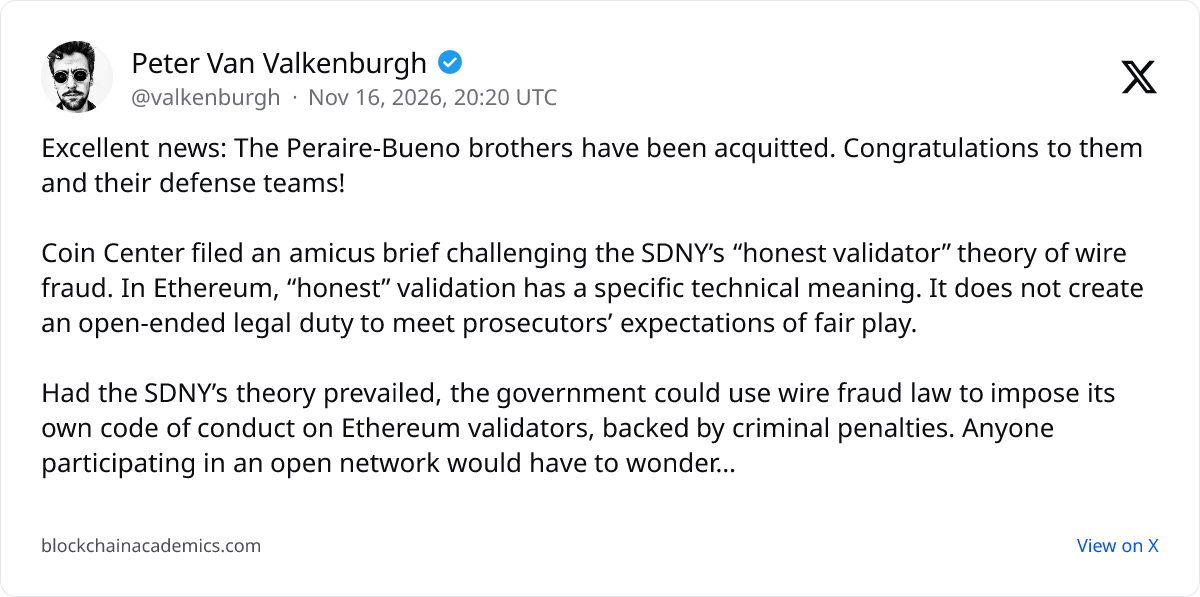
Coin Center executive director Peter Van Valkenburgh called the acquittal "excellent news," arguing that prosecutors' honest validator theory risked letting the government impose its own standards of conduct on Ethereum validators through wire fraud laws.
"Anyone participating in an open network would have to wonder whether prosecutors might later declare their behavior 'dishonest' and haul them into court,"
Peter Van Valkenburgh
The decision is not a finding that the conduct was ethical or lawful in every respect. Clarke explicitly set aside whether it violated uncharged laws, and prosecutors had alleged the brothers spent months planning the attack and took steps to hide the proceeds.
For market participants, the practical point is the element the court found missing: a wire fraud theory needs a material misrepresentation, and exploiting code behavior in a permissionless system did not meet that bar here.