Binance Confirms $6.3B Hack, Points to Possible Compromised DevOps Laptop
Binance put the Oct. 29 hack at about $6.3 billion with roughly $3 billion frozen on-chain. Initial findings point to a possibly compromised DevOps laptop, no private key leak. SAFU and company funds will cover losses; withdrawals remain suspended.
Update: November 11, 22:46 UTC
The Binance hacker's remaining stolen XRP has dropped to about 60 million as the attacker swaps it into Bitcoin, according to Elliptic's Nov. 10 update, as reported by CryptoSlate. Elliptic said swap interruptions are complicating further conversions.
The report did not say which services or bridges are being used for the swaps, or what is causing the interruptions.
Update: November 7, 22:49 UTC
Binance CFO Ng is leaving nine days after the hack, according to The Block. Co-CEO Yi He said Ng is departing to pursue a new venture under a transition plan put in place over the past six months.
Separately, Blockonomi reported that Elliptic tracked the conversion of $175 million in stolen altcoins into roughly 2,300 BTC across more than 20,000 wallets on 16 blockchains. According to Blockonomi, the laundering involved at least 36 services and 65,000 transactions.
Update: November 7, 19:16 UTC
Elliptic said the Binance attacker's bitcoin holdings are growing considerably larger, with the hacker accumulating 2,300 more BTC, according to Bitcoin.com News. The report said the hack drained 18,270.2 BTC from the exchange's wallet.
Bitcoin.com News said Elliptic's finding follows the $6.3 billion theft. The snippet available did not say which wallets hold the new bitcoin, over what period it was acquired, or which swaps or bridges were used.
Separately, ZyCrypto reported that Changpeng Zhao told CoinDesk in a recent interview that traditional banks may be more vulnerable to cyberattacks than crypto exchanges as AI boosts hacking power.
Update: November 7, 09:34 UTC
Federal Reserve and Office of the Comptroller of the Currency staff phoned US banks on Monday about the $6.3 billion Binance hack, according to Blockonomi. Supervisors asked about unusual transactions and service disruptions.
Blockonomi reported that one large US bank contacted Binance within hours and is preparing an internal report. It cited a source who said fast-improving AI models are the main worry.
Update: November 6, 19:34 UTC
Binance's attackers had about eight weeks of access before the $6.3 billion theft, according to an estimate from Security Alliance reported by Cointelegraph. Cointelegraph said the cybersecurity company flagged similar multi-stage intrusion patterns behind other high-profile heists, including the $388 million Bitget hack.
Separately, Bloomberg reported the hackers found a way to take 40% of the stolen cryptocurrency in one hit, which reduced their chances of being caught in the act. Bloomberg said the move, worth $2.5 billion, cost them just $15.
Cointelegraph also quoted experts as saying blockchain records show repeated wallet drains but cannot establish Binance's internal signing controls or transaction limits.
Update: November 5, 17:49 UTC
Binance asked Arbitrum DAO tokenholders on Nov. 5 to authorize the release of 8,425.997 ETH and 74.56 million ARB frozen on Arbitrum One, according to crypto.news. The proposal came through the Binance_Post_Listing forum account. The assets sit at an intermediary address, and a forum discussion, a Snapshot temperature check and a binding onchain vote are still to come.
Binance requests no new DAO treasury allocation and expects no direct budget expense beyond normal governance execution overhead, crypto.news reported. Binance says it will cover affected users' losses through SAFU and company treasury, and recovered assets could replenish reserves already used for compensation.
Arbitrum's Security Council froze the assets on Oct. 30 at 8:08 a.m. Hong Kong time, per crypto.news. It said no other users' funds or applications were affected, and the assets can only move through a DAO vote. Binance's schedule runs roughly 49 days, and could take longer.
Update: November 4, 16:41 UTC
Privacy Cash, the privacy protocol, paused deposits after Elliptic traced about $1.2 million in theft-linked ETH and SOL into its pools, according to The Defiant. The Defiant said the team states that withdrawals remain open.
The Defiant's report did not say how the team plans to screen deposits or when deposits might resume.
Update: November 4, 15:40 UTC
Binance said it has replenished about 98% of affected assets and is expanding Proof of Reserves to 44 tokens, according to The Defiant. The outlet said the new cryptographic proof is unfinished and withdrawals are not fully reopened.
Separately, Coinbase said the $6.34 billion hot-wallet hack has had no impact on its systems or customer funds, according to crypto.news. The outlet reported that more than 99% of Coinbase customer assets are held in cold storage, citing TechFlow's Nov. 4 account of a Coinbase blog post.
Update: November 4, 07:47 UTC
The hacker behind the $6.3 billion Binance breach is still accumulating Bitcoin, according to U.Today. The outlet said the attacker is converting stolen Solana (SOL) tokens into BTC through a complex series of cross-chain transactions.
U.Today described the buying as aggressive and ongoing. The snippet available did not give amounts, wallet addresses or the bridges used for the latest swaps.
Update: November 4, 05:20 UTC
A Binance shareholder is publicly demanding answers and greater transparency about the $6.3 billion hot wallet breach, according to Crypto Briefing.
Crypto Briefing said the breach underscores the urgent need for stronger security measures and transparency across the crypto industry to maintain investor trust. The outlet did not name the shareholder in the material available.
Separately, BeInCrypto reported that Binance co-CEO Teng said the industry must learn from the hack. The outlet also asked whether new crypto features raise risk.
Update: November 4, 02:46 UTC
Hackers compromised two Binance engineers through a tampered tool delivered in an ad and a fake job interview, according to Blockonomi's account of Binance's findings. The outlet said the attackers then moved 233.46 million XRP out of five hot wallets in four minutes on Oct. 29, Binance said.
Binance froze about $2.85 billion, according to Blockonomi, but transfers continued nearly four hours after the attack began.
Update: November 3, 23:22 UTC
Binance's tracked wallets have swung to roughly $3.25 billion in 24-hour net inflows, according to Bitcoin.com News. The outlet said the reversal follows more than $7 billion in daily outflows recorded after the $6.3 billion hack.
Bitcoin.com News said money is starting to flow back into the exchange as users return.
Separately, Crypto Briefing said the hack highlights risks for tokenized assets amid North Korean thefts. It said the incident underscores the need for stronger security measures and regulatory frameworks to protect tokenized assets globally.
Update: November 3, 23:19 UTC
South Korea's Financial Services Commission called Upbit, Bithumb and other exchanges to an emergency meeting and asked for more offline storage, extra reserves and round-the-clock withdrawal monitoring, according to Unchained.
Separately, Binance's initial findings say a fake job assignment helped attackers reach its wallet systems, AMBCrypto reported. The attackers expanded access across employee computers and kept transferring funds after withdrawals were suspended, according to the outlet.
In his first interview since the hack, Changpeng Zhao said AI is accelerating cyberattacks and called for an industry security alliance, The Block reported. Unchained said Zero Knowledge Group founder Austin Campbell argued on Bits + Bips that a $1 billion transfer should face a 24-hour clock.
Update: November 3, 18:42 UTC
An address linked to the Binance hacker deposited nearly $798,000 in Solana into the Privacy Cash mixer, according to a Nov. 3 post by Onchain Lens, as cited by crypto.news.
Crypto Briefing said the use of privacy mixers to launder stolen crypto highlights ongoing challenges for regulators and could bring more scrutiny of privacy tools.
Separately, Binance said on Nov. 2 that it had completed a zero-knowledge proof-of-reserves procedure for a snapshot taken Oct. 31, according to NewsBTC. Crypto Briefing also quoted DayTrading.com's CEO as saying leveraged traders were hit hardest by the hack's fallout.
Update: November 3, 12:50 UTC
Binance has restored withdrawals for SHIB, XRP and RLUSD, along with major ETH-based assets, according to U.Today and Bitcoin.com News. U.Today said the token's chart still points to further downside.
Ripple issued 110.57 million RLUSD on the XRP Ledger in a single transaction on Nov. 2, hours before Binance began reopening XRP and RLUSD withdrawals, Bitcoin.com News reported.
Binance may recover little of the $6.3 billion loss through insurance, according to a report cited by Crypto Briefing. The outlet said the hack shows how exposed exchanges are to state-backed cyber threats and how hard it is to secure comprehensive coverage.
Update: November 3, 12:41 UTC
Binance began a second phase of crypto withdrawals at 04:00 UTC on Tuesday, according to Blockonomi. The phase covers networks including Ethereum, Solana, XRP Ledger, Tron and Base. Blockonomi said net outflows from the exchange fell to $2.57 billion on Monday.
Separately, Binance has missed its monthly Luna Classic burn for the first time since 2023, according to Crypto Briefing and Decrypt. Decrypt said LUNC holders are still waiting for the November burn as the exchange recovers from the hack. Crypto Briefing said the miss raises uncertainty about Binance's commitment and could affect LUNC's deflationary efforts and community trust.
Update: November 1, 20:31 UTC
Nearly $3.8 billion was withdrawn from Binance in the 10 hours after it reopened withdrawals, according to Crypto Briefing. The outlet said the outflow points to significant trust issues in the crypto market and underscores the need for stronger security and transparency.
Binance has also drawn on a reserve used to absorb losses from bankrupt futures positions as it replaces the stolen cryptocurrency, crypto.news reported. The exchange says it moved only excess funds, according to the outlet, while published balances give traders only a partial view of the protection that remains.
The hacker reportedly dumped 499 billion SHIB tokens, U.Today reported. The outlet said the Shiba Inu price absorbed the sale.
Update: November 1, 14:04 UTC
The Binance hacker sold 908,793 PROM tokens, worth about $5 million at nominal value, into a thin Uniswap V2 pool and received only 0.0316 ETH, roughly $71, according to Lookonchain.
The trade shows how little liquidity some of the stolen tokens have. Lookonchain's figures imply the pool could absorb almost none of the position at anything near its quoted price.
Update: November 1, 11:48 UTC
The attacker behind the Binance hack moved 485,270 SOL, worth about $46.4 million, through Relay Protocol to swap into Bitcoin, according to crypto.news. The move followed the conversion of about $279 million in altcoins, crypto.news reported.
Crypto Briefing, which put the SOL transfer at $46 million, said the tokens went to an unknown wallet. It said the movement highlights ongoing security challenges in crypto and could affect market trust and regulatory scrutiny.
Update: November 1, 09:19 UTC
Binance has restored withdrawals for USDC, USDT, ETH and BNB, according to Crypto Briefing, extending the phased reopening beyond Bitcoin. Crypto Briefing described the move as part of the exchange's recovery after what it called a hot wallet breach.
Crypto Briefing said the speed of the recovery and Binance's financial resilience could help rebuild user trust, though it noted the episode highlights ongoing security challenges for crypto exchanges.
Update: November 1, 08:17 UTC
Binance updated its Proof of Reserves addresses and will route all withdrawals through new wallets, according to Crypto Briefing. The change is meant to restore trust after the breach.
The first reopening phase covers 15 networks, according to crypto.news. U.Today reported that, beyond Bitcoin, the exchange is set to resume withdrawals for XRP, Ethereum and Solana on Nov. 1, among other major tokens.
Lookonchain reported that Binance has reopened BTC withdrawals on the Bitcoin network.
Update: November 1, 06:41 UTC
Binance has begun phased withdrawal reopenings, starting with the Bitcoin network, according to Crypto Briefing and The Defiant. Bloomberg reported that the exchange said it would resume withdrawals in phases on Sunday.
The exchange said it has now replenished about 95% of the impacted amount, up from about 90%, The Defiant reported. Binance said less-liquid tokens account for the remaining 5%.
Update: October 31, 22:16 UTC
Binance said Saturday it has replenished about 90% of the cryptocurrency taken in the theft and plans to resume withdrawals on Sunday, Nov. 1, after security checks, with services returning in phases, according to Blockonomi. The share replenished rose from about 80% in the exchange's previous statement. Co-CEO Richard Teng said users would not bear the financial impact.
Binance set aside more than $6.34 billion in company funds, Blockonomi reported. The money comes from its corporate treasury, part of its futures insurance fund and the SAFU fund, which Binance plans to restore to about $1 billion. The exchange is buying the missing assets on open markets and over-the-counter.
Binance said BTC, ETH, USDT, BNB, SOL, USDC, XRP, USD1, RLUSD and ZEC are fully backed. The remaining 10% is less liquid tokens. The roughly $3 billion frozen on-chain is separate from the replacement assets.
Investigators found additional points of breach beyond the initially suspected compromised laptop, according to Blockonomi. Binance plans to publish a detailed incident report.
Original report: October 30, 03:44 UTC
$6.3 billion. That is Binance's own estimate of the damage from the Oct. 29 hack, with roughly $3 billion frozen on-chain so far. The exchange pledged to cover every dollar of user losses. Its first findings point to a possible employee laptop compromise and report no evidence of a wallet private key leak.
That moves the story well past our earlier report, which carried a $2.5B-$3.5B range and no confirmed loss.
What Binance says happened
In its announcement on X, Binance said the initial investigation suggests the incident "may involve a compromised DevOps engineer's laptop, which allowed an attacker to gain access to a service container and submit unauthorized withdrawal transactions."

The wording is hedged. A full technical post-mortem will follow once the investigation is complete and the facts are verified. On keys, Binance was direct:
"We have found no evidence of any wallet private key leak."
Binance
Analysts tracking the outflows had earlier flagged as much as $5.8 billion in potentially compromised assets before Binance issued its own figure.
Frozen is not recovered
About $3 billion is frozen with blockchain partners. Restricted, not returned. Roughly half the estimated impact is not yet locked down. Binance said it has engaged law enforcement and blockchain intelligence partners to trace and recover funds.
Losses covered, withdrawals halted
Binance said it will cover all losses from the SAFU fund, its user protection fund, and company funds.
"Binance will cover all losses from the SAFU fund and the company's funds. User funds are safe."
Binance
Deposits and withdrawals are temporarily suspended during security checks, and authorisation for the affected addresses has been revoked. No reopening date. Yi He said: "We will enable withdrawals as soon as the security scan is complete." Binance will publish an updated Proof of Reserves once remediation is done.
Changpeng Zhao acknowledged help from industry participants, including competitors, and described an overnight response involving hundreds of employees. "It hurts, but we will survive," he said.
Market reaction
Bitcoin slid from above $81,000 to around $76,400 as the news spread. Altcoins sold off, and Coinglass data showed about $1.5 billion in total derivatives liquidations.
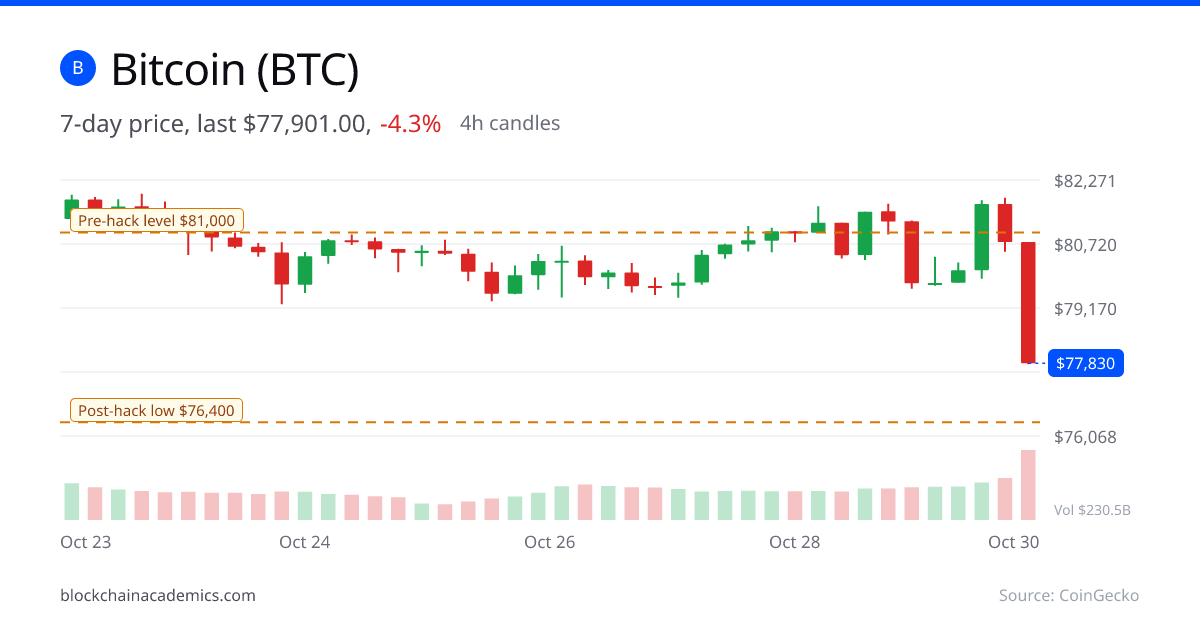
Many in the industry read the relatively modest decline, set against the size of the hack, as a reason for optimism.
What it means
At $6.3 billion, the estimate is more than double the low end of the range first reported from hot wallet outflows. Two questions stay open: the root cause and how long withdrawals stay shut. A DevOps laptop, if confirmed, would make this an operational security failure rather than a cryptographic one. The fund doing the paying is also in flux: a SAFU conversion into bitcoin began in February under a plan to shift $1 billion in stablecoin reserves.