
Vitalik Buterin Defends EIP-8037 State Gas Hike for Glamsterdam
Vitalik Buterin defended EIP-8037, a Glamsterdam proposal that splits state gas from execution gas and makes storage slots, accounts and contract deployments far pricier. Contracts with hardcoded gas limits, including the OP Stack bridge, could break. Developers meet Nov. 19.
Update: November 16, 10:42 UTC
Vitalik Buterin now supports leanPCS, a separate proposal that bundles quantum-resistant signatures into a single proof per block, according to Blockonomi.
Blockonomi reported that quantum-resistant signatures can take up 1,000 to 6,000 bytes each, compared with 65 bytes for a standard Ethereum signature. Aggregating them would limit the extra data load on the network.
Bitcoinist described the backing as renewed optimism about a proposal that could speed Ethereum's move toward quantum-resistant cryptography.
Original report: November 16, 08:20 UTC
Writing a fresh storage slot on Ethereum could cost roughly five times more gas after Glamsterdam, and Vitalik Buterin is fine with that. In a Nov. 16 statement, he defended EIP-8037, the proposal that would lift a new storage slot from 22,100 gas to 110,020 and push a 24 KiB contract deployment from about 4.95 million gas to 37.8 million.
His core argument is to split permanent storage fees from ordinary execution fees. Buterin called that "the best method to scale and make it safe simultaneously." In a lengthy post on X, he wrote that something like EIP-8037 is, unfortunately, the only way for Ethereum to scale safely.
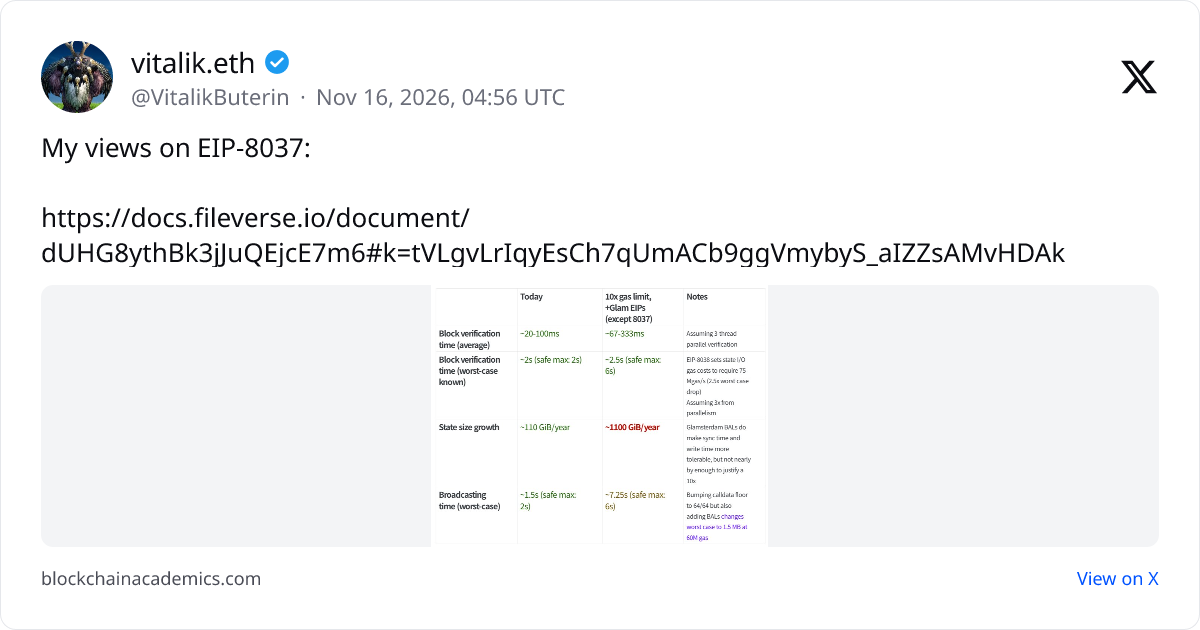
What EIP-8037 changes
The proposal runs a separate "state gas" meter, distinct from execution gas, with a fixed cost per state byte (CPSB) of roughly 1,530 gas. Anything that leaves permanent data on-chain gets repriced: creating accounts, opening storage slots, deploying contracts. Account creation would jump from 36,600 to 197,900 gas, more than five times the current cost.
The rationale is state bloat. State is the live record of balances, contract code and storage that every node has to keep. Buterin says execution is easy to scale, but Ethereum state already grows by about 110 GiB per year. Run a 10x gas limit without EIP-8037 and that could reach roughly 1,100 GiB per year. The proposal aims to hold growth at 60 to 120 GiB.
Maria Silva, Ansgar Dietrichs and Jochem Brouwer drafted it in October 2025, alongside a companion, EIP-8038.
Breakage risk
The bill comes due in compatibility. Contracts that forward fixed gas for storage writes or cap gas on calls could fail. The OP Stack bridge has a hardcoded 40,000 gas limit that could break under higher state gas costs, and ChainSecurity has identified at least 13 mainnet contracts with outdated gas assumptions.
Other tallies run lower. The Ethereum Foundation compiled eight contract assumptions that could be affected, and as of Nov. 9 developers had received four reports of deployed contracts that could face issues. Those numbers do not line up with the 13-contract count.
Factory contracts, wallet deployment flows and storage-heavy apps face the steepest adjustment. Developers are split on the fix: some want old contracts to keep existing gas rules, others want state gas computed in a different part of the transaction fee.
Airdrops and the "don't fix gas" rule
Airdrops write a lot of storage slots at once, so they sit right in the blast radius. Buterin's suggestion is Merkle trees, where recipients claim with proofs and pay the costs themselves. Longer term he pointed to UTXOs and privacy-preserving keyed nonces, saying "the expectation is that both will be significantly cheaper than storage slots."
He also told teams not to treat gas metrics as fixed. He admitted that rule had not been written down or repeated since 2021, and suggested listing features likely to change, from gas mechanics to slot time.
Timeline and what it means
Glamsterdam activation on the Hoodi testnet has been delayed over compatibility reviews, with no replacement date announced. Developers will discuss audit results and possible spec changes on Nov. 19.
For builders, the move is simple: audit anything with hardcoded gas stipends now. The trade-off is real, cheaper scaling at the protocol level against a repricing bill for apps that assumed today's numbers would last. It sits alongside Buterin's argument earlier this month that ETH should be valued as a store of value rather than for fee burns, where he warned that maximizing fees would threaten decentralization. The Nov. 19 call is the next checkpoint for whether the spec changes.