Vitalik Buterin Backs ETH as Store of Value Over Fee Burns
Vitalik Buterin argues ETH should be valued mainly as a store of value rather than a fee-burning token. He wants EIP-1559 kept, but says burns from 2021 to 2023 were never a true valuation floor and that maximizing fees would threaten decentralization.
For years, a good share of the ETH investment case rested on the burn, the idea that network activity would steadily destroy supply and make the asset scarcer. Vitalik Buterin now wants holders to look elsewhere. In a post on X on November 8, 2026, the Ethereum co-founder argued that ETH should be valued mainly as a store of value rather than as a "fee-burning token," while insisting that the EIP-1559 burn mechanism itself should stay.
"ETH as fee-burning token never was as strong as it seemed"
Vitalik Buterin
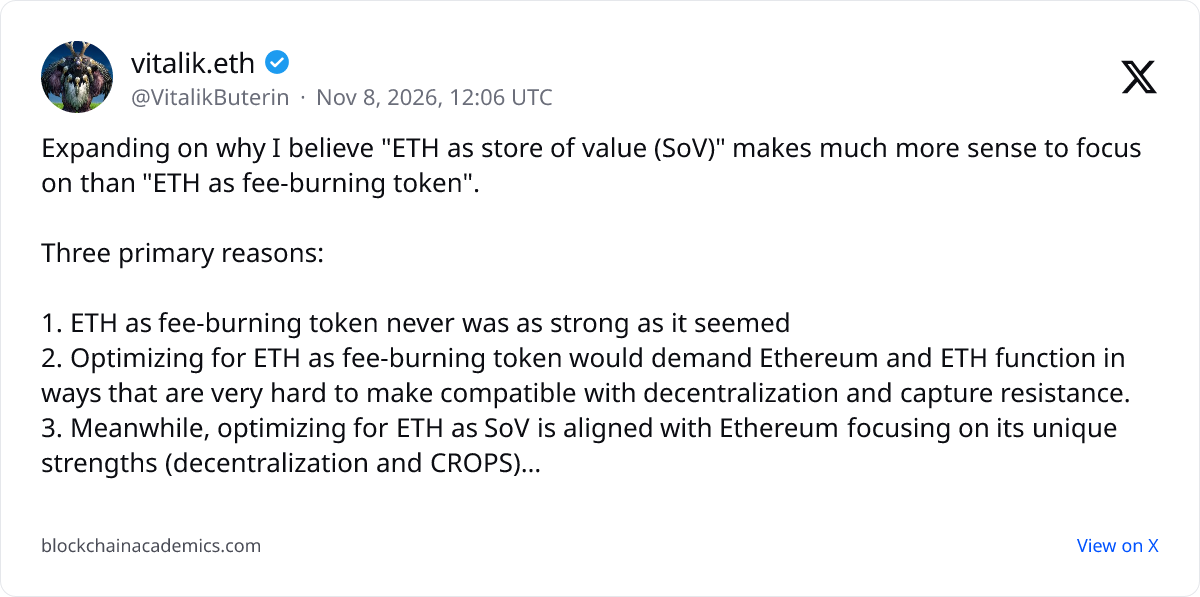
On the mechanism, he was explicit: "EIP-1559 (including its burn) is fine and good, we should keep them." His point is about what holders should rely on, not about removing the burn.
Why burns are a weak floor
Buterin said ETH can keep its store-of-value appeal even if long-term fee burns stay below 10% of the break-even level needed to offset issuance. The heavy burns of 2021 to 2023, he noted, came largely from activity inside the crypto ecosystem, namely NFT and DeFi demand. That makes them a poor valuation floor, because a steep ETH price drop could cut the very spending that generated the fees.
His illustration makes the circularity concrete. At a 4% discount rate, $1 billion in annual burns would theoretically justify a $25 billion valuation, but only if fee revenue holds steady while the token loses value, which is roughly like valuing a shop on sales that depend on the shop's own share price. In practice, burns have covered only about 2.07% of new ETH issuance, so supply has grown on net. Layer-2 growth, including after the March 2024 Dencun upgrade, has also reduced fee burning on mainnet.
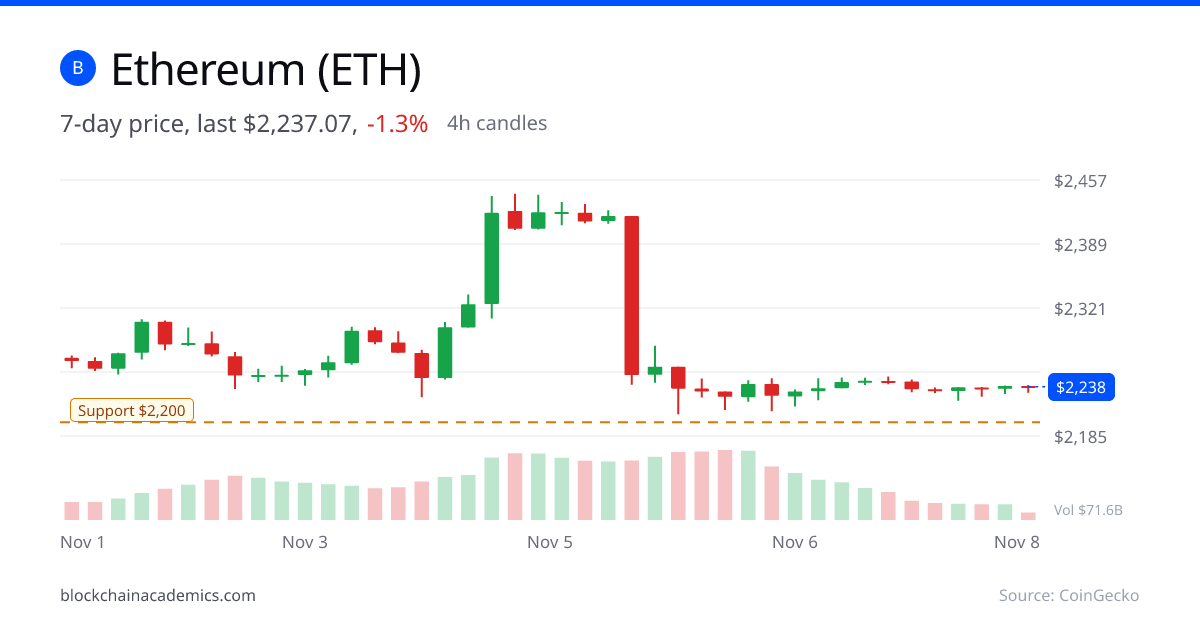
ETH trades near $2,235 to $2,240, holding the $2,200 support level.
Fees versus decentralization
Buterin also warned against the opposite strategy. Maximizing fees, he argued, could push up gas prices, undermine affordability and decentralization, and invite centralization. He estimated that a corporate-style, in-protocol funding model would need about 700,000 ETH annually, a figure that has been set against ETH's roughly $270 billion market cap and also framed as protocol research and development spending.
Instead, he pointed to decentralization, CROPS (censorship and capture resistance, open source, privacy, security), post-quantum security, Kohaku wallet privacy tools, multisig wallets, private account abstraction and FOCIL as the foundation of ETH's value. He also tied the case to AI-driven disruption, arguing that stable, censorship-resistant infrastructure may become more valued. The post-quantum theme echoes Justin Drake's push to finish Ethereum's post-quantum transition by December 2028.
The counter-case
The argument carries a tension. A store of value with net supply growth must convince holders on grounds other than scarcity: Bitcoin leans on its fixed supply, while ETH would have to rely on decentralization and credible neutrality. If the narrative moves away from burns, burn dashboards and short-term transaction spikes may carry less weight in how investors assess ETH.
Buterin acknowledged that tokenized real-world assets bring more conventional-market activity to Ethereum, though he did not expect mature products to reproduce speculative NFT-era fees.
In effect, he is asking investors to treat ETH less like a cash-flowing equity and more like a claim on a durable, hard-to-capture network. That is a harder story to price than a burn rate, and it asks holders to value properties that do not show up on a fee dashboard.