Ethereum Researcher Targets December 2028 for Quantum Resistance
Ethereum Foundation researcher Justin Drake hopes to wrap Ethereum's post-quantum and post-AI transition by December 2028, a year early. Three upgrades in 24 months stand in the way, and the official 2029 roadmap still stands.
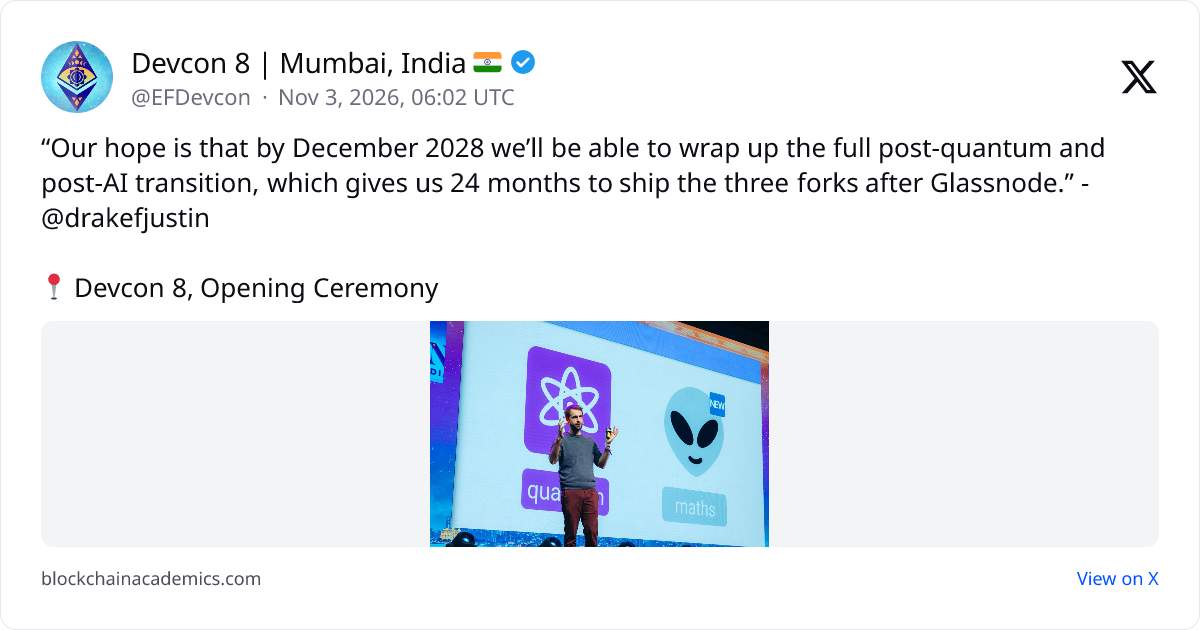
Ethereum might try to beat its own quantum deadline by a full year. Speaking at Devcon 8 in Mumbai on November 3, 2026, Ethereum Foundation researcher Justin Drake said he hopes the network can wrap its post-quantum and post-AI transition by December 2028. The foundation's existing quantum-resistance target is December 2029.
"Our hope is that by December 2028 we’ll be able to wrap up the full post-quantum and post-AI transition,"
Justin Drake, Ethereum Foundation researcher
Note the word "hope." Drake pitched the date as an aspiration, not a promise, and it does not formally replace the roadmap the foundation published in September 2025. That roadmap targets quantum resistance across Ethereum's execution, consensus and data layers, and it is due for reassessment in January 2027.
What has to ship
Drake said developers have 24 months to deliver three additional network upgrades, which would follow a milestone expected in early 2027. Back in August, he outlined plans for production-ready leanVM technology in 2027, then post-quantum deployments across all three layers in 2028.
The research centers on hash-based signatures, with leanSPHINCS and leanXMSS as the named candidates. Quantum-resistant data availability designs are part of the plan too. A dedicated Post-Quantum Security team has been working on this since January 2026.
Why the clock matters
Ethereum runs on two elliptic-curve signature schemes: ECDSA for user accounts and BLS for validators. Both face quantum risk. Roughly 72% of ETH supply sits in accounts whose public keys are already exposed.
Then there's the "post-AI" part. Drake warned in October that AI advances could break current signature schemes before quantum hardware gets there.
Execution risk
The schedule is tight. Three hard forks in about two years leaves little slack, and if the early 2027 milestone slips, the target could slide back to 2029 or later. Upgrade timing has already wobbled this autumn: developers cancelled the October 26 Glamsterdam fork on the Hoodi testnet, leaving an early December mainnet window less certain.
Outside pressure is building as well. StarkWare CEO Eli Ben-Sasson has previously called the 2029 target "too late" and warned that deadlines could slip. In October, Starknet's community backed research into becoming an independent post-quantum layer-1 network.
For traders, nothing here changes protocol rules today. The 2028 date is one researcher's hope. The January 2027 reassessment is the first checkpoint where the official timeline could actually move.