
Study: $72B in ETH Sits in Wallets Exposed to Quantum Risk
Researchers at the University of Pittsburgh and SeQure estimate 42 million ETH, about $72 billion, sits in wallets whose public keys are exposed to a future quantum attack. Migration could take 29 to 235 days, and none of 25 exchanges reviewed had compatible documented backups.
Wallets that have already sent a transaction hold about 42 million ETH, worth roughly $72 billion at current prices, and could be exposed to a future quantum attack, according to a new paper from researchers at the University of Pittsburgh and Chicago-based SeQure. No publicly known quantum computer can exploit that exposure today.
The figure represents nearly 55% of the ether the researchers counted outside staking. They also found that 61% of staked ether was set to be transferred to wallets with exposed keys once withdrawn.
Why sending a transaction matters
Sending ether leaves a signature on-chain that reveals the wallet's public key. A sufficiently powerful quantum computer could, in theory, derive the matching private key from it and sign transactions to move funds. A key becomes visible only once a wallet sends a transaction, which is why the exposure count centres on addresses with outgoing history.
Proposed migration routes
The researchers outline two paths. The first uses a wallet's current key to register a new one, at about $1 per account under the study's fee assumptions. The second turns off old signatures, which would freeze any wallet still relying on them.
Timing is the constraint. The migration could take 29 days for early registrations, or 235 days for recovery if all 4.45 million eligible wallets waited and had compatible backups. The researchers reviewed 25 exchanges and found no publicly documented backups compatible with their recovery method.
Ethereum developers are weighing quantum defenses for the planned Hegotá upgrade. A faster timeline is also on the table: Ethlabs has proposed pqai27, a plan to bring post-quantum readiness forward to 2027, two years ahead of the Ethereum Foundation's December 2029 roadmap. Core developers have not approved it.
Market backdrop
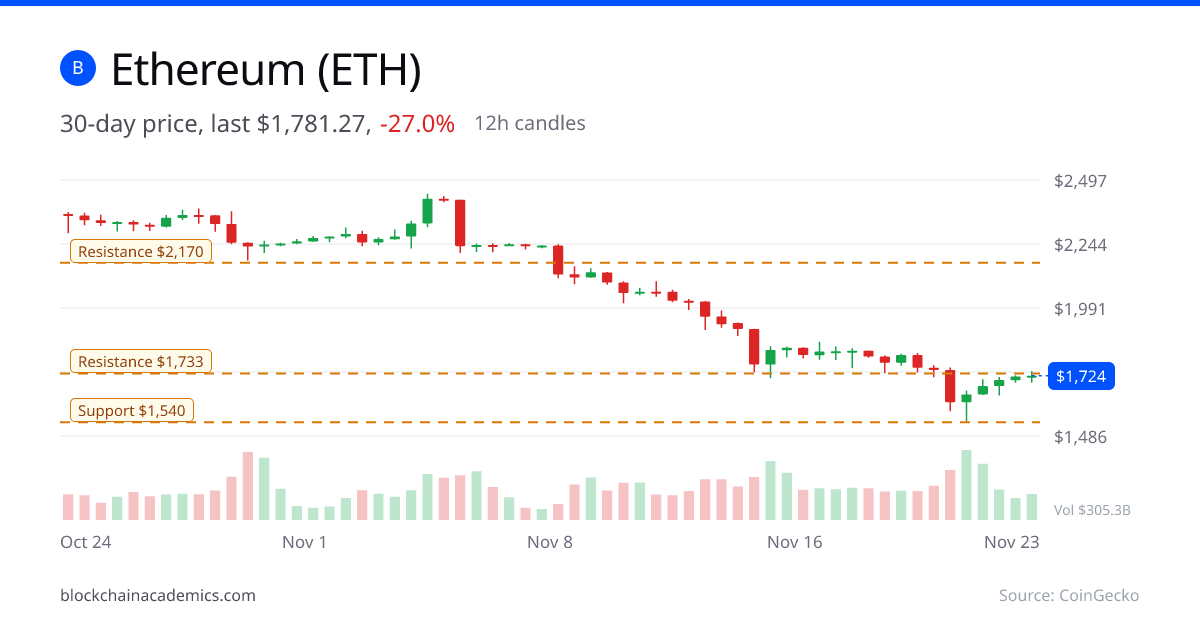
The paper landed with ETH near $1,720 on Monday, little changed to slightly higher on the day and down about 28% over 30 days. One market reading showed a 0.82% gain to $1,722.88, in step with a market-wide bounce rather than an Ethereum-specific catalyst. Estimates of the weekly decline range from about 6% to nearly 13%.
Short liquidations outpaced longs, $42.86M against $16.15M, according to CoinGlass data. U.S. spot Ether ETFs lost about $97.3M on Nov. 20 and about $306M over the five sessions ending Friday, per Farside. Neither the liquidations nor Binance withdrawal data point to buyers accumulating.
Technical readings vary by source. One set places support near $1,540 and resistance near $2,170 and $2,300, with daily RSI at 30. Another puts support at $1,698, resistance at $1,733 and $1,885, and RSI at 29.80.
What it means
The threat itself remains distant: no exploit exists and no funds are at risk today. Price has tracked the chart more than the report, and the study's nearer-term effect falls on sentiment and on the pressure for developers to map out quantum-resistant signatures.
Its practical value is the scale it puts on the problem: a migration measured in months, millions of wallets, and a backup gap across the 25 exchanges reviewed. Those numbers give Hegotá planners, and the debate over an accelerated 2027 timeline, a concrete workload to test against.