Ethlabs Pulls Quick Slots, Urges 2027 Ethereum Quantum Upgrade
Ethlabs is pulling Quick Slots from the Hegotá hard fork and proposing pqai27, a plan to bring Ethereum's post-quantum and post-AI readiness forward to 2027, two years ahead of the Ethereum Foundation's December 2029 roadmap. Core developers have not approved it.
2027, not 2029. That is the post-quantum deadline Ethlabs wants for Ethereum, and it is giving up its own Quick Slots proposal (EIP-8198) from the Hegotá hard fork to get there. The research nonprofit, founded by former Ethereum Foundation researchers, published the plan, called pqai27, on November 11 on the Ethereum Magicians forum.
The Ethereum Foundation's roadmap targets December 2029 for quantum resistance across the execution, consensus and data layers. Ethlabs wants to beat that by two years.
Quick Slots would initially have cut slot time from 12 seconds to 10. Ethlabs says it will still pursue faster slots, but in 2028. For now, the resources go to pqai27.
"We don't take this decision lightly"
Ethlabs
Two targets for 2027
pqai27 sets two goals. The first, pqai-ready, means consensus is post-quantum and users have a post-quantum route for their accounts. The network keeps running, potentially at reduced capacity.
The second, pqai-scaled, means full capacity, with post-quantum transactions and data availability. Ethlabs named EIP-8288 (signature aggregation) and EIP-8479 (quantum-resistant data availability) as required for that target. It also listed two consensus options: modifying Gasper or adopting decoupled consensus.
"Post-AI" is Ethlabs' term for cryptography that relies on as few assumptions as possible, plus client software hardened against AI models that find bugs at scale. The tools: formal verification and client diversity.
"Being post-quantum is not enough, we intend on being post-AI too"
Ethlabs
The full proposal is on the Ethereum Magicians forum.
Why now
Ethlabs cited the US government moving its quantum risk goal from 2035 to 2030, and Google planning to be post-quantum by 2029. It also pointed to AI solving hundreds of open math problems and finding about 1,000 Linux vulnerabilities. The argument rests on uncertainty, not a fixed date:
"What has changed is that it has become much harder to reason when any of them will arrive."
Ethlabs
Ethlabs acknowledges researchers cannot establish when AI might threaten cryptography, or whether certain mathematical attacks will ever become possible. Its case is that switching course gets more expensive the longer developers wait.
"A pivot later, when we are deep into shipping the currently planned fork, would be far more costly than today"
Ethlabs
Trade-offs for the roadmap
FOCIL should be scheduled only if it does not interfere with the quantum deadline, Ethlabs says. Frame Transactions (EIP-8141) remain a priority. Glamsterdam should proceed as planned. Hitting 2027 would mean reconsidering Hegotá features and reshuffling existing upgrade priorities.
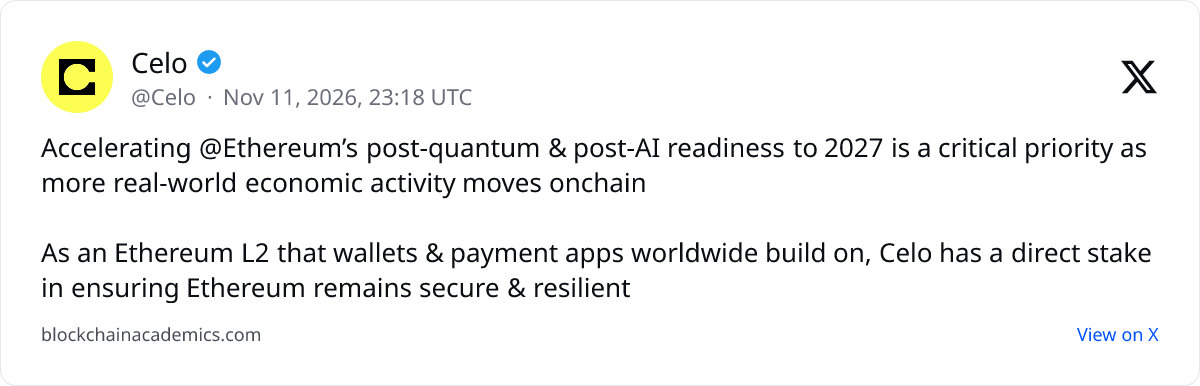
Celo backed the plan in a post on X, calling an accelerated 2027 timeline for Ethereum's post-quantum and post-AI readiness a critical priority and citing its stake as an Ethereum L2.
Core developers have not approved the proposal. The larger plan needs their agreement.
Against existing timelines
Ethereum Foundation researcher Justin Drake has said he hopes to finish the transition by December 2028, as we reported earlier this month. The official 2029 roadmap still stands. The Foundation plans to reassess risks with outside experts in January 2027.