Zcash Devs Urge Migration of 400,000 ZEC Out of Sapling Pool
Zcash team Zakura, led by Sean Bowe and Dev Ojha, wants Sapling made withdrawal-only and urges holders of about 400,000 ZEC to migrate to Ironwood. It calls a practical pairing break highly speculative and says no working attack exists.
400,000 ZEC. Roughly $300 million. Nearly 2% of total supply. That is what still sits in Sapling, Zcash's older shielded pool, and on Thursday, November 26, the development team Zakura asked holders to move it to the newer Ironwood pool. Zakura, led by co-founder Sean Bowe and developer Dev Ojha, made the call in an announcement on X.

"Let's deprecate Sapling faster, and if you're in that last 2%, please migrate to Ironwood!"
Zakura, Zcash development team
The threat is long-range. AI-accelerated mathematical advances or quantum computers could one day undermine the pairing-based cryptography behind Sapling, which launched in 2018. An attacker able to forge proofs could mint counterfeit ZEC.
Zakura's own caveat: a practical pairing break is highly speculative, and no working attack exists today.
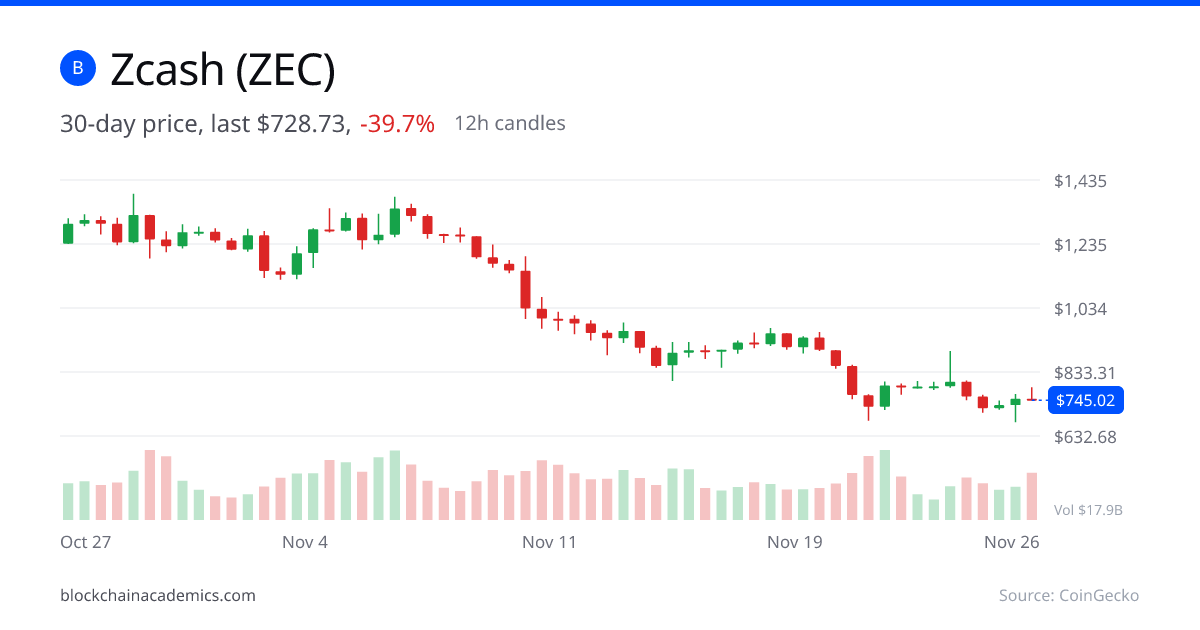
ZEC traded around $746.70, up 2.76% in 24 hours but down 39.69% over the past month. Other market data put it near $755.
A two-stage plan
Step one: a network upgrade blocks new deposits into Sapling while keeping withdrawals open. Step two, only if credible signs of an attack emerge: the community freezes the pool. Zakura also floated pulling the deposit cutoff forward to the NU7.1 upgrade instead of waiting for NU8.
None of it is locked in. No activation date, no governance approval. Dev Ojha first proposed making Sapling withdrawal-only in April 2026.
Ironwood already dominates
Migration touches a small minority. Ironwood launched in July 2026, runs on Halo 2 proofs that do not rely on pairings, and already holds about 85% of shielded ZEC. Sapling handled under 2.6% of transactions over the last 30 days, and 66% of those involved miners.
Zakura also wants post-quantum transparent transactions using 192-bit SPHINCS+ hash-based signatures.
Rumors, not attacks
The warning follows an AI-assisted claim to have proved the Riemann hypothesis and rumors of factoring breakthroughs. Nobody has shown how either could lead to a working attack on Sapling.
Shielded-pool security has drawn scrutiny before. On June 3, developers briefly suspended Orchard transactions after finding a shielded-pool vulnerability; functionality was restored the same day through an emergency upgrade. The Zcash Foundation said there was no evidence it was exploited.
The call also lands days after Bitwise filed an S-1 for a spot Zcash ETF on November 18.
The ask is precautionary: move funds now, before any deadline forces the issue.