House Panel Files Report on Strategic Bitcoin Reserve Bill
The American Reserve Modernization Act is now eligible for a full House vote. The reported text bars Treasury from selling reserve bitcoin for 20 years, but Polymarket puts the odds of a reserve before 2027 below 5%.
A bill to write the Strategic Bitcoin Reserve into federal law is now eligible for a full House vote. The House Financial Services Committee filed its report on H.R. 8957, the American Reserve Modernization Act of 2026, on Nov. 24, and the bill was placed on the House Union Calendar as No. 789. No floor date has been announced.
The bill has not passed the House. It would still need a House vote, Senate passage and a presidential signature. The text as reported by the committee is now public.
What the bill does
Rep. Nick Begich (R-Alaska) introduced the measure in May with Rep. Jared Golden (D-Maine) as co-lead. The bill has 23 cosponsors, and Golden is the only Democrat among them. The committee voted 28-21 on Sept. 16 to send it to the House, and rejected 21-28 an amendment from ranking member Maxine Waters (D-Calif.).
The committee text is a substitute amendment from Rep. Bryan Steil (R-Wis.), adopted by voice vote at that markup. Under it, the Treasury secretary would establish the reserve and a separate Digital Asset Stockpile within 180 days of enactment. Federal agencies would have 60 days to account for their crypto holdings, which would move to Treasury custody.
Treasury would be barred from selling, swapping or pledging reserve bitcoin for 20 years after the law takes effect. After that, the secretary may propose sales capped at 10% of the reserve per two-year period.
Rep. French Hill called the measure "a common-sense measure that brings digital assets held across federal agencies under Treasury custody and consistent oversight." Golden said the bill would establish the reserve "with the weight of law."
Changes from the May version
The reported text scales back several provisions of the original bill:
- Proof of Reserve reports move from quarterly to annual, with an independent auditor and Comptroller General oversight in both versions.
- Coins obtained through forks and airdrops are locked for one year, down from five.
- The study on acquiring more bitcoin without adding to the national debt no longer names Federal Reserve remittances or a revaluation of Fed gold certificates as funding sources.
Politics and timing
Calendar placement came three weeks after Democrats won control of both the House and Senate in the midterms, and the new majorities take over in January. The current Congress adjourns Jan. 3, and both chambers would have to pass the bill before then. Traders on Polymarket put the odds of a reserve before 2027 below 5%.
The bill builds on President Donald Trump's March 6, 2025 executive order creating the reserve, which the legislation would put into permanent law. Addresses linked to the U.S. government hold 306,795 BTC, worth more than $18.7 billion, according to Arkham on-chain data.
Market reaction
Bitcoin traded near $61,000 on Wednesday, flat over 24 hours. That is down about 3% on the week and roughly 24% over 30 days, leaving the price below its 50-day average near $71,000 and its 200-day average near $75,000.
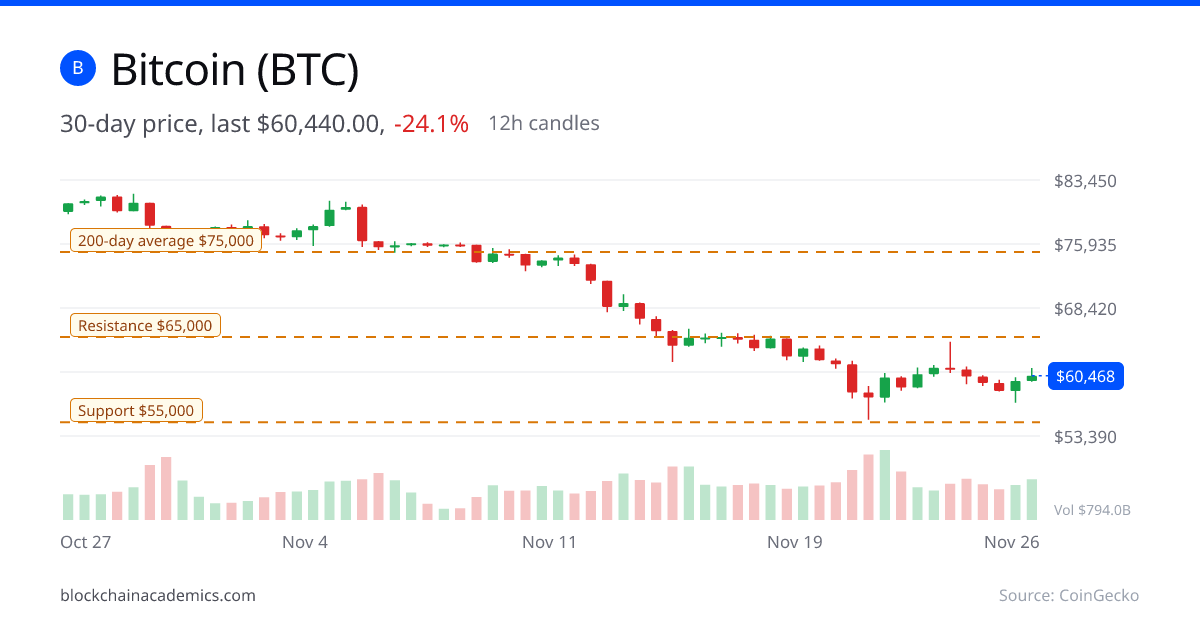
Traders largely shrugged off the committee news, treating the bill as a long shot.
What it means
Calendar placement is a procedural step, not a vote. The committee split along party lines, and control of both chambers changes hands in January, so the bill's path depends on whether leadership schedules it in the weeks remaining. For market participants, codification would matter mainly because it would move the reserve from an executive order into statute, with a 20-year lock on sales.