Utah Moves to Drop Criminal Charges Against Kalshi After Exit
Utah's attorney general filed a motion to withdraw 14 criminal complaints against Kalshi and executives, including its CEO, after the prediction market exited the state. Six rivals also agreed to stay out, and charges return if Kalshi does.
Kalshi's withdrawal from Utah has bought it a reprieve from criminal prosecution, for now. The state's attorney general on Monday filed a motion to withdraw 14 criminal complaints against the prediction market company and individual executives, including its CEO, after Kalshi stopped serving the state and blocked new trades there. The charges, which included a felony count, were filed last month.
The dismissal request covers the company and its co-founders. It is conditional. Attorney General Derek Brown said the charges will be reactivated if Kalshi returns to Utah, and prosecutors could refile if the company resumes offering prediction markets there.
"Kalshi has pulled out of Utah, and if it returns, so will the charges"
Derek Brown, Utah Attorney General
The attorney general's office announced the motion on its website. Brown said six other prediction market companies have also agreed not to do business in Utah, and he framed the outcome as a warning to the sector.
"Every company in this space should take note. If they promote, support, or enable gambling, we will hold them accountable."
Derek Brown, Utah Attorney General
Utah outlaws gambling in its constitution and has joined many state governments that treat Kalshi and its competitors as gambling operations. Kalshi, its rivals and the CFTC take the opposite view: that event contracts on these platforms are derivatives, a category regulated at the federal level rather than by the states.
Kalshi's new general counsel, Yaakov Roth, who joined this week from Jones Day, welcomed the development in a post on X.
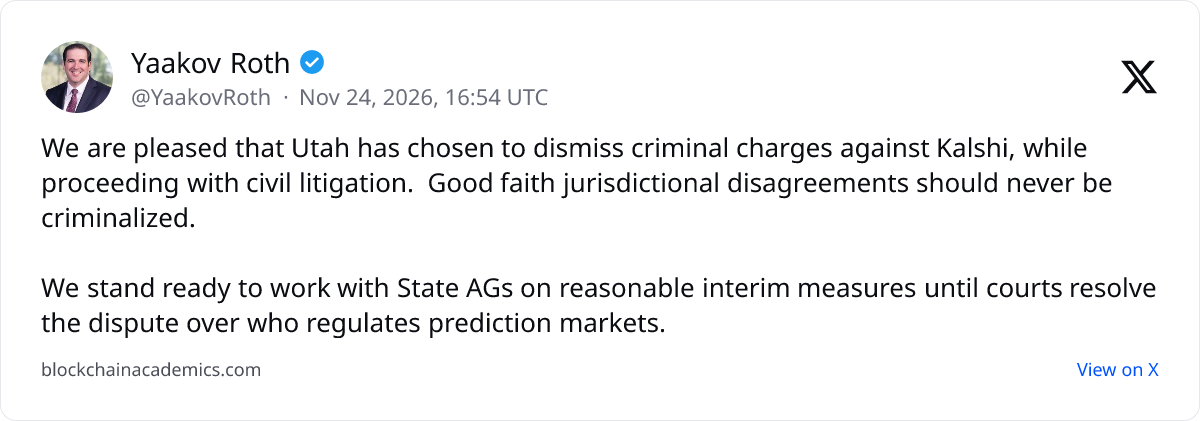
Roth argued that the jurisdictional fight belongs in the courts, not in criminal proceedings.
"Good faith jurisdictional disagreements should never be criminalized,"
Yaakov Roth, Kalshi general counsel
"We stand ready to work with state AGs on reasonable interim measures until courts resolve the dispute over who regulates prediction markets," Roth said.
What it means
The motion leaves the underlying legal question untouched. Utah gets the practical result it sought, with Kalshi and six rivals agreeing to stay out of the state, while Kalshi's executives step back from criminal exposure for as long as the company stays away. Whether states or federal regulators oversee event contracts remains a question for the courts, and the reactivation threat means any return to Utah would reopen the criminal case. For other prediction market operators, the episode shows how a state prosecutor can secure a market exit while that jurisdictional dispute is still pending.