United Fidelity Bank Fails, Costing FDIC $1.83B
The OCC closed Indiana's United Fidelity Bank on Nov. 27, the biggest U.S. bank failure since April 2024. The FDIC expects a $1.83 billion hit to its insurance fund as First Citizens assumes deposits and buys assets at a $2.6 billion discount.
The largest U.S. bank failure since April 2024 will cost the FDIC's Deposit Insurance Fund an estimated $1.83 billion, after federal regulators closed United Fidelity Bank, FSB, of Evansville, Indiana, on Nov. 27.
The Office of the Comptroller of the Currency (OCC) shut the bank and named the FDIC as receiver. In its news release, the OCC said the bank was in an "unsafe or unsound condition to transact business" and was likely to become unable to pay its obligations or meet normal depositor demands. The FDIC did not give a reason for the closure.
First Citizens takes the deposits
As of Sept. 30, United Fidelity held about $5.9 billion in assets and $5.4 billion in deposits. According to the FDIC press release, First-Citizens Bank & Trust Company of Raleigh, North Carolina, agreed to assume substantially all deposits and buy substantially all assets.
First Citizens took about $3.1 billion in loans and about $4.5 billion in deposits, at a roughly $2.6 billion asset discount and with no deposit premium. Certain brokered deposits will not transfer; the FDIC did not say how many. The $1.83 billion estimated cost equals about 31% of the bank's assets.
"Depositors of United Fidelity will become depositors of First Citizens, so customers do not need to change their banking relationship and will retain all of their funds and deposit insurance coverage."
FDIC statement
First Citizens CEO Frank Holding Jr. called the deal "both financially and strategically compelling."
Branches and customers
The 22 branches in Indiana, Illinois, Florida, Colorado and the U.S. Virgin Islands will reopen as First Citizens locations. Those with weekend hours reopen Saturday, Nov. 28, and the rest on Monday, Nov. 30. The Virgin Islands branches had operated as Bank of St. Croix.
Prior supervisory actions
The OCC took enforcement action against the bank in October 2023 over capital planning, risk management and contingency funding. The Federal Reserve issued a cease-and-desist order against the parent companies in June 2024.
Market reaction and context
The failure is the largest since Republic First Bank, which had about $6 billion in assets, collapsed in April 2024, and the second-largest since the 2023 regional banking crisis. It is reportedly the seventh U.S. bank failure of 2026; the six earlier ones were considerably smaller.
First Citizens also acquired Silicon Valley Bank's deposits and loans in 2023.
Polymarket flagged the news on X within minutes as the largest U.S. bank failure in over two years.
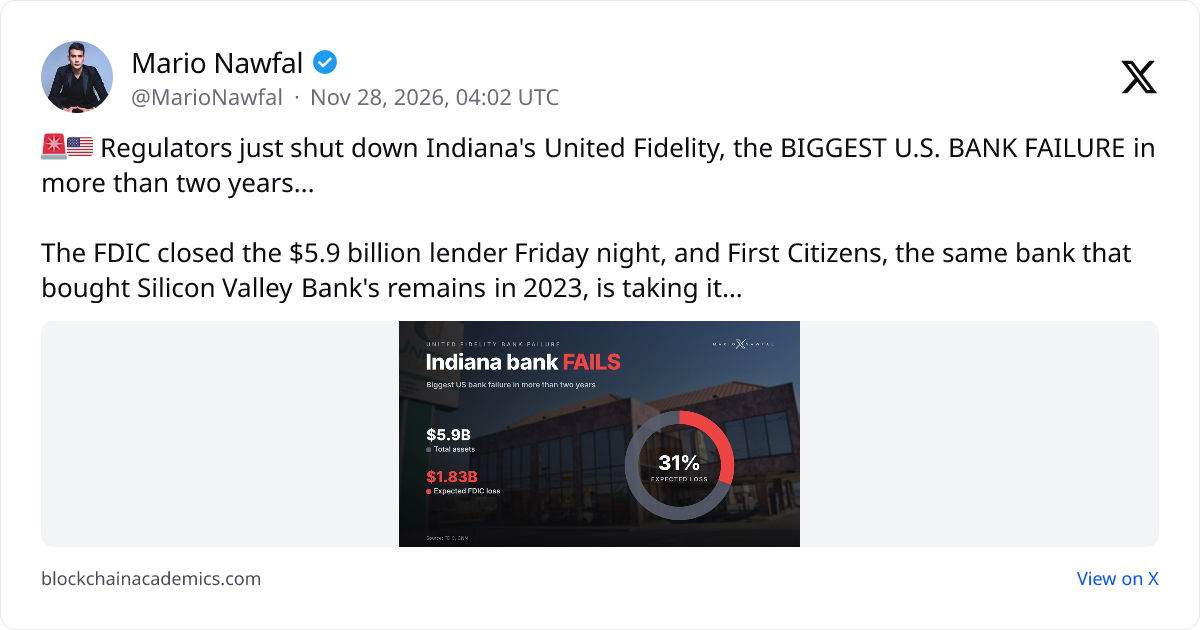
Commentator Mario Nawfal was more pointed. "Nobody pays that kind of discount for healthy loans," he wrote on X. "One failed bank isn't a crisis, but regulators owe Americans an answer on whether United Fidelity was one bad lender or the first crack in a bigger pile of bad loans."
Bitcoin traded near $60,000, down about 2.5% from the previous day. First Citizens shares (FCNCA) closed Friday at $2,173.50, and Monday's trading will provide the first market read on the deal.