Safe Wallet Drained of About $6.4M Through Zodiac Roles Module
A Safe wallet was drained of about $6.4 million in USDC and syrupUSDC through its Zodiac Roles module. An onchain analyst says the role never restricted the trade executor, and part of the funds was traced toward Monero.
Update: November 16, 22:17 UTC
Zodiac's co-founder said a likely compromised key and overly permissive wallet settings enabled the theft, not a flaw in its smart contracts, according to Cointelegraph. The statement is the first from the project itself.
Cointelegraph put the loss at $6.5 million, while CoinGape reported $6.45 million. CoinGape also said the attacker has been laundering the proceeds into Monero across decentralized platforms, including Hyperliquid and Wagyu.
Original report: November 16, 15:45 UTC
An onchain analyst blames a delegated trading permission, not a contract bug, for a roughly $6.4 million drain of a Safe wallet on Nov. 16. The funds left through the wallet's own Zodiac Roles module and were redirected to another wallet.
The Ethereum transaction, executed at 6:35 a.m. ET, moved about 4.39 million USDC and 1.72 million syrupUSDC to a single recipient. Etherscan valued the syrupUSDC at about $2.05 million. Other estimates put the total at $6.45 million, so the headline number shifts slightly by source. The affected wallet is 0x5953…80de, and the receiving address is 0x2b02…B9E1. Specter Investigation flagged the suspected compromise but did not name the Safe's operator.
The transaction did not go through as an ordinary Safe transaction. It called the module's role-based execution function, redeemed a Gauntlet USDC vault position, then sent the USDC and syrupUSDC out.
What the analyst says went wrong
Onchain analyst disco_trooper said on X that the transaction used the Safe's existing Zodiac Roles manager key, and blamed the wallet's permissions rather than a contract flaw.
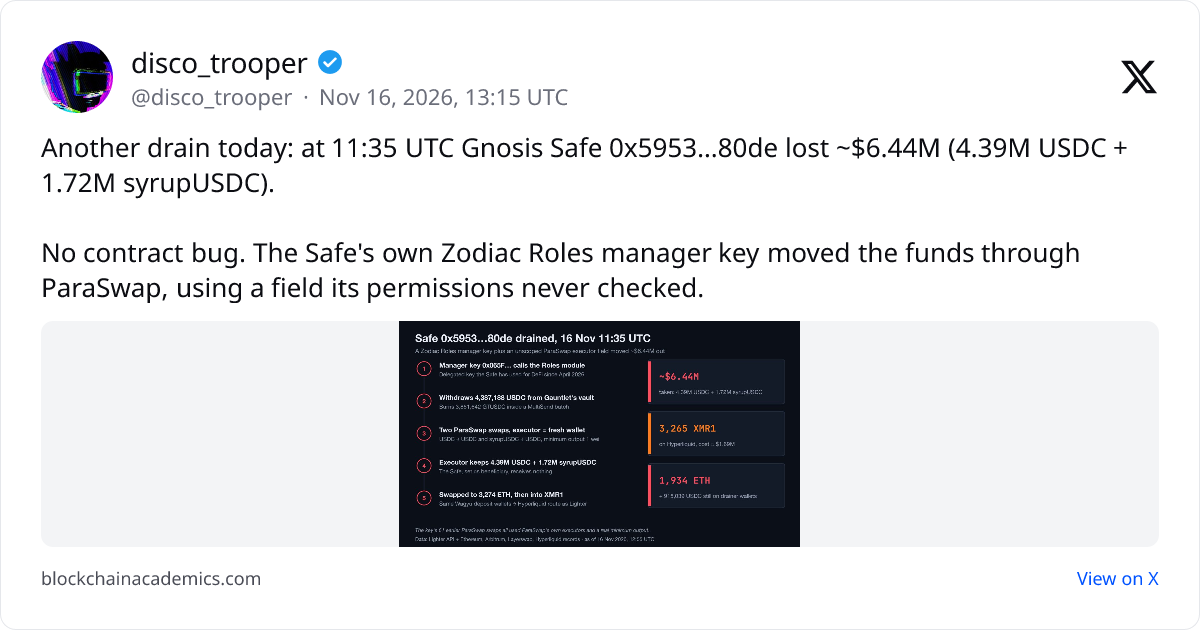
In a follow-up post, the analyst explained that the role checked the intended beneficiary and output token for ParaSwap trades but did not restrict the executor, the address that receives the input tokens. Name your own wallet as executor and you keep the assets.
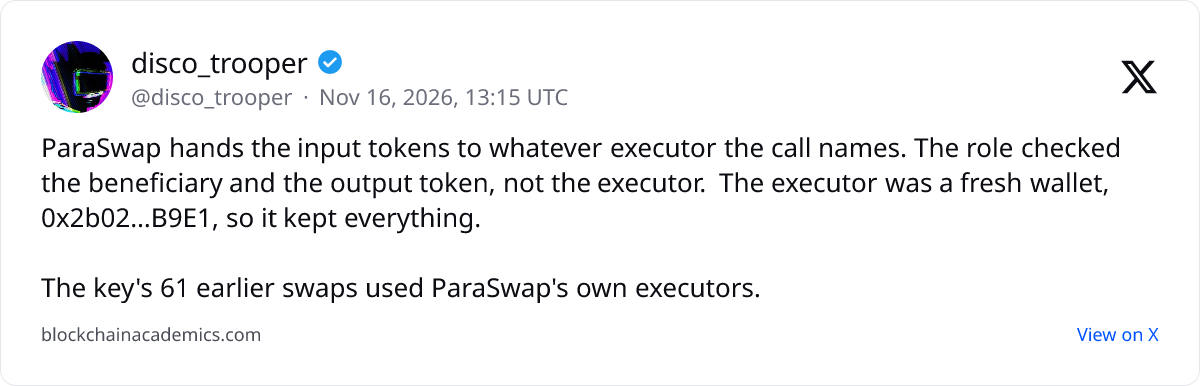
That points to a specific configuration risk. It does not establish a vulnerability affecting every Safe or every Zodiac Roles installation. Zodiac's documentation describes Roles as a way to let service providers, teams or trading bots make specified calls for a Safe, with protection depending on the permissions set.
Where the money went
The initial recipient sent 3 million USDC to 0xe804…6198, which passed 160 ETH to 0x67e0…0668. That wallet bridged to Arbitrum through LI.FI and deposited about 287,106 USDC into Hyperliquid. Its history there lists three XMR1 purchases totaling about $287,100. Those alone do not show a withdrawal to the Monero network.
Specter said about $1.2 million was converted into Monero through Wagyu, an attribution rather than a verified destination. PeckShield separately flagged the incident on X, citing Specter's findings, and said the attacker spent roughly $813,000 buying Monero on Hyperliquid. The $813,000 and $1.2 million figures describe different reported transactions.
Context
Safe add-ons have bled money before. In October, the FlashLoopAdapter exploit drained an estimated $305,000 from two Safe wallets tied to Aave positions. In May, Blockaid identified a $3 million exploit of the SquidRouterModule affecting 86 Gnosis Safe wallets, and in June Gnosis Pay had a $1.5 million incident involving the Zodiac Delay Module.
At about $6.4 million, this drain is bigger than any of those three. The lesson for treasury operators is practical: a role that validates outputs but not who receives inputs is an open door. Audit every parameter a delegated key can set, not just the ones that look like the destination.