Boris Johnson Repeats Bitcoin Doubts at Solana Breakpoint London
Former UK Prime Minister Boris Johnson told Solana Breakpoint in London he still doubts Bitcoin, asking who guarantees it and who is in charge, while arguing London should lead in blockchain and tokenized assets.
Who guarantees Bitcoin, and who is in charge of it? Former UK Prime Minister Boris Johnson put both questions to Solana's Breakpoint conference in London on November 16, telling an audience of crypto developers that he remains skeptical of the world's largest cryptocurrency.
Speaking on a panel titled "Crypto is Key to the UK's Economic Future," Johnson mocked Bitcoin's pseudonymous creator, Satoshi Nakamoto, by deliberately mangling the name.
"As far as I can see, nobody knows who's in charge, apart from Yakimoto Nakasori, and I don't know where to find him"
Boris Johnson
He then turned from governance to consumer protection: "If six billion got stolen from some cryptocurrency, I wouldn't know who to apply to, or how to get the money back. That's my problem."
A repeat of the Ponzi argument
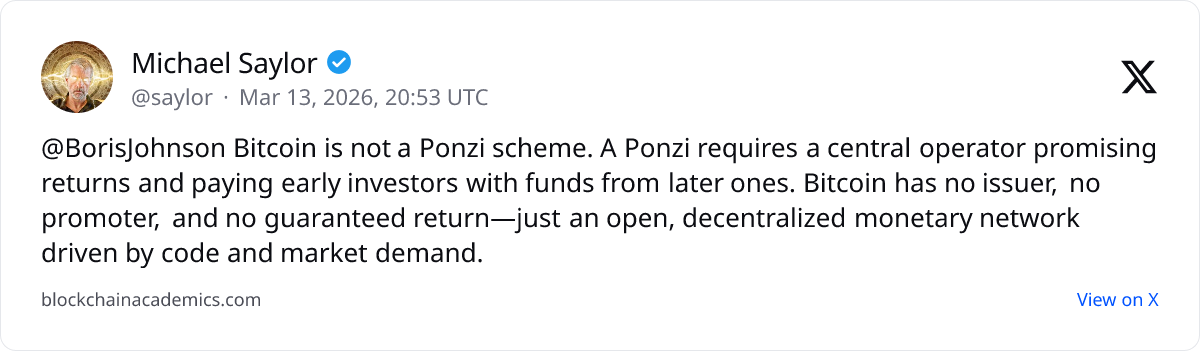
Johnson was asked about his March Daily Mail column calling Bitcoin a "giant Ponzi scheme," which we covered in our report on the column. The column drew industry pushback, including a March 13, 2026 post on X from Michael Saylor, executive chairman of Strategy, saying Bitcoin has no issuer, promoter or guaranteed return.
Johnson described himself as "not a great crypto buff" and said he holds little, if any, crypto. His view, he said, was shaped by a man in his Oxfordshire village who lost thousands.
His doubts stop short of the underlying technology. Johnson separated Bitcoin from blockchain, arguing London should lead in blockchain and in the tokenization of assets.
Pushback on stage
Moderator Gareth Jenkinson pushed back on a claim about drug dealers, arguing that blockchains are more traceable than cash. On the guarantee question he was direct:
"No one has to guarantee it. That's the beauty of the protocol."
Gareth Jenkinson, moderator
Lord Ross Kempsell, a Conservative peer and former Johnson aide who also sat on the panel, said, "I share Boris's anxieties about the risks," but argued that within the regulatory perimeter there is "a lot of scope here for a high growth industry." He said more than 8% of UK adults hold crypto and that the UK is "on the precipice of creating a lot of regulation."
Regulatory backdrop
Kempsell's ownership figure is in line with FCA research that found 8% of UK adults held crypto in August and September 2025, down from 12% in 2024. In June, the FCA finalized its crypto rulebook ahead of a mandatory regime due in late 2027. The Bank of England also eased its stablecoin rules, replacing individual holding caps with a £40 billion issuance limit per coin.
Breakpoint 2026 runs November 15 to 17 at Olympia London under a "Token Supercycle" theme, with expected attendance above 8,000. Executives from Revolut, Mastercard and DTCC are on the program.
What it means
Johnson's position, skeptical of Bitcoin but supportive of blockchain and tokenization, separates the asset from the infrastructure. His objection rests on recourse and accountability: someone to call when funds go missing. Jenkinson's answer, that the protocol needs no guarantor, rests on the opposite premise, and the exchange on stage showed how far apart those two framings remain as UK rulemaking moves ahead.