Polygon PIP Proposes Hard Fork to Recover 70.49M Stolen POL
A Polygon Improvement Proposal would zero out five attacker-controlled addresses and credit about 70.49 million POL, stolen in the Binance and Polymarket incidents, to verified recovery wallets, without changing total supply.
Roughly 70.49 million native POL stolen in separate incidents at Binance and Polymarket could be handed back to its owners through a hard fork of the Polygon proof-of-stake network, under a Polygon Improvement Proposal introduced on November 4. Its author is Parvez03, a member of the Polygon Labs Validator Support Team, according to the proposal on the Polygon governance forum.
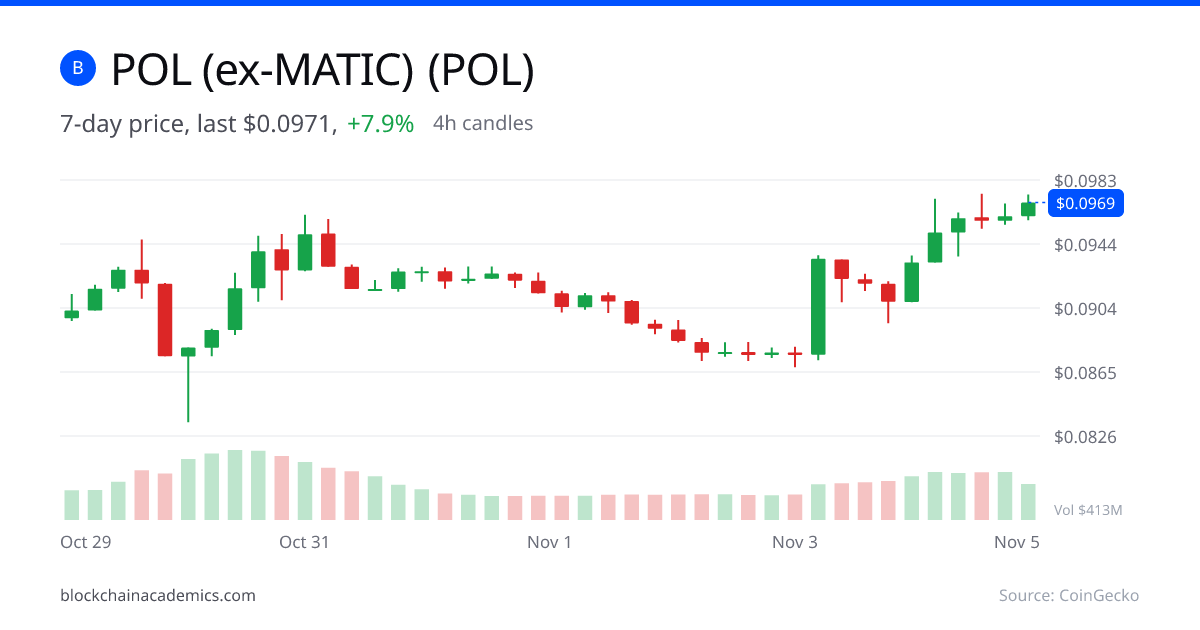
The tokens sit in five attacker-controlled addresses: roughly 23.86 million POL across four addresses tied to the Polymarket breach, and about 46.63 million POL in a single address linked to the Binance incident. At the Oct. 29 POL price of $0.0924 used in one estimate, that comes to around $6.5 million. Other estimates put the figure between $6.8 million and $7 million, depending on the price used.
Mechanically, the fork would set the five balances to zero at a predetermined block and credit matching amounts to verified recovery wallets designated by Polymarket and Binance. Total POL supply would not change. Before activation, both companies would have to demonstrate control of those wallets and confirm the addresses in writing.
Why a fork, and why now
Blocking alone has not settled the matter. All four Polygon block producers have added the addresses to transaction block lists, but the proposal says these measures are temporary and cannot return the funds. Each producer reads its list only at software startup, so any update requires a restart.
The attacker has not been idle either. The proposal says another transaction was attempted on October 30 offering a fee worth roughly 219,450 POL, and that validators were approached with cash offers for help moving the funds. Polymarket reportedly tried to reach the attacker through an onchain channel and received no response.
The author frames the step narrowly:
"extreme action that should not be reproduced commonly"
Parvez03, proposal author
The proposal rejects a general recovery mechanism, arguing that permanent authority to move user funds would raise control concerns.
Scope and risks
The scope covers only native POL on Polygon PoS. USDT and other tokens are excluded, and Tether has already frozen the 6.19 million USDT sent to the Binance attacker address. Other major contracts and earlier transactions stay unchanged. Polymarket and Binance have reportedly already reimbursed most affected users themselves, so the fork mainly targets the remaining stolen assets.
The risks are the familiar ones. Rewriting balances cuts against the immutability that public chains sell, and the proposal itself names a chain-split risk: nodes that fail to upgrade could follow an incompatible chain. Validators, exchanges and node operators would all need to move in step.
What happens next
The proposal was slated for discussion at the Polygon Protocol Governance Call on November 5 at 14:30 UTC. If approved, client development and Amoy testnet validation are expected to take about two weeks. No activation block or mainnet date has been set.
The thefts trace back to Binance's $6.3 billion hack and a separate Polymarket incident, in which trading was suspended after a third-party provider was compromised. The dollar sum here is small beside the $6.3 billion Binance headline, which is part of what makes the case instructive: the debate is less about the amount than about whether a validator-coordinated state change, however narrowly drawn and explicitly labeled a one-off, becomes a template the network has to defend later.