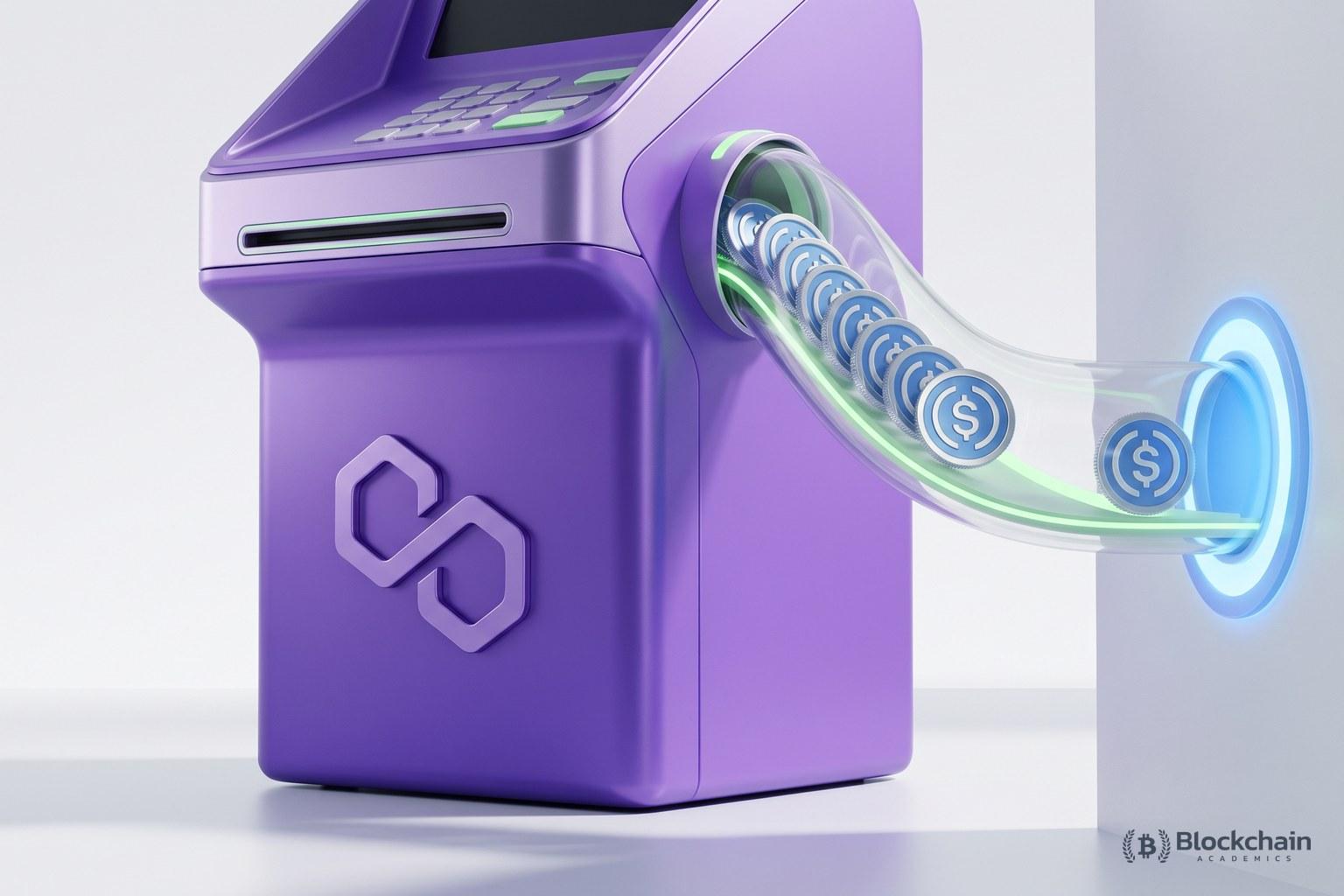
Polygon Labs Brings Open Money Stack Payments to Coinbase Base
Polygon Labs says its Open Money Stack is live on Coinbase's Base with full service, letting businesses pay cross-border recipients in USDC or local currency through one integration. Base joins Polygon Chain, Ethereum, Solana and Tron.
Base, the layer-2 network built by Coinbase, is now the fifth chain on Polygon Labs' Open Money Stack (OMS), joining Polygon Chain, Ethereum, Solana and Tron. The company said Thursday, Nov. 26, that OMS is live on Base with full service. A business paying recipients in other countries can now deliver USDC or local currency on Base through a single integration.
OMS is best understood as a bundle. It packages fiat on-ramps and off-ramps, embedded wallets and settlement into one integration, so a business does not have to stitch together separate vendors to move money from its bank account to a seller's wallet and back again.
Marc Boiron, CEO of Polygon Labs, framed the move around where users already hold money:
"Merchants and consumers around the world now hold dollars on Base, and any business paying them across borders needs a simple way to reach that money,"
Marc Boiron, CEO of Polygon Labs
The logic follows the money. Base carries nearly $5 billion in stablecoins, according to DefiLlama data, which makes it a natural place to meet recipients who already hold USDC. One illustration of the use case: a marketplace in Mexico could pay U.S. sellers in USDC on Base, or send dollars straight to their bank accounts.
The mechanics matter here. Because OMS runs directly on each supported network, payments sent on Base settle on Base rather than being routed through another chain, and businesses can add other chains later through the same provider. OMS also supports USDT and PYUSD alongside USDC, and it offers one-click cross-chain routing through services such as Trails, so a business can send value from one blockchain to another without bridging assets by hand.
The regulatory layer behind the stack
Polygon's US footprint rests on its acquisition of Coinme, a deal that closed on October 14, 2026, and that lets Polygon Labs operate as a US-regulated payments platform. The company reaches 48 states through 37 money-transmitter licenses plus 11 exemptions, and it is registered with FinCEN as a money services business.
The Base launch follows a run of additions. The Solana integration went live on October 29, 2026, with early customer Kira using it to move stablecoins into bank accounts. SoFi has also brought its bank-issued SoFiUSD stablecoin onto the platform; as we reported, SoFiUSD went live on Polygon on Nov. 12 as the stablecoin's third chain, after Ethereum and Solana.
What it signals
Polygon built its reputation as an Ethereum scaling network, so supporting Base, another Ethereum layer-2, reads as a change in strategy: less a rival chain competing for activity than a payments layer that works across chains. The pitch is that the compliance and fiat plumbing travels with the business, wherever the stablecoins happen to sit.
Caveats apply. Polygon claims tens of billions of dollars in stablecoin transfer volume across its supported networks, but that is the company's own figure and has not been independently audited. The tests worth watching are named customers beyond Kira, an independent check of those volumes, and whether more networks join the list.
Some market commentary has also read the expansion as raising anticipation of a Base token launch, a question prediction markets are tracking. That is interpretation, not anything either company has said: neither Polygon nor Coinbase has linked the two.