Uniswap v4 Fee Switch Delivers $325K Daily Revenue as UNI Climbs 16% in a Week
Three days of on-chain data confirm Uniswap's fee switch is working: protocol revenue has nearly tripled to $325,000 daily, pushing UNI to $4. But liquidity providers warn the gains come from their pockets, raising questions about whether volumes will hold.
Uniswap v4 Fee Switch Delivers $325K Daily Revenue as UNI Climbs 16% in a Week
Three days of on-chain data have settled the question of whether Uniswap's long-debated fee switch would actually move the needle: protocol revenue has nearly tripled since activation, landing at roughly $325,000 per day and pushing UNI to $4, a 16% gain over the past week.
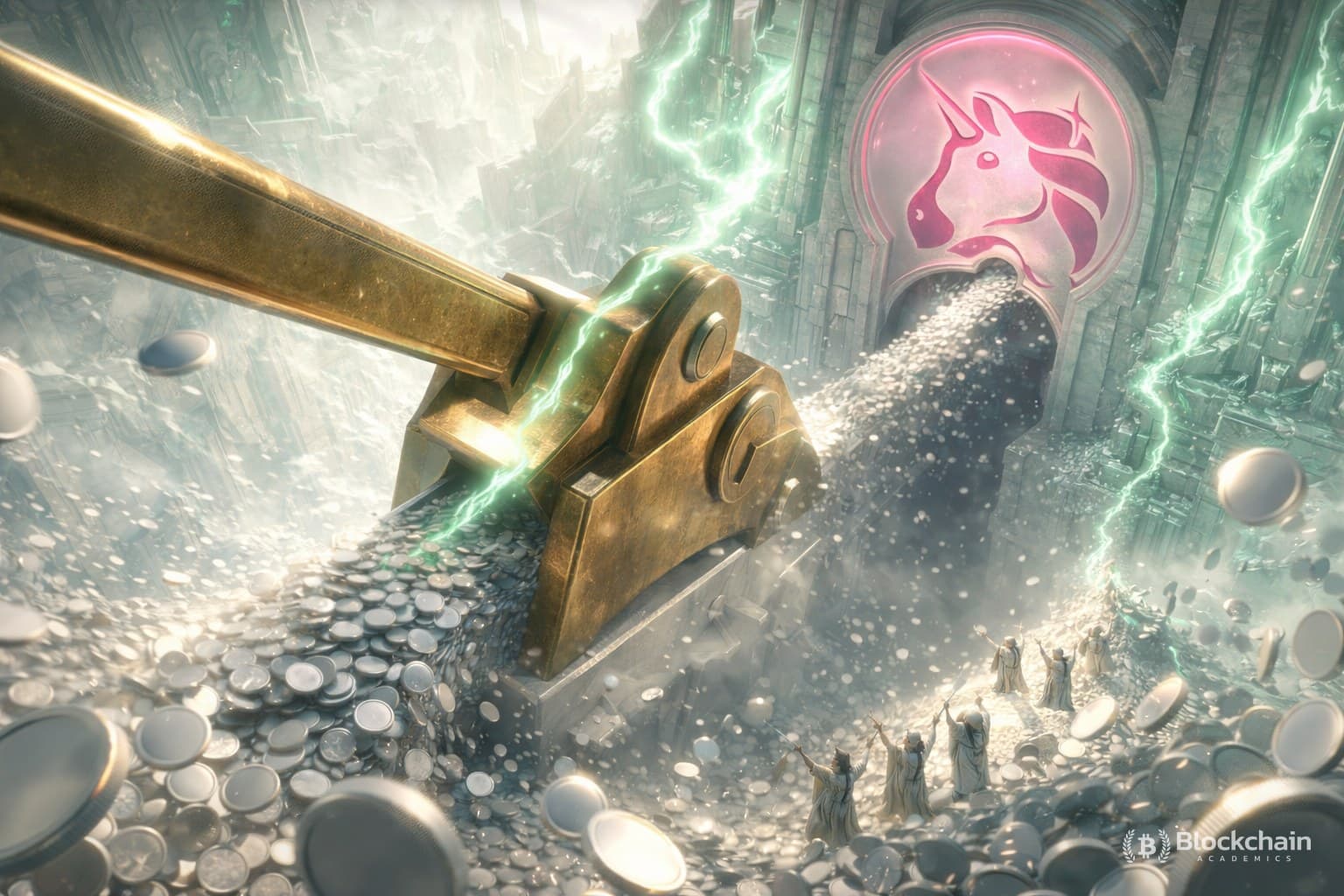
Uniswap activated the fee switch on its v4 pools on or around July 27-28, 2026, marking the first time the protocol has captured a share of trading fees on its latest architecture. Under the previous model, every basis point of fee revenue flowed exclusively to liquidity providers (LPs), the parties who deposit assets into pools to enable trading. The switch redirects a portion of that flow to the protocol itself, with proceeds earmarked for UNI token burns, a mechanism that permanently removes tokens from circulation and, in theory, creates upward pressure on price by reducing supply.
The fee switch has been a fixture of Uniswap governance discussions for years. That it took until v4 to implement reflects how contentious the tradeoff always was: protocol sustainability on one side, LP economics on the other. The numbers arriving this week suggest the protocol side of that argument now has real ammunition.
Three days of onchain data show the expanded fee switch is delivering for UNI holders. About $325,000 a day now flows toward UNI burns, and the token is up 16% on the week.
Not everyone is celebrating. Liquidity providers and rival DEX founders are pushing back with a straightforward counter: that $325,000 daily doesn't materialize from thin air. It comes directly out of LP earnings, compressing the yield that makes providing liquidity attractive in the first place. If LPs migrate to competing venues offering lower protocol overhead, Uniswap's trading volumes could soften, and with them, the very revenue base the fee switch depends on. The concern is circular but legitimate. A DEX lives and dies by its liquidity depth, and thinner pools mean worse execution, which drives traders elsewhere.
Rival DEX founders have been quick to frame the fee switch as a competitive gift. Any protocol that charges less overhead becomes a more attractive destination for yield-seeking LPs, and several competing decentralized exchanges have been positioning themselves as the lower-cost alternative. The broader DeFi landscape has seen this dynamic play out before: a dominant protocol tightens its economics, and nimble competitors absorb the displaced capital. Whether that pattern repeats here depends on how much LP tolerance for reduced yield actually exists at current volume levels.
The structural logic behind the burn mechanism deserves a closer look. Token burns reduce circulating supply, but their price impact is a function of demand as much as scarcity. If trading volumes decline because LPs leave, the burn rate slows, and the deflationary narrative weakens. Conversely, if Uniswap's brand dominance and v4's technical improvements retain enough liquidity, the $325K daily figure could hold or grow, making the burn a genuine, sustained tailwind for UNI holders. At current rates, the protocol would remove roughly $118 million worth of UNI from circulation annually, assuming flat volumes.
The activation also fits a broader DeFi maturation trend. Protocols across the sector have spent years prioritizing growth over revenue capture, subsidizing liquidity with token emissions and deferring the question of how to fund operations sustainably. Uniswap's move mirrors revenue-sharing mechanisms already adopted by competing DEXs and signals that the industry's largest trading venue is now orienting toward long-term economic viability rather than pure market share accumulation. That shift, if it holds, has implications beyond Uniswap: it sets a precedent that even dominant protocols can implement fee capture without immediately collapsing their liquidity base.
The next few weeks will be the real test. Three days of data confirm the mechanism works mechanically. What remains open is whether LP attrition accelerates, whether volumes hold, and whether the UNI price move reflects genuine repricing of the token's cash-flow profile or a shorter-term momentum trade. At $4, UNI is pricing in some optimism. The on-chain data will either justify it or not.