
Ripple Backs SEC Regulation Crypto Assets, Urges Agency to Finalize Rule
In a 20-page comment letter sent October 20, Ripple backed the SEC's proposed Regulation Crypto Assets and urged it to finalize the rule, while opposing limits on the Rule 400 safe harbor, a company-backed vs network token split, and Rule 500(b)'s treatment of dealers.
Ripple wants the SEC to finish what it started. In a 20-page comment letter sent on October 20, the company backed the agency's proposed Regulation Crypto Assets and urged it to finalize the rule, even as it pushed back on several of the provisions inside it.
Chief Legal Officer Stuart Alderoty shared the development on X and framed the company's position bluntly.
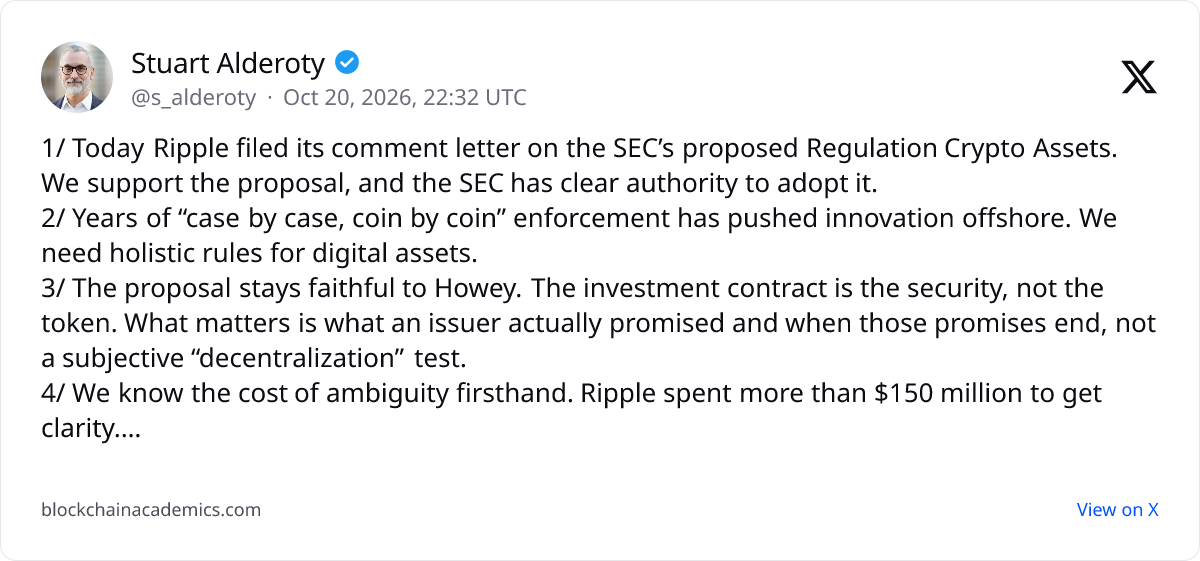
"We are for this proposal. The SEC clearly has the authority to do it,"
Stuart Alderoty, Chief Legal Officer, Ripple
What Ripple endorses
The proposal rests on a simple distinction: the investment contract, not the token, is the security. Alderoty called that approach faithful to Howey, the Supreme Court case that defines an investment contract. Ripple argues the rule would replace years of case-by-case, coin-by-coin enforcement with an established framework, while investor protection continues under existing law. The company also criticises the use of decentralization as a core test.
"What matters is what an issuer actually promised and when those promises end, not a subjective 'decentralized' test."
Stuart Alderoty, Chief Legal Officer, Ripple
The SEC revealed the proposal in August with two exemptions: one letting qualifying projects raise up to $5 million over four years, and another allowing up to $75 million raised each year. It also includes a conditional safe harbor for digital assets that have ceased to be investment contracts.
Where Ripple wants changes
Rule 400 is the proposed safe harbor. It would let an issuer file a public Form TR certifying that promised work is finished or abandoned. Ripple opposes an SEC suggestion to limit it to issuers that fulfilled their promises, and asks for a new clause stating that skipping Form TR creates no presumption that a token is tied to an investment contract.
Ripple also rejects sorting tokens into "company-backed" and "network" camps, warning that the split would revive the "implicit" promise standard the SEC dropped in its 2026 interpretation. The letter offers an example of where the line should sit: a company sending 5% of each sale to buy and burn its own token creates an investment contract, because the code automates a promise to return revenue to holders.
A further fix targets Rule 500(b), which overrides state law for secondary-market trades but excludes dealers with no end date. That leaves registered dealers to seek exemptions state by state.
The legislative backdrop
Ripple cites Section 28 of the Securities Act and Section 36 of the Exchange Act as giving the SEC power to exempt classes of securities. It says the failed 49-50 Senate vote on September 15 to advance the Digital Asset Market Clarity Act does not remove that power. In effect, the company is arguing that the agency can proceed even though Congress has not.
Ripple's own case as evidence
The letter draws on the company's own history. After the December 2020 SEC suit, XRP fell roughly 70% within days and about $15 billion in market value disappeared. A July 2023 district court ruling that XRP is not in itself a security added about $21 billion, and Coinbase and Kraken restored US trading the same day.
"Ripple spent more than $150 million to get clarity. No company should have to do that to learn what the law requires,"
Stuart Alderoty, Chief Legal Officer, Ripple
The letter also cites a National Cryptocurrency Association study estimating that clearer rules from 2022 to October 2026 would have brought 382 to 1,518 more US token offerings and $325 million to $1.117 billion in capital.
Why it matters
The filing follows Ripple's compliance layer for U.S. credit markets, which our earlier coverage described as among the first major infrastructure moves of the post-settlement era. With the Clarity Act stuck after its 49-50 Senate vote, Ripple is betting on the rulemaking route instead, and it is using its comment letter to argue both for speed and for specific edits.