
Pentagon Bars Personnel From Trading on Nonpublic Data on Polymarket, Kalshi
Defense Secretary Pete Hegseth's October 20 memo bars military and civilian DoD personnel from using nonpublic information to trade on prediction markets, following the Van Dyke Polymarket case tied to the Maduro operation.
Department of Defense personnel who use nonpublic information to trade on Polymarket, Kalshi or any other financial platform now face possible disciplinary action or criminal prosecution. Defense Secretary Pete Hegseth set out the prohibition in an October 20 memorandum, citing both operational security and ethics.
The memo, titled "Do Not Compromise Military Operations for Personal Financial Gain," went to senior Pentagon leaders and combatant commanders. It applies to military and civilian staff alike and prohibits financial transactions that rely on nonpublic information, whether made directly or through third parties. It covers both classified and unclassified material, and it lists traditional betting services and other financial platforms alongside the two prediction market operators. CBS News obtained the document.
What the directive does and does not do
This is not a blanket ban on prediction market participation. The memo targets the exploitation of nonpublic information for financial gain, not lawful trades by service members.
Violators may face administrative penalties, disciplinary proceedings or criminal prosecution under the Uniform Code of Military Justice and federal law.
Hegseth warned that foreign intelligence services could analyze betting signals to anticipate U.S. military movements, targets and timing. He also argued that financial stakes could compromise the judgment of analysts and logistics personnel.
"Make no mistake why this matters. Our enemies watch movements in these markets,"
Pete Hegseth, U.S. Defense Secretary
He described the stakes in blunt terms: "Not entertainment. Not a payout." Elsewhere he wrote, "Nothing should distract us from that sacred mission."
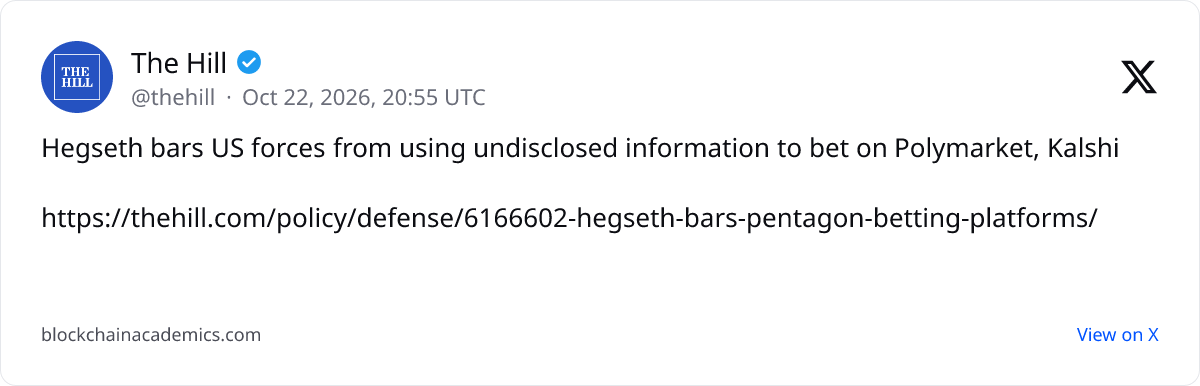
The Hill posted about the directive on X.
The Van Dyke case behind it
The memo follows the prosecution of U.S. Army Master Sergeant Gannon Ken Van Dyke, 38, a Special Forces soldier who pleaded not guilty in April to five federal charges. Prosecutors allege he placed about $33,000 in Polymarket bets between December 27 and January 2 on Nicolás Maduro's removal and U.S. entry into Venezuela. Those positions allegedly generated more than $404,000 after the January 3 capture of Maduro, known as Operation Absolute Resolve. The allegations remain subject to court proceedings.
The CFTC filed a parallel civil action, its first insider-trading action involving event contracts and its first use of the "Eddie Murphy Rule."
Polymarket said it flagged Van Dyke's trading to authorities and cooperated. Kalshi had earlier blocked him from opening an account through identity verification.
Wider scrutiny of prediction markets
Congress had already turned its attention to the sector. On May 22, House Oversight Chairman James Comer opened an investigation into Polymarket and Kalshi covering identity checks, suspicious trades and rule enforcement. Kalshi has introduced employment disclosures for some higher-risk markets.
Six recently created Polymarket wallets also reportedly earned nearly $1 million around U.S. strikes on Iran. Reports did not establish that those traders held classified information.
For market participants, the memo places the compliance burden on an identifiable population. Platforms can verify identity, as Kalshi did with Van Dyke, but identity checks alone do not reveal who holds privileged knowledge. A Pentagon rule backed by UCMJ penalties adds an enforcement channel on the user side, alongside the CFTC's civil authority.