NFT Standards: ERC-721 vs. ERC-1155
ERC-721 and ERC-1155 dominate Ethereum’s NFT space—learn their key differences, strengths, and best use cases for creators and developers.
Overview
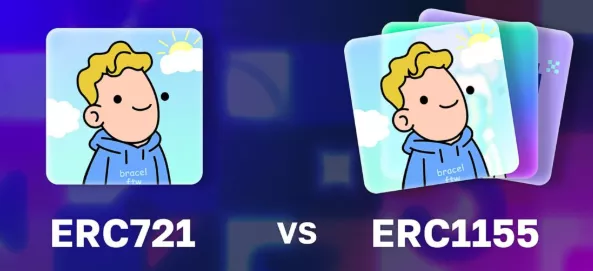
Non-Fungible Tokens (NFTs) revolutionized digital ownership by enabling verifiable, unique assets on the blockchain. The two primary Ethereum standards for NFTs are ERC-721 and ERC-1155. While both enable the creation of NFTs, they differ significantly in terms of structure, flexibility, and use cases:
img src="https://lh7-rt.googleusercontent.com/docsz/AD_4nXfRGz5c2bGDrvRULZZRkqFfAs-gpa93vDaewggqvcUdwKHoC9fI6qB8C4Igc6VygJJajNThLdWLjSUuPFzKfcmVSKxzNqB_ZG1hs5-PGFs_jlh-ZP04gOB9Mw6C_vdYB3Y8k18b?key=-8HYqAuGamUw90a4aMBdBnHS" width="637" height="291">
/p>h4>Examples of Each Standard/h4>p>ERC-721:
ERC-1155:
/p>h4>Pros & Cons/h4>p>Pros of ERC-721:
Cons of ERC-721:
Pros of ERC-1155:
Cons of ERC-1155:
/p>p>
/p>h4>Evolution of Both Standards/h4>p>2017: ERC-721 Introduced
2018–2019: ERC-1155 Proposed by Enjin
2021–2023: Market Matures
2024–Present: Coexistence and Specialization
Market Sentiment
The NFT space recognizes ERC-721 as the go-to for high-value, unique assets, while ERC-1155 is increasingly seen as the smart choice for scalable, utility-driven projects. As adoption grows, ERC-1155’s efficiency and flexibility continue to gain favor, especially in gaming and multi-item environments.
/p>p>
/p>h4>Conclusion/h4>p>Both ERC-721 and ERC-1155 have carved out important roles in the NFT ecosystem. While ERC-721 remains king in terms of unique, collectible assets, ERC-1155 opens the door to mass efficiency and multi-token environments. The future of NFTs will likely involve both standards working in tandem, depending on the project’s needs.
By Alejandro Silva Ramírez, Crypto Analyst & Columnist
- ERC-721 introduced the first standard for NFTs, where each token is completely unique and stored separately.
- ERC-1155 is a more advanced, multi-token standard that allows both fungible and non-fungible tokens within a single smart contract.
- CryptoKitties: The original NFT game that popularized unique, breedable collectibles.
- Bored Ape Yacht Club (BAYC): Profile picture NFTs where each ape is a unique asset.
- Decentraland Land Parcels: Each plot is an individual token.
- Gods Unchained: A blockchain trading card game where cards can be fungible or non-fungible.
- The Sandbox Assets: Includes multiple item types (wearables, props, lands) in one contract.
- Enjin-powered games: Used to issue both items and currencies in a single framework.
- Simpler to understand and widely supported by NFT marketplaces.
- Designed specifically for true 1-of-1 ownership.
- Great for projects focused on uniqueness and scarcity.
- Inefficient for minting large batches (each NFT requires its own contract call).
- Higher gas fees for batch transfers.
- No support for fungible tokens or shared metadata structures.
- Supports both fungible and non-fungible tokens in one smart contract.
- Lower gas costs for batch mints, transfers, and burns.
- More efficient storage and metadata handling.
- Slightly more complex for developers to implement.
- Not as universally supported on older platforms or tools.
- Difficult for users to distinguish between fungible and non-fungible tokens at a glance.
- CryptoKitties launches and causes Ethereum congestion, leading to the official proposal of ERC-721 as a standard.
- Becomes the default choice for most NFT projects, especially collectibles.
- Created to solve the inefficiencies of ERC-721 in gaming and batch operations.
- Gains popularity in blockchain gaming and metaverse applications.
- ERC-721 dominates profile picture (PFP) projects and high-value art NFTs.
- ERC-1155 gains traction in gaming, event ticketing, and multiverse economies.
- Both standards coexist with distinct use cases.
- Developers choose based on whether they need uniqueness (ERC-721) or versatility and scale (ERC-1155).
- Multi-standard marketplaces like OpenSea support both natively.