Klarna’s Leap Into Digital Currency Signals a New Phase for Global Payments
Klarna launches a USD-pegged stablecoin on Stripe’s Tempo chain, signaling fintech’s growing shift toward blockchain payments.
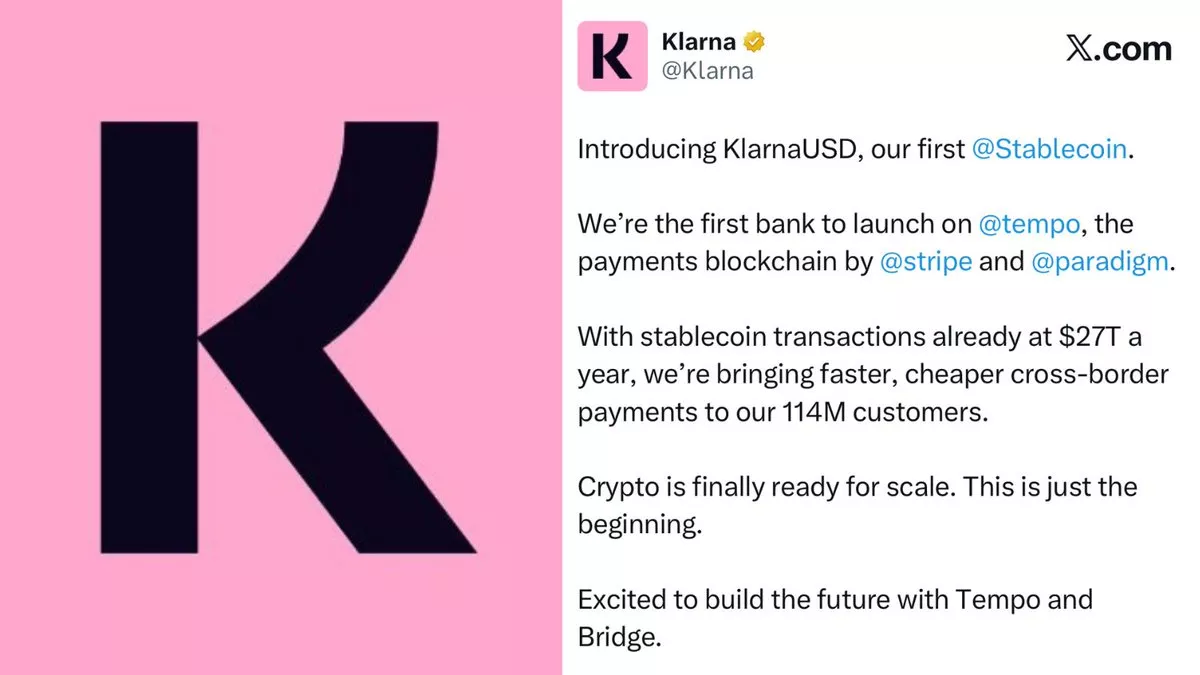
Klarna, one of Europe’s most recognizable fintech brands, has stepped into the digital currency arena, unveiling a U.S. dollar–pegged stablecoin developed on Tempo, the new layer-1 blockchain launched by Stripe and Paradigm. The move makes Klarna the first licensed digital bank to issue a token on the network, marking a strategic shift in how traditional payment companies position themselves within the accelerating stablecoin economy.
The company revealed that its token, KlarnaUSD, is already operational on Tempo’s testnet ahead of a projected mainnet launch in 2026. Built by Bridge, a stablecoin infrastructure firm under Stripe’s umbrella, the token extends a partnership that has long connected Stripe’s payment architecture with Klarna’s global footprint across 26 markets. The underlying message is unmistakable: stablecoins are becoming too significant for mainstream payment providers to ignore.
Klarna’s CEO, Sebastian Siemiatkowski, underscored the changing landscape, stating that crypto technology has reached a phase that is “fast, low-cost, secure, and built for scale.” His framing suggests that the company sees blockchain not as a speculative experiment but as an operational tool capable of improving cross-border settlement, liquidity flows, and internal financial efficiency.
Despite the ambitious tone, Klarna is not yet targeting consumer-facing crypto features. A company spokesperson clarified that the initial use cases revolve around internal efficiencies, particularly reducing the cost of international transfers within the firm’s payment network. There are no current plans to integrate stablecoin functionality into its popular buy now, pay later service. Instead, the company appears to be testing the foundational infrastructure before exploring broader applications.
Klarna’s announcement arrives amid what many analysts describe as a breakout year for stablecoins. The passage of the GENIUS Act in the United States formalized federal guidelines for stablecoin issuance and transparency, giving both fintech firms and blockchain developers a clearer regulatory runway. The legislation catalyzed a wave of new stablecoin projects, including MetaMask’s mUSD, launched in September and now holding a market capitalization nearing $844 million.
Traditional financial firms are also entering the arena. Western Union disclosed plans for a Solana-powered settlement network built around its forthcoming US Dollar Payment Token, scheduled for release in 2026. Visa broadened its stablecoin settlement capabilities in July, adding support for the Global Dollar token and enabling transactions across both Stellar and Avalanche. These developments signal that established payments providers view blockchain as a competitive necessity rather than a peripheral experiment.
The stablecoin sector itself has grown to roughly $304 billion, dominated by Tether’s USDT at about $184 billion and Circle’s USDC at more than $74 billion. With this scale, the entry of a consumer-facing global brand like Klarna highlights how payment companies are positioning themselves around emerging digital settlement standards.
KlarnaUSD may remain an internal tool for now, but its debut serves as an early indicator of how retail financial platforms will weave blockchain into their operational backbone. As Tempo prepares for its mainnet launch, Klarna’s experiment reflects a broader industry migration toward digital settlement architectures that promise speed, transparency and global reach.