
Hyperliquid Strategies Files to Become CFTC FCM, Posts $620.6M Profit
Hyperliquid Strategies (PURR) has applied to the CFTC to become an FCM that could carry U.S. client accounts for HIP-3 perps. Its $620.6M quarterly profit rests on $803M in unrealized HYPE gains, and HYPE now trades about 14% below the quarter-end mark.
A company built to hold a token now wants to hold customer accounts. Hyperliquid Strategies, the Nasdaq-listed HYPE treasury company trading as PURR, said in its Nov. 5 earnings release that it has applied to the CFTC to become a futures commission merchant (FCM), a registration that would let it carry U.S. client accounts. The same release reported $620.6 million in net income for the quarter ended Sept. 30, almost all of it unrealized.
The FCM filing is aimed at HIP-3, the name Hyperliquid gave to its expanded deployer functions for perpetual futures markets. If approved, the firm could carry U.S. client accounts for those markets, and it said it would "play a role" in bringing perpetual futures to U.S. customers within a regulated framework. The application remains subject to regulatory approval, and the company was direct about the uncertainty:
"There can be no assurance as to the timing or outcome of the application or regulatory approval of permissioned HIP-3 markets"
Hyperliquid Strategies, company release
The filing joins a field that has filled up quickly. Last week, ICE said it would invest in Trade.xyz to build a U.S. venue for Hyperliquid-based perps, also pending CFTC approval. Days before that, Hyperliquid said it intends to make Payward the first CFTC-regulated HIP-3 deployer, with Bitnomial deploying and NinjaTrader Clearing carrying accounts. A PURR FCM would add another U.S. access route.
The numbers behind the headline
Revenue came to $13.3 million, above analyst estimates of $10.6 million to $12 million depending on the data provider. Staking rewards and validator commissions contributed $12.3 million, and interest income added $1 million.
Net income is a different story. The $620.6 million figure rests on $803 million in net unrealized gains on HYPE holdings, offset partly by a $172.3 million income tax provision. A further $15.3 million in primarily non-cash expense was tied to the company's committed equity facility. The prior fiscal year, ended June 30, produced $305.5 million in net income, driven by $709.9 million in unrealized HYPE gains.
The company's annual report states that HYPE holdings are measured at fair value, with changes recognized in net income each period. In practice, the token's price drives the bottom line: a fall in HYPE can produce a loss on paper without a single token being sold.
Balance sheet and the price since quarter-end
Holdings rose from 29.3 million to about 38.5 million HYPE during the quarter, valued at $3.505 billion at $90.99 per token on Sept. 30. Total assets were $3.764 billion with no debt, and cash and cash-like instruments stood at $254.6 million. The company raised $911 million in equity and spent roughly $785 million to $802 million on tokens; reported figures for the purchase differ. It also spent $17 million repurchasing 2.7 million PURR shares. By late October the treasury held about 38.9 million HYPE.
At 4:52 p.m. ET on Nov. 5, HYPE traded at $78.09 on CoinGecko, about 14.2% below the quarter-end valuation price.
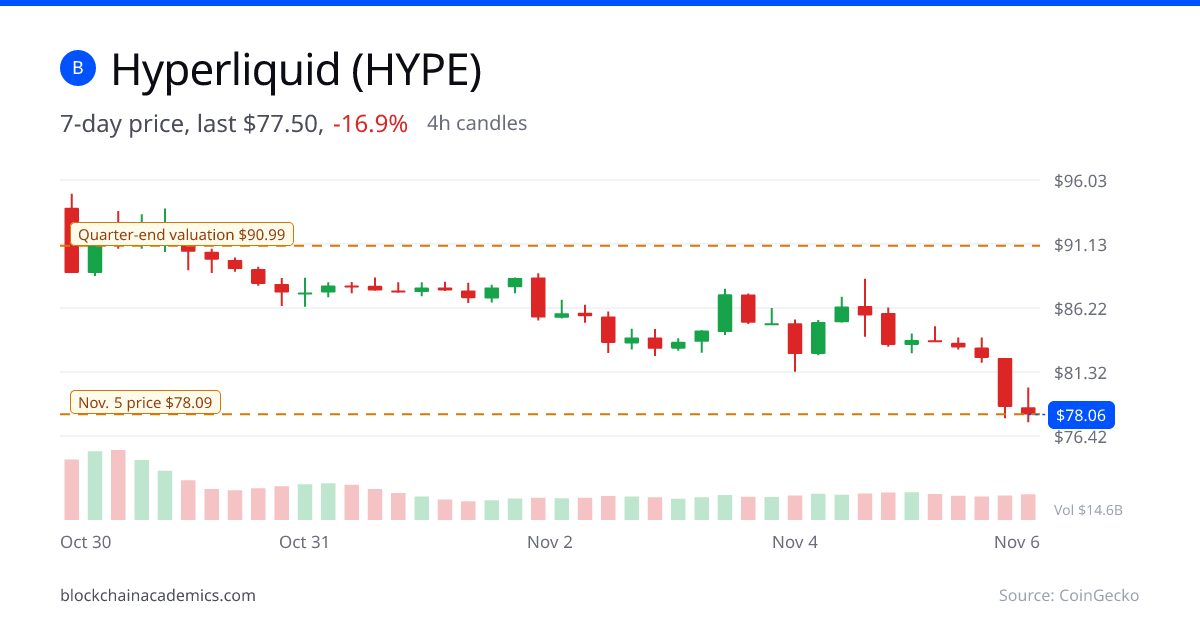
That gap matters. Because the holdings are marked to market, a price that stays below the quarter-end mark could weigh on the next quarter's earnings, while the $12.3 million in staking and validator income is the part of revenue that recurs regardless of price. Issuing $911 million in equity also expands the share count, so shareholder benefit depends on HYPE held per share rather than total tokens.
What it means
The release shows a treasury vehicle trying to become more than a passive holder: staking income covers a sliver of earnings, while a regulated FCM role would tie the company to U.S. perp distribution. Whether that happens depends on a CFTC decision with no stated timeline, and regulatory delays could push back any market entry.