DOJ and CFTC Sue Arkansas to Block State Case Against Kalshi
The Justice Department and CFTC filed a federal suit against Arkansas, seeking to halt its enforcement case against Kalshi and to protect other CFTC-regulated exchanges, their affiliates and partners. Arkansas says the contracts are gambling; no judge has ruled.
Arkansas's gambling case against Kalshi now faces the federal government itself. The US Justice Department and the CFTC sued the State of Arkansas on November 12. They are asking a federal court to halt the state's enforcement action against the prediction-market operator and to shield other CFTC-regulated exchanges from similar state action.
The complaint was filed in the US District Court for the Eastern District of Arkansas. It names the state and Attorney General Tim Griffin in his official capacity. Kalshi is not a party. The government is suing on its own behalf, which makes this a direct federal challenge to a state rather than a company defending itself. The case is captioned USA v. State of Arkansas.
The preemption argument
Federal lawyers contend that the Commodity Exchange Act gives the CFTC exclusive authority over derivatives traded on designated contract markets, including the event contracts Arkansas has targeted. If that holds, state gambling law cannot reach them. This is federal preemption, and it works much like a deed to a plot of land: once Congress has staked out a field, a state cannot build its own rules on the same ground. Michael Selig put it plainly:
"Congress entrusted the CFTC to be the federal regulator with sole responsibility to oversee these markets."
Michael Selig, CFTC
The complaint asks the court to declare Arkansas's restrictions preempted. It also seeks preliminary and permanent injunctions against investigations and enforcement actions aimed at registered markets, with protection extending to their affiliates and business partners. No judge has ruled.
What Arkansas alleges
Griffin sued KalshiEX LLC and Kalshi Inc. on November 4 in Independence County Circuit Court, as we reported in our earlier coverage. The 57-page complaint alleges unlicensed gambling and violations of the Arkansas Deceptive Trade Practices Act. It seeks an injunction, restitution, unpaid taxes and civil penalties. These are allegations, not findings.
Griffin has rejected the idea that calling a wager a contract changes how state law treats it:
"Arkansas law is concerned with substance, not semantics."
Tim Griffin, Arkansas Attorney General
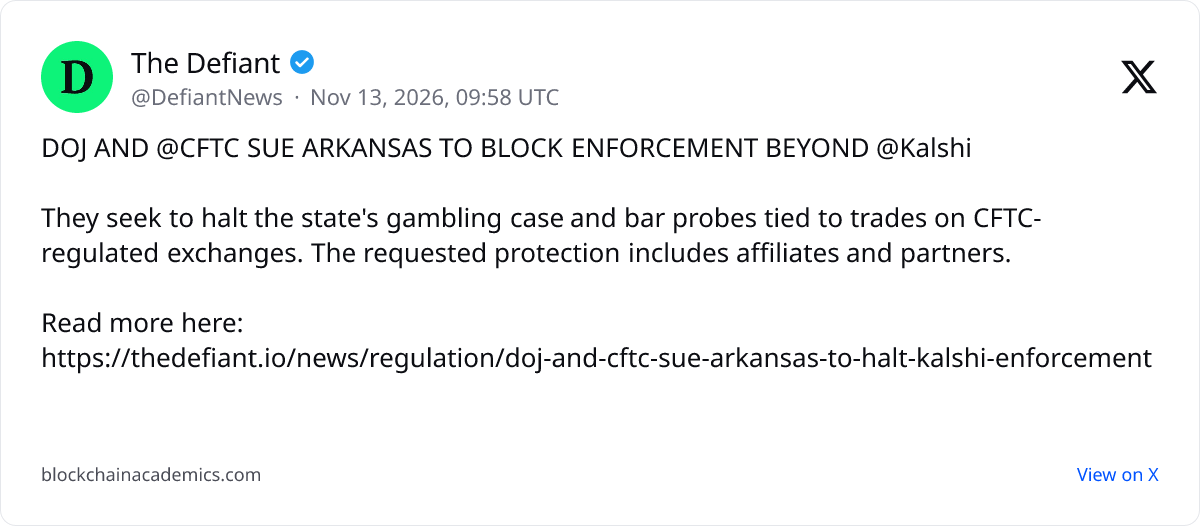
On X, the filing was summarized as a bid to block enforcement beyond Kalshi, reaching affiliates and partners as well.
A widening map of disputes
Gaming lawyer Daniel Wallach identified Arkansas as the eleventh state the CFTC has sued over prediction-market oversight, after Arizona, Connecticut, Illinois, Kentucky, Minnesota, New Mexico, New York, Rhode Island, Utah and Wisconsin. The Utah suit was announced October 27.
Arkansas is also fighting on a second front. Polymarket US and OG.com, associated with Crypto.com, sued Griffin and state gaming officials on November 9 over restrictions on their event contracts.
The federal posture has hardened in other ways too. On November 5 the CFTC published guidance on impartial access, saying exchanges generally cannot block otherwise eligible US traders based only on domestic location; they have 30 days from that notice to end non-compliant geographic blocks. The agency has also proposed rules that would define event contracts as swaps.
Why it matters
Courts have not converged. A California federal judge issued a preliminary injunction on November 4 restricting Kalshi sports contracts on two tribes' lands, and Louisiana obtained a ten-day temporary restraining order against operators, with a hearing set for November 30. New Jersey's dispute with Kalshi has reached the Supreme Court as a petition for review.
Against that patchwork, the federal government is no longer leaving the preemption question to operators defending themselves one state at a time. By suing states directly and asking for relief that covers registered exchanges, their affiliates and partners, the CFTC is pressing the argument on its own terms. Arkansas maintains these products are gambling under its own laws, and no court has found that Kalshi broke state law.