
Bitcoin Drops to $78,442 After Warsh Hawkish Pivot; Corporate Buyers Step In
Fed Chair Kevin Warsh's hawkish Jackson Hole remarks sent Bitcoin tumbling to $78,442, down 3.2% in 24 hours. But beneath the price action, corporate treasury strategies and a shifting correlation toward gold suggest institutional adoption is accelerating despite macro headwinds.
Bitcoin Drops to $78,442 After Warsh Hawkish Pivot; Corporate Buyers Step In
Fed Chair Kevin Warsh's Jackson Hole address on Friday delivered the bluntest inflation warning of his tenure, and Bitcoin paid for it immediately. The asset slid to $78,442, down 3.2% in 24 hours, snapping a run that had carried it past $81,000 resistance earlier in the week. Prediction markets moved fast: September rate hike odds jumped to 59% within hours of his remarks.
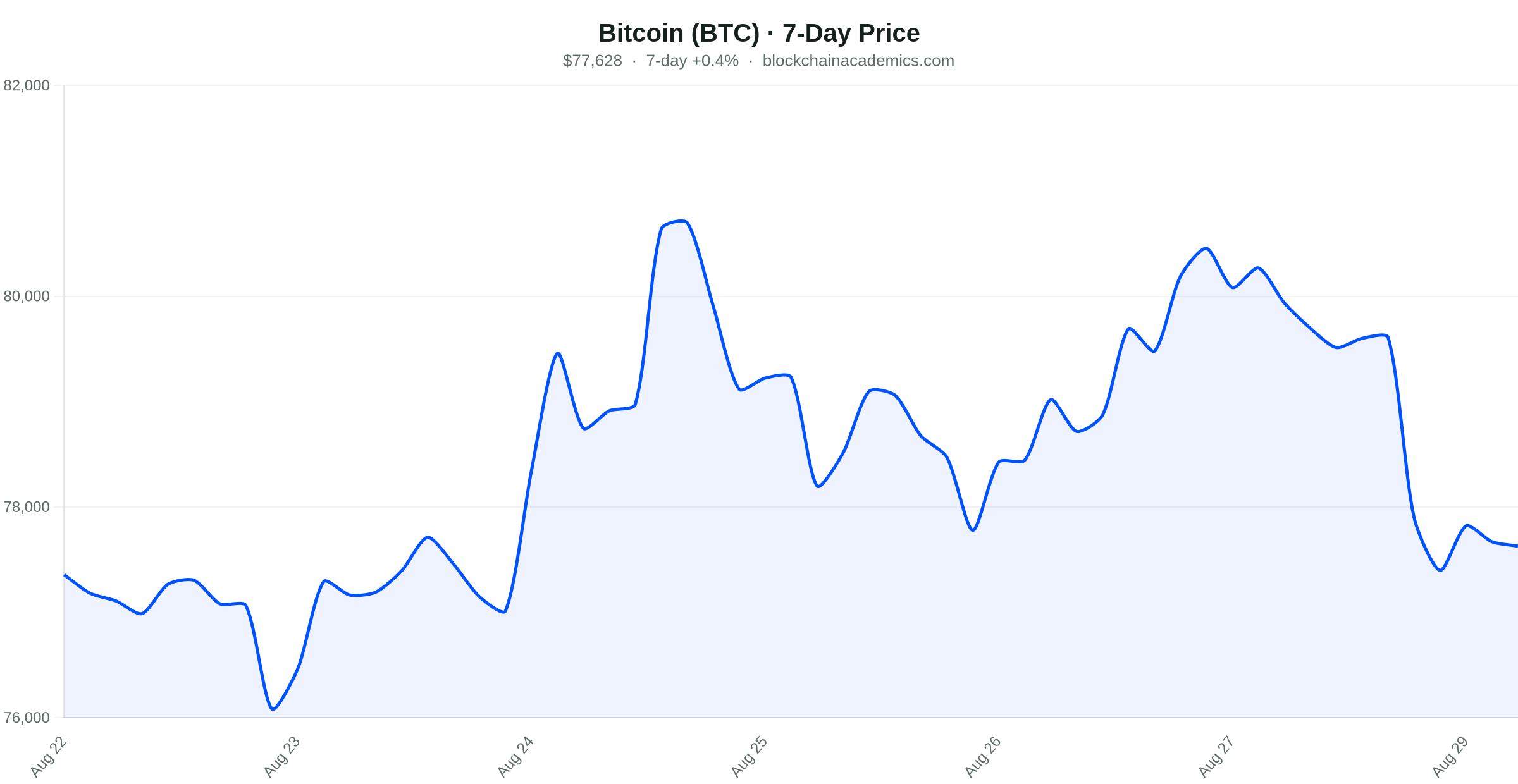
The selloff wiped out the tail end of a strong ETF inflow streak. Spot Bitcoin ETFs recorded $202 million in net outflows, ending nine consecutive days of positive flows that had contributed to a roughly $3 billion cumulative surge. A single bad macro day can unwind weeks of patient accumulation. That's the reality of trading an asset that still has one foot in the risk-on bucket. Still, zoom out slightly and the picture is less grim: Bitcoin is up 3% over the past seven days, and the $78,000 level has held as near-term support.
The more interesting story is what's happening beneath the price action. Bitfinex analysts flagged a structural shift this week, arguing that Bitcoin is decoupling from Nasdaq-correlated behavior and moving closer to gold's price dynamics. Their reasoning centers on the debasement trade: U.S. national debt crossed $40 trillion, and investors looking for a hedge against fiscal deterioration are increasingly treating Bitcoin and gold as substitutes rather than separates.
"Analysts from Bitfinex stressed that this regime change comes as the debasement trade narrative takes center stage once again, with bitcoin starting to be considered, alongside gold, as a hedge against deteriorating fiscal and monetary fundamentals."
Bitfinex Research
Grayscale's research team made a similar call, stating plainly that the debasement trade is benefiting Bitcoin. If that framing sticks, Warsh's hawkishness is actually a double-edged sword: tighter policy that fails to tame inflation reinforces the case for hard assets, including BTC. The bear scenario is simpler. If Warsh signals multiple hikes and inflation data cooperates, fixed-income yields become genuinely competitive and risk assets, including Bitcoin, face sustained rotation pressure.
Corporate treasury activity this week suggests at least some institutions are treating the dip as an entry point rather than an exit. Cardone Capital, the $5.3 billion private equity firm run by Grant Cardone, purchased an additional 1,200 BTC and disclosed a strategy of using rental cash flows from roughly 2,000 multifamily units to fund ongoing Bitcoin purchases. Strive raised $100 million through preferred equity and continued buying. Metaplanet's U.S. subsidiary raised $2.3 million through its first at-the-market offering, extending what the firm describes as a Japan-U.S. capital bridge approach. None of these are MicroStrategy-scale moves, but the pattern of real-economy cash flows being converted into Bitcoin is a different kind of institutional adoption than ETF flows. It's slower, stickier, and less sensitive to a single Fed speech. This mirrors the broader trend of corporate Bitcoin treasury strategies gaining traction, as Evernorth's XRP treasury vehicle recently cleared an SEC hurdle on its way to a Nasdaq listing, suggesting regulators are growing more comfortable with crypto-native balance sheet strategies.
On-chain signals are mixed. Long-dormant wallets, untouched for a decade, moved $40 million worth of Bitcoin this week. Critically, on-chain data shows most of that supply avoided exchanges, which reduces the immediate liquidation risk. Ireland's Criminal Assets Bureau separately moved 500 BTC ($38 million) from seized drug dealer holdings, another supply overhang worth watching. Meanwhile, Ethereum's exchange balance has dropped by 1.4 million ETH since June, suggesting holders are pulling coins into self-custody. Bitcoin's exchange balance moved slightly in the opposite direction this week, a modest but notable divergence.
The macro setup heading into September is genuinely uncertain. The 2022-2023 rate hike cycle offers a cautionary reference point: Bitcoin fell roughly 75% peak-to-trough as the Fed tightened aggressively. But the institutional infrastructure that exists now. ETFs, corporate treasuries, regulated custody. simply did not exist at that scale four years ago. The debasement trade thesis also has limits. Gold correlation cuts both ways: if macro sentiment stabilizes and gold retreats, Bitcoin follows. And corporate treasury strategies, while growing, remain a small fraction of overall market structure. A sharp BTC drawdown could reverse the trend quickly if balance sheets start showing paper losses.
What Friday's move clarified is that $81,000 is real resistance and $78,000 is where buyers showed up. The next meaningful test comes with September's CPI print and whatever the Fed signals in the weeks following Jackson Hole. Prediction markets are leaning bullish on BTC despite the Warsh-driven volatility, but prediction markets have been wrong before. The debasement trade is a thesis, not a guarantee. Position accordingly.