Anza Proposes Solana Validators Drop Blocks That Lost Consensus
Anza developer Philippe Laferrière filed a Nov. 23 draft letting Solana validators stop replaying blocks that already lost to a finalized rival. It depends on a scheduler change landing first, and Anza has published no savings estimates or release dates.
Solana validators can burn compute finishing blocks the network has already rejected. A new Anza proposal would let them walk away the moment a rival version is finalized.
Anza developer Philippe Laferrière submitted the GitHub proposal on Nov. 23. It targets Agave, Solana's main validator client, and specifically replay: the part of validator software that executes transactions in blocks received from other participants and verifies the resulting state changes.
Here is the problem. Validators can receive competing versions of a block for the same slot, and they may start executing one before the network settles on which is accepted. If the other version is finalized midway, whatever work remains on the loser is wasted.
The pull request simplifies an earlier approach that explored temporarily pausing work on competing blocks while keeping the option to resume. The new version drops the resume path and uses finalization as the trigger to stop for good.
Draft status and open questions
Don't expect this on mainnet soon. The proposal is still a draft and depends on a separate Anza effort to reduce transaction scheduling delays being merged into Agave first.
Anza also has not published estimates of how often validators hit competing blocks, or how much compute the change would recover. No release dates have been given either. So the logic is clean, but the upside is unquantified.
Where it fits
The proposal follows the Oct. 21 rollout of Alpenglow, Anza's redesign of Solana consensus aimed at cutting finality from roughly 12.8 seconds to about 150 milliseconds. Alpenglow removed validator votes from blocks, and operators now pay a flat admission fee of 0.8 SOL per epoch rather than fees on individual vote transactions.
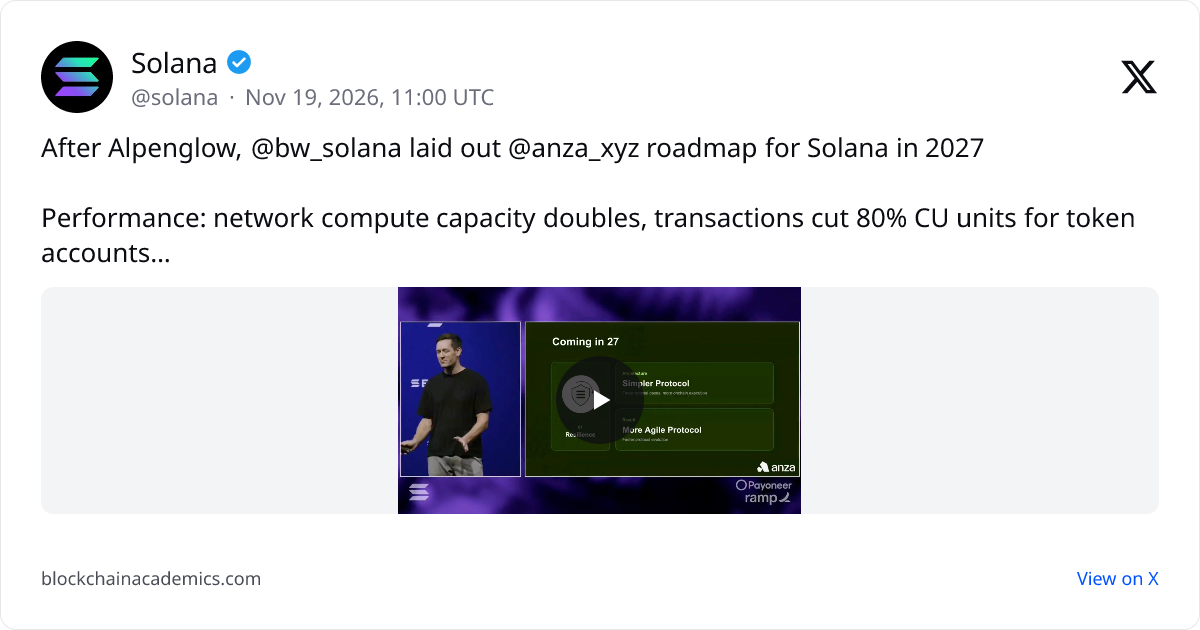
This is plumbing, not a headline feature, but it fits Anza's wider push. At Solana Breakpoint in London, Anza CEO Brennan Watt outlined a 2027 roadmap that includes doubling compute capacity and cutting compute units for token account transactions by 80%. It also lists further Alpenglow improvements and Constellation, a mechanism for more predictable transaction ordering. Solana's Nov. 19 post summarizing the roadmap pitched the direction as a "simpler protocol with fewer special cases, safer to change."
For traders, nothing here moves fees or throughput today. If the savings prove meaningful, that is compute validators get back. Until Anza publishes numbers on how often validators actually replay losing blocks, treat it as housekeeping with upside, not a catalyst.