

Bitcoin Halving Explained
Bitcoin was designed with a hard ceiling: only 21 million coins will ever exist. The mechanism that enforces this scarcity is the halving, a scheduled event baked into Bitcoin's code that cuts the reward miners receive for processing transactions by exactly 50 percent roughly eve
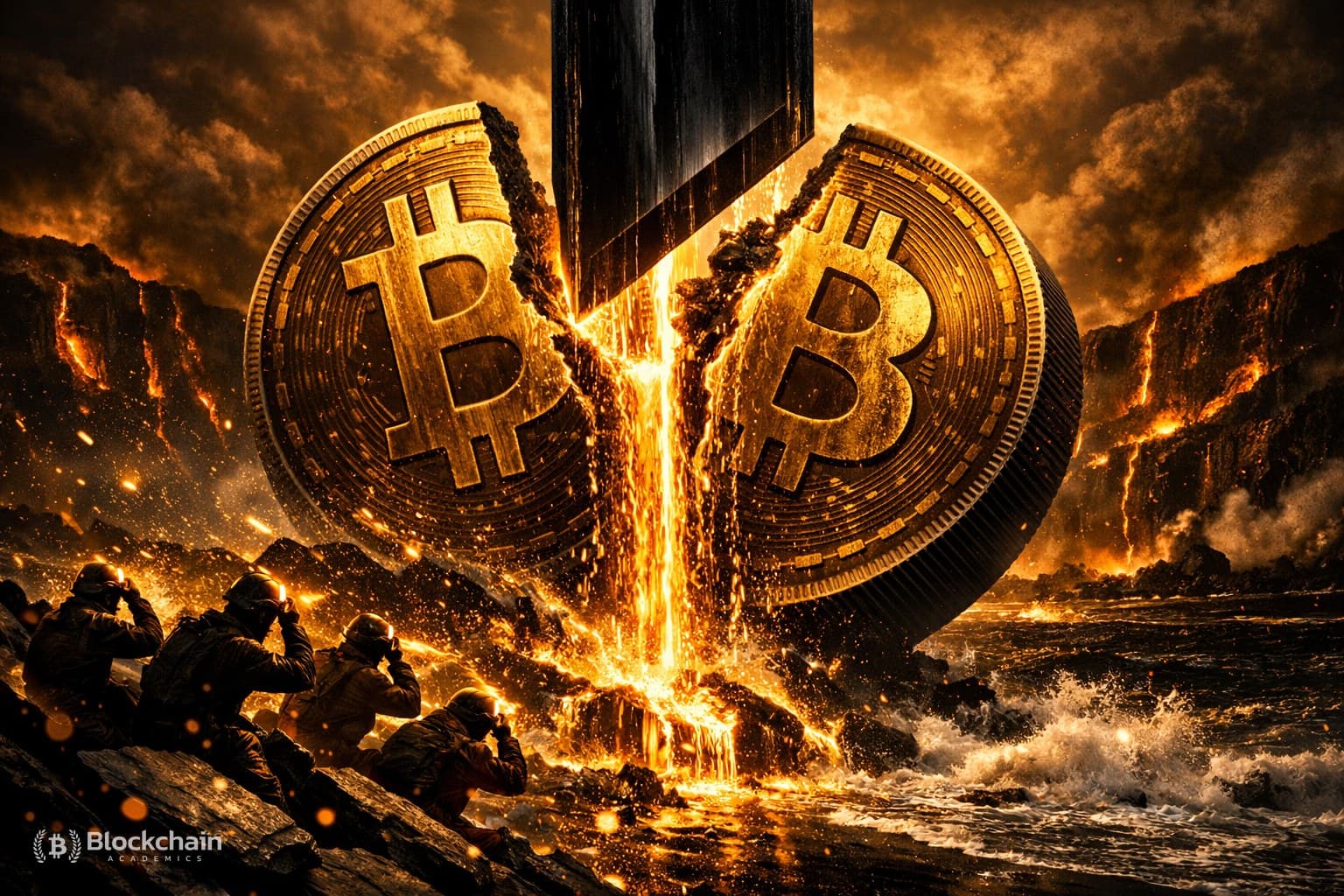
Bitcoin was designed with a hard ceiling: only 21 million coins will ever exist. The mechanism that enforces this scarcity is the halving, a scheduled event baked into Bitcoin's code that cuts the reward miners receive for processing transactions by exactly 50 percent roughly every four years. Understanding the halving means understanding one of the most fundamental forces shaping Bitcoin's economics.
The halving is not a policy decision made by any company, committee, or government. It is an automatic rule written into the Bitcoin protocol itself, running the same way it always has since the network launched in January 2009. That makes it one of the most predictable events in all of finance, and one of the most studied.
Why the Halving Exists
To understand the halving, you first need a quick picture of how new Bitcoin enters the world.
Bitcoin transactions are grouped into blocks and added to a shared, public record called the blockchain. The people who do this work are called miners. They run specialized computers that compete to solve a mathematical puzzle, and the winner earns the right to add the next block. As payment, that miner receives a set number of newly created bitcoin, called the block reward.
Satoshi Nakamoto, Bitcoin's pseudonymous creator, set the initial block reward at 50 BTC per block. But Satoshi also wrote a rule: every 210,000 blocks added to the chain, that reward is cut in half. At roughly ten minutes per block, 210,000 blocks takes approximately four years. This periodic cut is the halving.
The purpose is straightforward. By reducing the rate at which new bitcoin enters circulation, Bitcoin mirrors the behavior of scarce commodities like gold, which become progressively harder and more expensive to extract over time. Unlike a central bank that can print more currency on demand, Bitcoin's issuance schedule is fixed and transparent, visible in the code for anyone to audit.
How the Math Works
The halvings follow a predictable sequence. When the block reward halves repeatedly, the total supply approaches 21 million but never quite reaches it, because each halving cuts an already small number in half again. Miners will still receive new bitcoin until approximately the year 2140, at which point the reward will round down to effectively zero.
Here is how the major events have unfolded:
- November 2012 (block 210,000): Reward drops from 50 BTC to 25 BTC
- July 2016 (block 420,000): Reward drops from 25 BTC to 12.5 BTC
- May 2020 (block 630,000): Reward drops from 12.5 BTC to 6.25 BTC
- April 2024 (block 840,000): Reward drops from 6.25 BTC to 3.125 BTC
More than 93 percent of all bitcoin that will ever exist has already been mined. The halvings ensure the remaining supply is released slowly over more than a century.
What Changes for Miners
Miners are businesses. They pay for electricity, hardware, cooling, and staff. When the block reward halves overnight, their revenue from each block they mine drops by 50 percent while their costs stay the same.
This creates real pressure. Miners operating with thin profit margins, often those using older, less efficient hardware or paying higher electricity rates, may find it no longer profitable to keep their machines running. They shut down, and the total computing power dedicated to the network, called the hashrate, can fall as a result.
Bitcoin's protocol has a self-correcting mechanism for exactly this situation. The difficulty of the mathematical puzzle miners solve adjusts automatically every 2,016 blocks, roughly two weeks, based on how much computing power is active. If many miners drop off, the puzzle gets easier, reducing costs for those who remain and helping the network return to its steady rhythm of roughly one block every ten minutes. If more miners join, the puzzle gets harder.
Over time, miners have historically compensated for declining block rewards in two ways. First, they have adopted more efficient hardware that produces more computation per unit of energy. Second, they earn transaction fees, small amounts of bitcoin attached to transactions by users who want their transaction processed quickly. As the block reward shrinks toward zero over the coming decades, transaction fees are expected to become miners' primary income source. Whether fees alone can sustain a robust, secure network is one of the most important open questions in Bitcoin's long-term design.
What It Means for Holders
For people who hold bitcoin rather than mine it, the halving matters because of supply and demand mechanics. Before each halving, miners collectively produce a certain number of new coins per day and, in aggregate, some fraction of those coins get sold on the open market to cover operating costs. After the halving, the daily production of new coins is cut in half. If demand for bitcoin remains constant or grows, a reduction in new supply creates upward pressure on price.
Each of the first three halvings was followed by a significant increase in bitcoin's price over the 12 to 18 months after the event. The 2012 halving preceded the run from roughly $12 to over $1,000. The 2016 halving preceded the climb to nearly $20,000 by the end of 2017. The 2020 halving preceded the move to roughly $69,000 in late 2021.
Correlation is not causation, however. Each of those periods also involved growing mainstream awareness, the entry of new categories of buyers, and macroeconomic conditions that boosted appetite for risk assets broadly. Isolating the halving's specific contribution to any price move is genuinely difficult. What the halving reliably does is reduce the mechanical selling pressure from miners. What markets make of that reduction is a separate question.
Risks and Common Mistakes
Treating past halvings as a guaranteed playbook. The first three halvings happened when Bitcoin was a young, growing network reaching new audiences. Past patterns may not repeat, and investors who treat them as a certainty have historically been disappointed when reality diverges from the template.
Ignoring the miner revenue squeeze. In the months immediately after a halving, some miners do shut down. This is normal and the difficulty adjustment handles it, but it can create temporary volatility in network conditions. New entrants to Bitcoin should understand that a halving is a stress test for miners, not just a reward for holders.
Confusing the halving with Bitcoin's only scarcity mechanism. The 21 million coin cap is the fundamental constraint. The halving is the schedule by which that cap is enforced. They work together, but they are not the same thing.
Expecting an immediate price response. Markets often move in anticipation of known events. By the time a halving occurs, sophisticated market participants have been preparing for months. A "buy the rumor, sell the news" dynamic has played out around halvings before, where prices rise heading into the event and then plateau or even dip shortly after.
If you want to go deeper on Bitcoin fundamentals and understand how these mechanisms connect to wallets, transactions, and network security, the BCA Academy has structured courses built for exactly that.
Frequently Asked Questions
How Do We Know When the Next Halving Will Happen?
Bitcoin targets one block every ten minutes, and a halving occurs every 210,000 blocks. You can watch the current block height, the count of blocks added to the chain so far, and calculate roughly how many blocks remain until the next halving. Because block times vary slightly, the exact calendar date shifts over time, but the block number never does.
Can the Halving Schedule Ever Be Changed?
Technically, it would require a change to Bitcoin's source code. In practice, any such change would need near-universal agreement from miners, node operators, developers, and users. The fixed issuance schedule is considered one of Bitcoin's core social contracts, and any attempt to alter it would be extraordinarily controversial and likely result in a split of the network.
Does the Halving Affect Transaction Fees?
The halving does not directly change transaction fees. Fees are set by users based on how quickly they want their transaction confirmed, and they fluctuate with network demand. Indirectly, though, as block rewards shrink, miners become more dependent on fee revenue, which creates long-term incentives for higher fee environments.
What Happens When All 21 Million Bitcoin Have Been Mined?
No new bitcoin will be created, and miners will earn only transaction fees for their work. Whether those fees will be sufficient to maintain a large, secure mining industry is a genuine open question that researchers and developers continue to study. It will not become relevant until well into the 22nd century, giving the ecosystem a long runway to develop solutions.