Zcash Surges 40% After Multicoin Capital Discloses Major ZEC Position
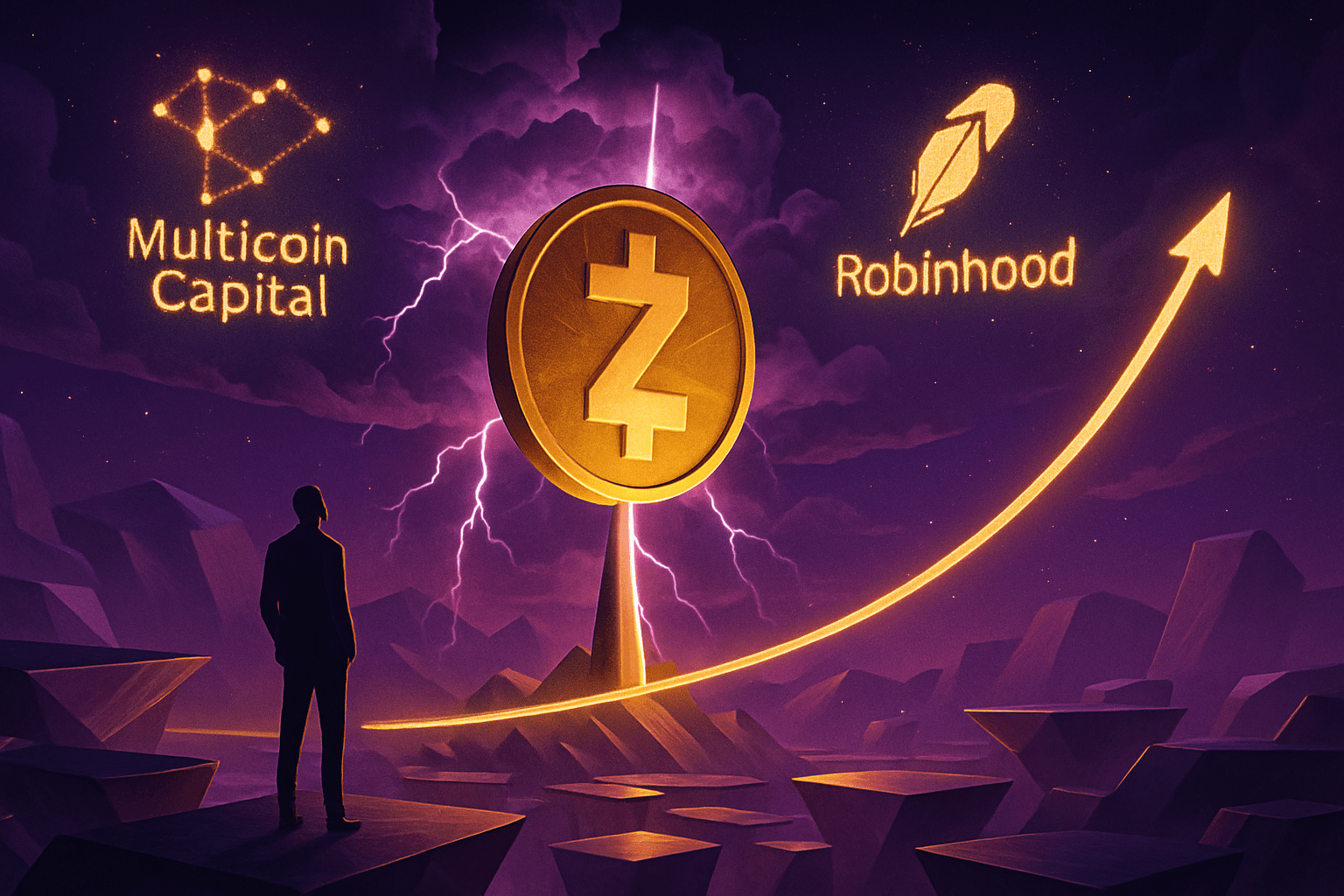
Zcash surged 40% on May 6, 2026, after Multicoin Capital disclosed a significant ZEC stake accumulated since February. The token hit $600, pushing its market cap to $10B, as Robinhood's listing and easing US-Iran tensions added fuel.
Zcash Surges 40% After Multicoin Capital Discloses Major ZEC Position
Zcash (ZEC) jumped roughly 40% on May 6, 2026, after Multicoin Capital co-founder Tushar Jain confirmed the firm has been accumulating a significant ZEC stake since February, citing wealth seizure risks and intensifying regulatory scrutiny as the core investment thesis. The token briefly touched $600, setting a new year-to-date high and pushing its market cap to approximately $10 billion.
The rally did not materialize in isolation. ZEC had already gained 80% in the six days prior to Multicoin's disclosure, erasing all of its 2026 losses in a compressed timeframe. Over the trailing seven days, the token was up 69%. The Multicoin announcement acted as an accelerant on an already-heated trade, compressing months of price recovery into a single week.
Jain framed the position explicitly around macro risk. Multicoin cited the threat of government wealth seizure and growing regulatory pressure on financial assets as reasons to hold a privacy-preserving asset. The firm confirmed it has been buying ZEC since February and has built a significant position, with wealth seizure risks cited as a primary catalyst for holding private assets. The thesis is not purely technical. It reflects a broader institutional argument that shielded transactions, enabled by Zcash's zk-SNARK cryptography (zero-knowledge proofs that allow transaction validation without revealing sender, receiver, or amount), offer a hedge against state overreach in an era of expanding capital controls and wealth taxation proposals.
Several additional catalysts reinforced the move. Robinhood's listing of ZEC opened the asset to millions of retail accounts that previously lacked direct access. Easing US-Iran tensions reduced broader risk-off pressure across crypto markets. Supply dynamics also played a role: ZEC's circulating supply is capped, and with Multicoin accumulating since February, liquid supply on exchanges appears to have tightened meaningfully heading into the disclosure. At peak momentum, ZEC briefly surpassed Monero (XMR) by market capitalization, a notable inversion given Monero's longer track record and its historical dominance as the benchmark privacy coin.
The counter-case deserves equal attention. On-chain data showed concurrent inflows and outflows during the rally, a pattern consistent with institutional accumulation being partially offset by retail profit-taking. A 40% single-session move in any asset carries mean-reversion risk, and ZEC is no exception. Privacy coins also face persistent regulatory headwinds globally. Several jurisdictions have pushed exchanges to delist privacy assets entirely, and a policy reversal or new enforcement action could rapidly unwind the current bullish positioning. Monero's technical privacy model, which uses ring signatures and stealth addresses to make all transactions private by default, remains more battle-tested than Zcash's optional shielding. The majority of ZEC transactions historically use transparent addresses, which undermines the privacy narrative if adoption of shielded transactions does not accelerate alongside price. Multicoin's concentrated position also introduces concentration risk: any rebalancing by the firm could generate significant selling pressure.
For the broader privacy coin market, the Multicoin disclosure marks a meaningful shift in how institutional capital is thinking about financial privacy as an asset class. The wealth taxation narrative has circulated in macro circles for years, but attaching it to a specific, sizable crypto position from a recognized fund adds institutional credibility to a thesis that previously lived mostly in retail forums. If the regulatory environment continues to tighten around traditional financial assets, and if wealth tax proposals advance in major economies, demand for assets with strong privacy properties could sustain beyond a single-week trade. Whether ZEC specifically captures that demand long-term depends on whether its shielded transaction adoption grows to match the privacy promise its price now reflects.