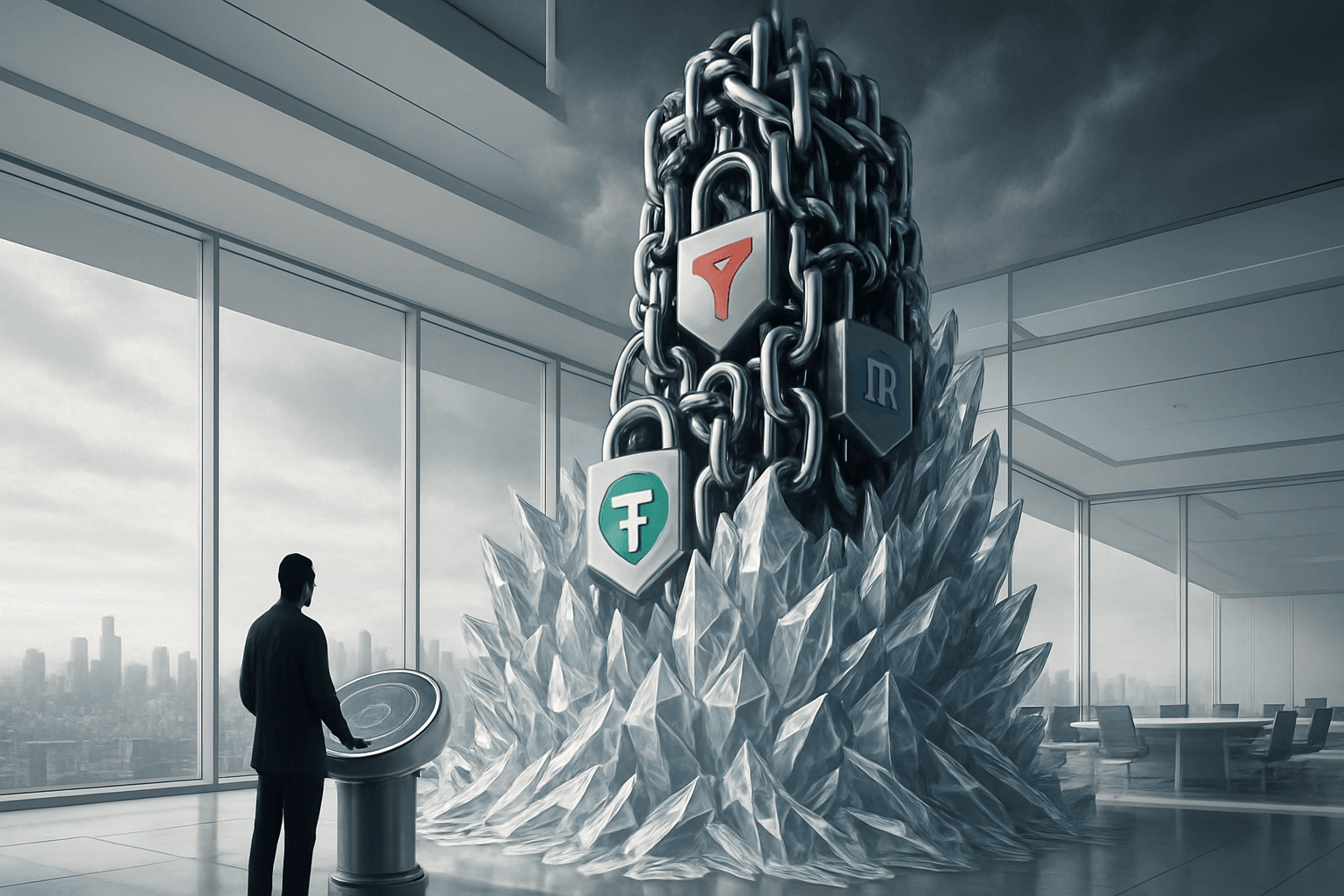
Tether, TRON, and TRM Labs Freeze $450M in Illicit Crypto
The T3 Financial Crime Unit, a public-private partnership between Tether, TRON, and TRM Labs, has frozen over $450 million in suspected illicit assets since 2024 and reported a 43.9% year-over-year increase in intercepted illicit proceeds during 2025.
Tether, TRON, and TRM Labs Freeze $450M in Illicit Crypto
The T3 Financial Crime Unit, a public-private partnership between stablecoin issuer Tether, blockchain platform TRON, and blockchain intelligence firm TRM Labs, has frozen over $450 million in suspected illicit assets since launching in 2024. The unit reported a 43.9% year-over-year increase in intercepted illicit proceeds during 2025, signaling accelerating enforcement activity across crypto markets.
T3 operates across 23 jurisdictions and coordinates directly with law enforcement agencies worldwide. The initiative represents one of the crypto industry's most visible compliance efforts, positioning major platforms as active partners in combating financial crime rather than passive infrastructure. The frozen assets span multiple categories of illicit activity, though the unit has not publicly detailed the breakdown between sanctions violations, ransomware proceeds, drug trafficking, and other criminal categories.
The 43.9% increase raises a critical question: does the surge reflect improved detection capabilities or accelerating illicit activity? Sources do not clarify which dynamic is driving the numbers. If detection has improved, T3's technical infrastructure and law enforcement coordination are working effectively. If illicit flows are actually accelerating, the $450 million frozen may represent a small fraction of total criminal crypto activity, limiting the initiative's practical impact on the broader problem.
Tether's central role in T3 carries strategic weight. The stablecoin issuer has faced sustained regulatory scrutiny over reserve transparency and compliance practices. By leading a high-profile enforcement unit, Tether signals commitment to regulatory cooperation and positions itself as a responsible actor in an industry often viewed as a haven for financial crime. Critics may view the initiative as a public relations counterweight to ongoing regulatory challenges rather than a genuine commitment to combating illicit activity.
The partnership structure itself is notable. TRON's involvement reflects the blockchain's growing prominence in stablecoin infrastructure, while TRM Labs brings forensic expertise developed through years of on-chain analysis for exchanges and regulators. This combination of issuer, platform, and intelligence firm creates a closed-loop system: TRM identifies suspicious transactions, TRON's validators can facilitate freezes, and Tether's dominance in stablecoin markets gives the unit enforcement leverage.
Asset freezing without prosecution or asset recovery has limited real-world impact. Frozen funds do not automatically translate to criminal convictions or restitution to victims. Law enforcement agencies must still conduct investigations, build cases, and navigate jurisdictional complexities. T3's role is preventive and intelligence-sharing rather than prosecutorial, which constrains its effectiveness in disrupting organized criminal operations.
The expansion to 23 jurisdictions positions T3 as a quasi-regulatory body operating across borders where traditional law enforcement cannot easily reach. This raises questions about due process and financial freedom. Privacy advocates argue that enhanced surveillance mechanisms and asset freezing without transparent judicial oversight create risks of overreach. The crypto industry's libertarian roots have always been skeptical of centralized gatekeeping, even when framed as crime-fighting.
For regulators, T3's success is valuable. The initiative demonstrates that the industry can self-police, reducing pressure for heavy-handed government intervention. For Tether and TRON, the unit serves dual purposes: legitimacy and market control. By controlling which transactions flow through their infrastructure, they gain influence over crypto's financial plumbing.
The 43.9% increase in intercepted proceeds will likely be cited by both industry advocates and regulators to support their respective positions. Advocates will point to it as evidence that crypto's compliance infrastructure is maturing. Skeptics will note that $450 million frozen since 2024 is modest relative to the scale of illicit crypto flows estimated by law enforcement, and that the year-over-year increase could signal a growing problem rather than a solution.
T3's trajectory will depend on whether it can maintain public-private coordination while avoiding perception of corporate gatekeeping. The unit's effectiveness will ultimately be measured not by frozen assets but by criminal convictions, asset recovery, and demonstrable reduction in illicit activity on major blockchains. For now, the numbers suggest an initiative gaining momentum, but the gap between enforcement activity and actual impact remains unclear.