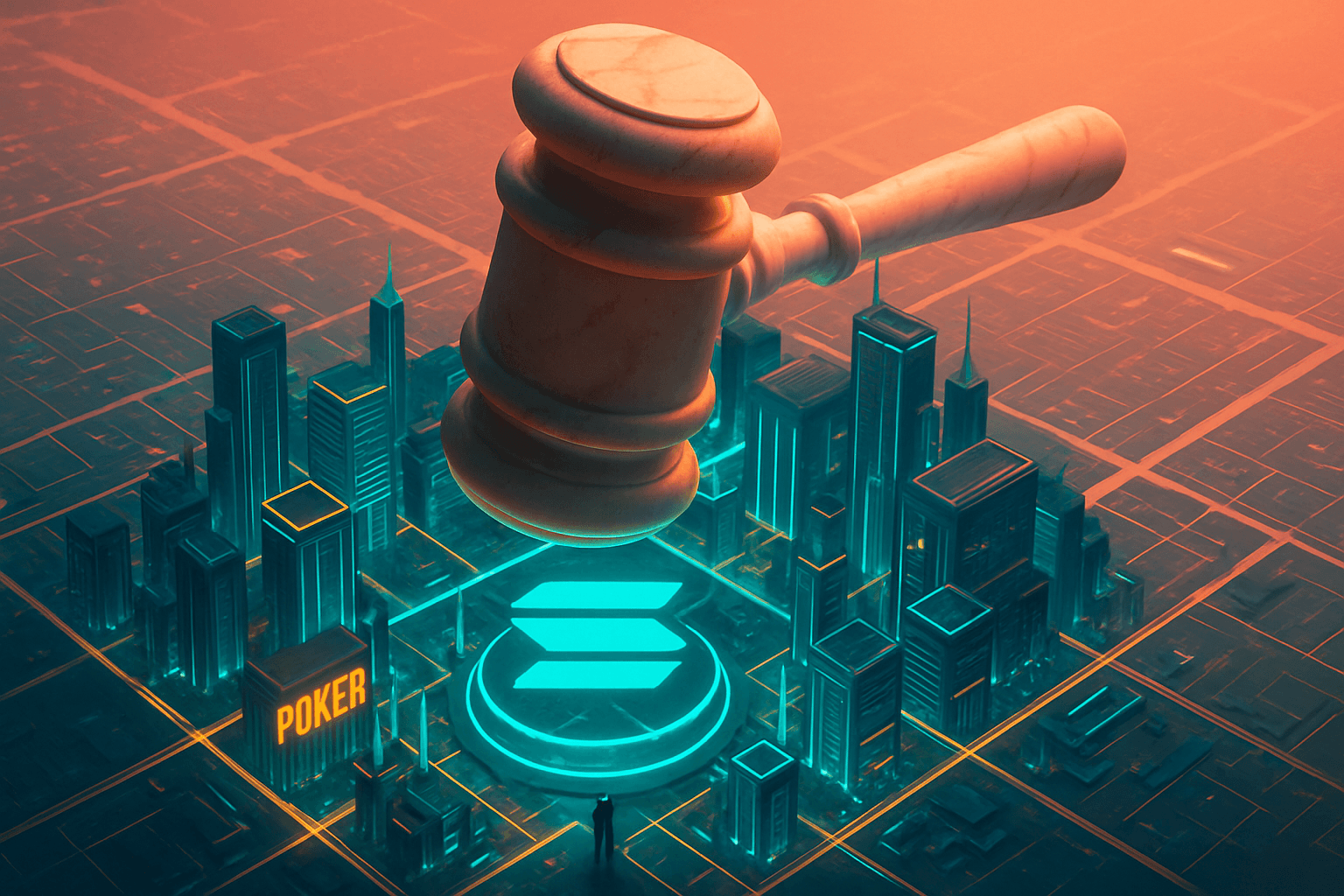
Solana Secures WSOP Sponsorship and WalletConnect Pay Integration
Solana has secured two major mainstream partnerships in a single day: World Series of Poker 2026 now accepts SOL for tournament buy-ins with zero processing fees, while WalletConnect Pay integrated Solana support for instant merchant payments in SOL, USDC, and USDT.
Solana Secures WSOP Sponsorship and WalletConnect Pay Integration
Solana has landed two significant mainstream partnerships in a single day, marking an escalation in the blockchain's bid to move beyond speculation into real-world payment infrastructure. The World Series of Poker 2026 announced Solana as its official Presenting sponsor on June 10, enabling players to pay tournament buy-ins directly with SOL at zero processing fees. On the same day, WalletConnect Pay integrated Solana support, allowing merchants to accept instant payments in SOL, USDC, and USDT.
The dual announcement signals coordinated momentum across two distinct adoption vectors: consumer-facing entertainment and merchant infrastructure. For WSOP, the integration removes a friction point that has historically deterred mainstream adoption of crypto payments. Players can now fund their tournament entries without converting to fiat or paying processing fees, a direct competitive advantage over traditional payment rails. For WalletConnect Pay, Solana integration expands the protocol's merchant reach, offering businesses a faster, cheaper alternative to card networks for point-of-sale transactions.
According to the Solana Foundation's official announcement, players can enter tournaments directly with crypto on Solana with zero processing fees. This framing targets a specific pain point: traditional payment processors charge 2-3% per transaction, eating into both player winnings and operator margins. By eliminating those fees, WSOP signals confidence that Solana's network can handle high-volume, low-latency settlement at scale. The partnership also carries symbolic weight. Poker is a high-stakes, trust-intensive vertical where participants are accustomed to managing risk. A major gaming operator betting on Solana legitimizes the blockchain in the eyes of institutional players and casual enthusiasts alike.
WalletConnect Pay's integration extends the reach beyond gaming. The protocol, which enables wallet-to-merchant communication, now supports Solana alongside existing blockchains. This matters because WalletConnect is infrastructure-layer software used by thousands of dApps and merchants. Every integration broadens the surface area for Solana adoption. Stablecoin support (USDC and USDT) is particularly relevant for merchants, who avoid the volatility risk of holding SOL directly. A poker player might accept a tournament payout in SOL, but a coffee shop prefers USDC.
The timing underscores Solana's recovery narrative. Following network outages and validator issues in 2023, the blockchain has pursued a deliberate strategy of high-profile partnerships to restore credibility. This year alone, the Solana Foundation has prioritized payments and infrastructure over speculation-driven announcements. WSOP and WalletConnect Pay fit that pattern: both are real-world use cases that require reliable settlement and low latency, the exact strengths Solana has invested heavily to rebuild.
Significant hurdles remain before these announcements translate to sustained adoption. Regulatory risk looms large. Gaming and poker transactions operate in a complex patchwork of state and federal jurisdictions. Crypto payments could trigger compliance challenges for WSOP operators, particularly around anti-money-laundering and know-your-customer requirements. Solana's speed and low fees solve a technical problem, not a legal one.
Onboarding friction poses another barrier. Most WSOP players are not crypto-native. Setting up a wallet, securing a seed phrase, and managing private keys represents friction that zero fees alone may not overcome. Industry precedent suggests that even compelling technical advantages struggle to drive adoption when user experience friction is high. PayPal's stablecoin initiatives and Visa's crypto partnerships faced similar headwinds, despite strong branding and distribution.
The announcements also benefit Solana exclusively, rather than establishing broader industry precedent. Ethereum, Polygon, and other blockchains are absent from both integrations. This concentration risk means the partnerships validate Solana's technology but may not signal a shift toward crypto payments as a category. If WSOP and WalletConnect had adopted a multi-chain approach, the narrative would be stronger: "Crypto payments are ready for mainstream use." Instead, the story is narrower: "Solana is ready for mainstream use."
For the broader market, these announcements matter primarily as a signal of institutional confidence in Solana's infrastructure. WSOP is not a small operator; it is the most prestigious poker tournament series globally. Its willingness to integrate crypto payments, even as a pilot, suggests that major entertainment companies see Solana as sufficiently stable and scalable for real transactions. That confidence, if validated by actual usage metrics, could attract other high-profile partnerships.
The real test will be adoption data. No figures have been disclosed on actual transaction volumes, player uptake, or merchant interest from WalletConnect Pay's integration. If WSOP players largely ignore the crypto option and continue paying with credit cards, the partnership becomes a PR exercise rather than a proof point. Conversely, if significant volumes flow through Solana, it resets expectations for crypto's role in mainstream commerce.