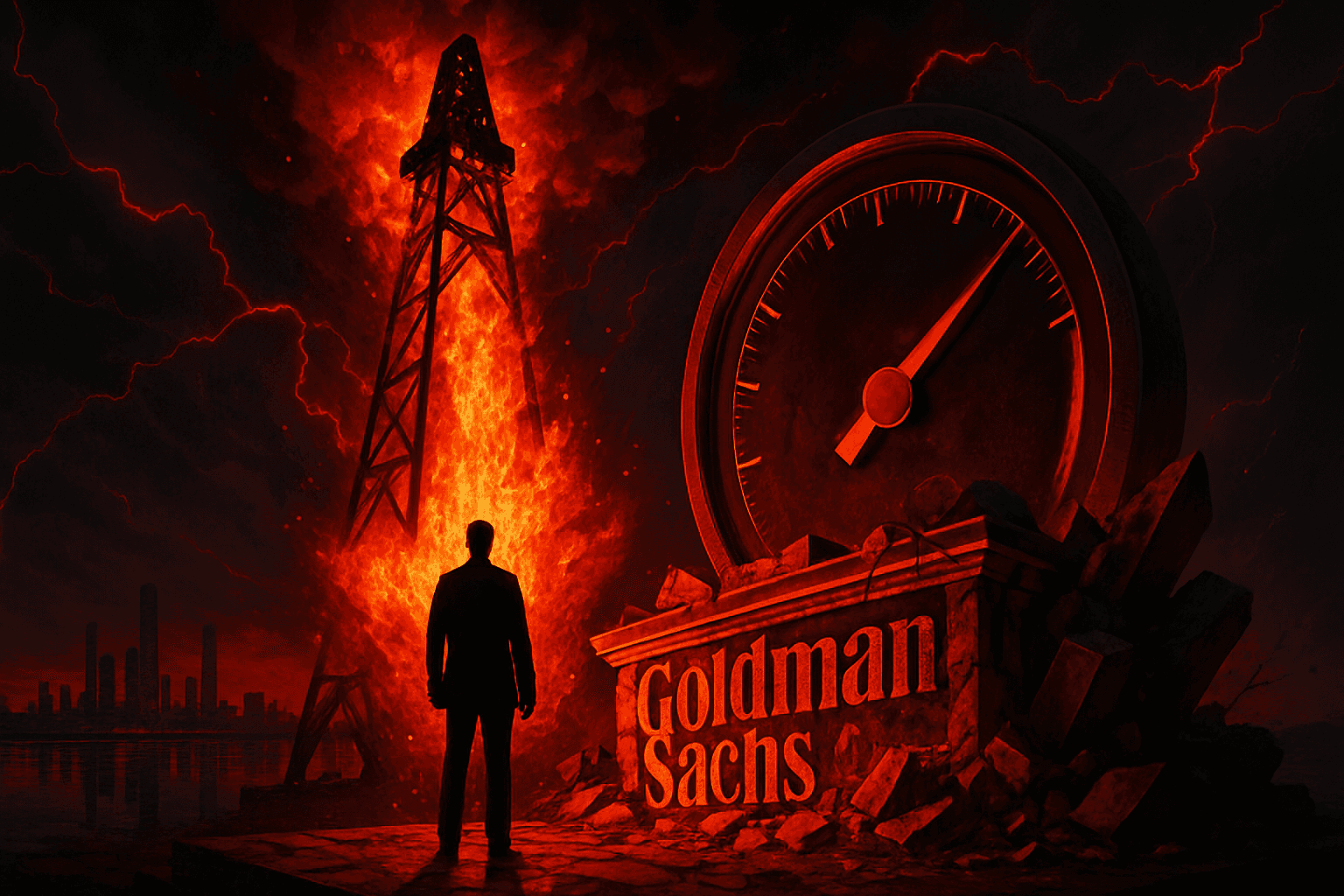
Goldman Sachs CEO: Iran Escalation Could Push Oil to $170, Raising Recession Risk
Goldman Sachs CEO David Solomon warned on April 21, 2026, that oil could spike to $170/barrel if the Iran conflict escalates, flagging recession risk and crypto market headwinds from tightening financial conditions.
Goldman Sachs CEO: Iran Escalation Could Push Oil to $170, Raising Recession Risk
Goldman Sachs CEO David Solomon warned on April 21, 2026, that oil prices could spike to $170 per barrel if the Iran conflict escalates significantly, with a near-term baseline forecast of $80 to $100 per barrel, and flagged rising recession risk for the United States amid ongoing Middle East tensions.
Solomon's comments centered on one specific chokepoint: the Strait of Hormuz. Roughly 20% of global oil supply transits this narrow waterway between Iran and Oman each day. If the strait remains largely closed, Solomon argued, the supply shock would be severe enough to send crude prices into territory not seen since the most acute phases of previous energy crises. At $170 per barrel, oil would exceed the inflation-adjusted peaks of the 1970s embargo era, when prices quadrupled in a matter of months and triggered a global recession.
The baseline forecast of $80 to $100 per barrel is itself a meaningful escalation from current levels and would represent a significant headwind for the US economy. Consumer energy costs, freight and logistics pricing, and manufacturing input costs would all rise in tandem. Solomon also raised a less conventional concern: social media's role in amplifying geopolitical tensions. He argued that the speed at which conflict narratives spread online could destabilize economic policy responses, making it harder for governments and central banks to act predictably. That unpredictability, he suggested, heightens recession risk beyond what traditional economic models might capture.
The warnings deserve scrutiny. Oil price forecasts from major financial institutions carry weight, but they also carry caveats. Strategic petroleum reserves held by the United States and the International Energy Agency exist precisely to buffer against short-term supply disruptions. US domestic production has expanded substantially over the past decade, reducing the economy's sensitivity to Middle East supply shocks compared to the 1973 or even 2011 Libya scenarios. A partial or temporary Hormuz disruption, rather than a sustained closure, would likely produce a price spike followed by a relatively quick correction as alternative supply routes and reserve releases absorb the shock. Solomon's $170 figure represents the tail risk, not the central case.
The social media argument is harder to evaluate. Information and misinformation travel faster than at any prior point in history, and market sentiment can shift violently on unverified reports. But attributing recession risk specifically to social media dynamics, rather than to the underlying geopolitical reality those platforms amplify, conflates the signal with the messenger. Traditional factors, including Federal Reserve policy, corporate earnings, and labor market conditions, remain the primary recession drivers. The broader point about policy unpredictability has merit: if markets cannot reliably forecast government responses to an escalating conflict, risk premiums rise across asset classes.
For crypto markets, the macro read matters. Risk-off sentiment driven by oil shocks and recession fears has historically pressured Bitcoin and altcoins alongside equities. The 2022 macro tightening cycle demonstrated clearly that crypto does not operate in isolation from global liquidity conditions. A sustained move to $100-plus oil would feed inflation, constrain Federal Reserve rate-cut expectations, and tighten financial conditions broadly. That environment is not friendly to speculative assets. Conversely, if the conflict de-escalates and oil retreats, the relief rally in risk assets could be sharp.
Goldman Sachs is not alone in watching the Strait of Hormuz closely. The waterway has been a recurring flashpoint since at least the Tanker War of the 1980s, and the 2019 to 2020 period of US-Iran tensions produced significant volatility without a sustained price breakout above $100. History suggests the strait rarely closes completely, because Iran itself depends on oil revenue that flows through it. That self-limiting dynamic is the primary reason Solomon's $170 scenario remains a tail risk rather than a base case. Major institutional players are nonetheless pricing in more uncertainty than they were even a few months ago, and a Goldman CEO making this warning publicly is itself a signal worth tracking.