DoorDash Partners With Tempo to Pay Drivers in Stablecoins
DoorDash has partnered with Tempo to let drivers receive earnings in stablecoins, joining Stripe, Coastal Bank, and ARQ on Tempo's payment rails in one of the most visible gig-economy stablecoin deployments to date.
DoorDash Partners With Tempo to Pay Drivers in Stablecoins
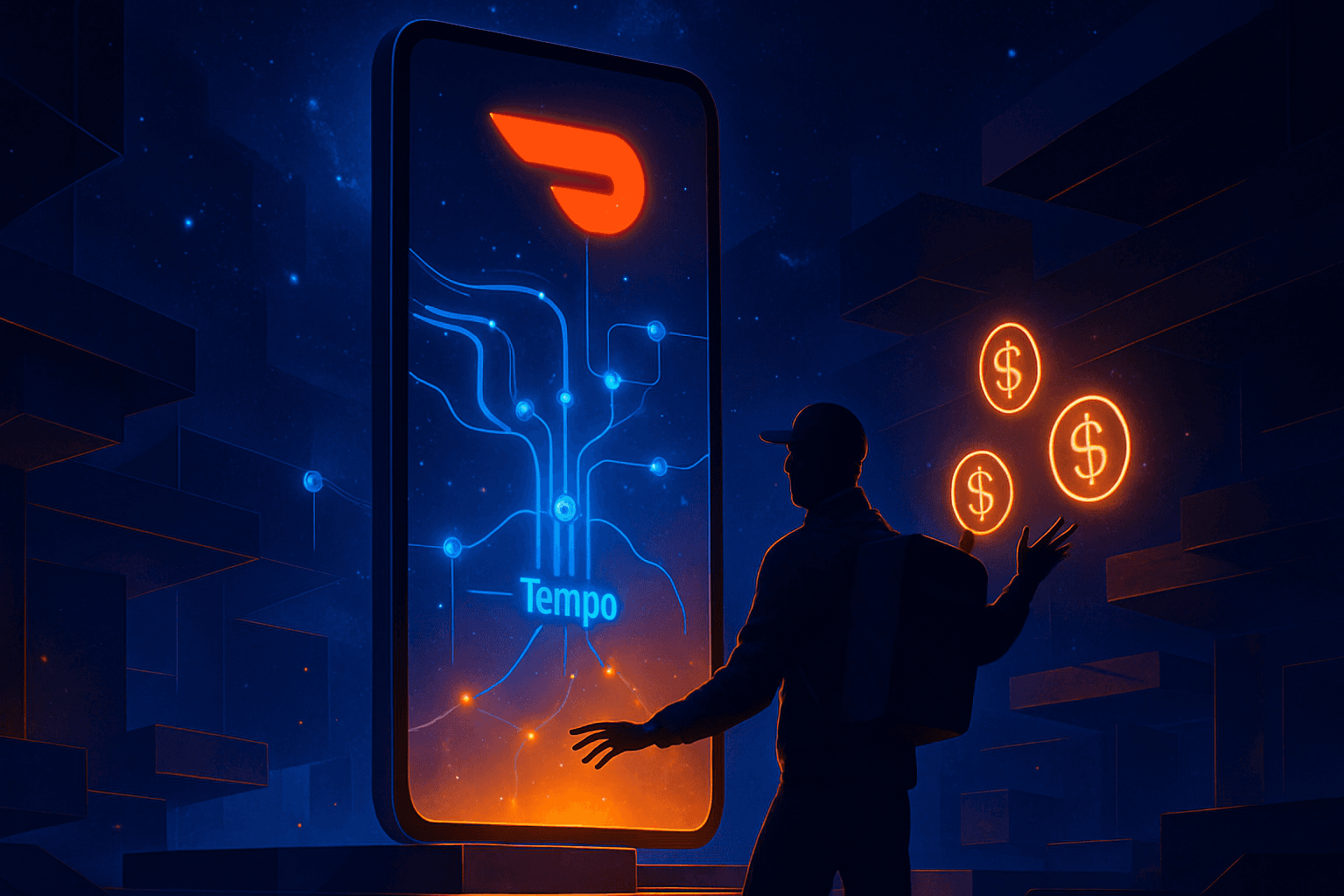
DoorDash has joined Tempo's payment network to offer stablecoin payouts to its driver base, the companies announced this week. The partnership is one of the most visible deployments of stablecoin infrastructure by a major gig-economy platform to date, placing DoorDash alongside Stripe, Coastal Bank, and ARQ as early adopters of Tempo's payment rails.
Drivers who opt in can receive earnings in stablecoins rather than traditional bank transfers. Tempo's network handles the underlying settlement layer, routing payments on-chain while abstracting away most of the technical complexity for end users. The Block first reported the partnership, noting that Stripe, Coastal Bank, and ARQ are also deploying stablecoin payment flows through Tempo's infrastructure.
Stablecoins are cryptocurrencies pegged to a fiat currency, typically the US dollar. USDC and USDT are the two largest by market cap, with combined circulation exceeding $200 billion as of mid-2025. Unlike Bitcoin or Ethereum, stablecoins don't fluctuate in price, which makes them practical for payroll and business payments where predictability matters. That stability has driven adoption in cross-border settlements and decentralized finance for years. Their appearance in domestic gig-economy payroll is newer territory.
DoorDash's driver network numbers in the hundreds of thousands across the United States. Getting even a fraction of that workforce onto on-chain payments would represent a meaningful real-world use case for stablecoin infrastructure, well beyond the relatively niche audiences that have driven adoption so far. The significance isn't just one company experimenting. It's the clustering of mainstream financial players: a payments giant in Stripe, a traditional bank in Coastal Bank, and a gig-economy platform in DoorDash, all choosing the same network within the same window.
The practical challenges are real, though. Regulatory treatment of stablecoin payroll varies by jurisdiction, and no federal framework in the US currently provides clear guidance on whether stablecoin wage payments satisfy labor law requirements in every state. Driver adoption is another open question. Receiving a paycheck in USDC is only useful if you can spend it or convert it to dollars without friction, and crypto wallet familiarity among gig workers remains low. Tempo will likely need to integrate off-ramp options, such as direct bank deposits or debit card access, to make the product genuinely usable for drivers who aren't already crypto-native.
Corporate interest in stablecoin payments has been building since at least 2021, when PayPal began allowing users to buy and spend crypto, and accelerated through 2023 and 2024 as institutional stablecoin volumes climbed. Stripe reintroduced crypto payments in 2024 after a years-long hiatus, signaling renewed confidence in stablecoin infrastructure. The GENIUS Act, a US Senate bill that would establish a federal licensing framework for stablecoin issuers, passed committee earlier this year, giving companies like DoorDash more regulatory visibility than they had even 12 months ago.
For the payments industry, the DoorDash-Tempo deal is a signal worth watching. Traditional payment networks charge interchange and processing fees that add up at scale. Stablecoin rails settled on-chain can reduce those costs significantly, particularly for high-frequency, small-dollar transactions like gig-economy payouts. If Tempo's infrastructure proves reliable at DoorDash's scale, other platforms in the gig and creator economy will likely evaluate similar arrangements. The friction that slowed earlier crypto payroll experiments, price volatility and regulatory ambiguity chief among them, has not disappeared. But it has decreased enough that a company with DoorDash's profile is willing to put its name on the product.