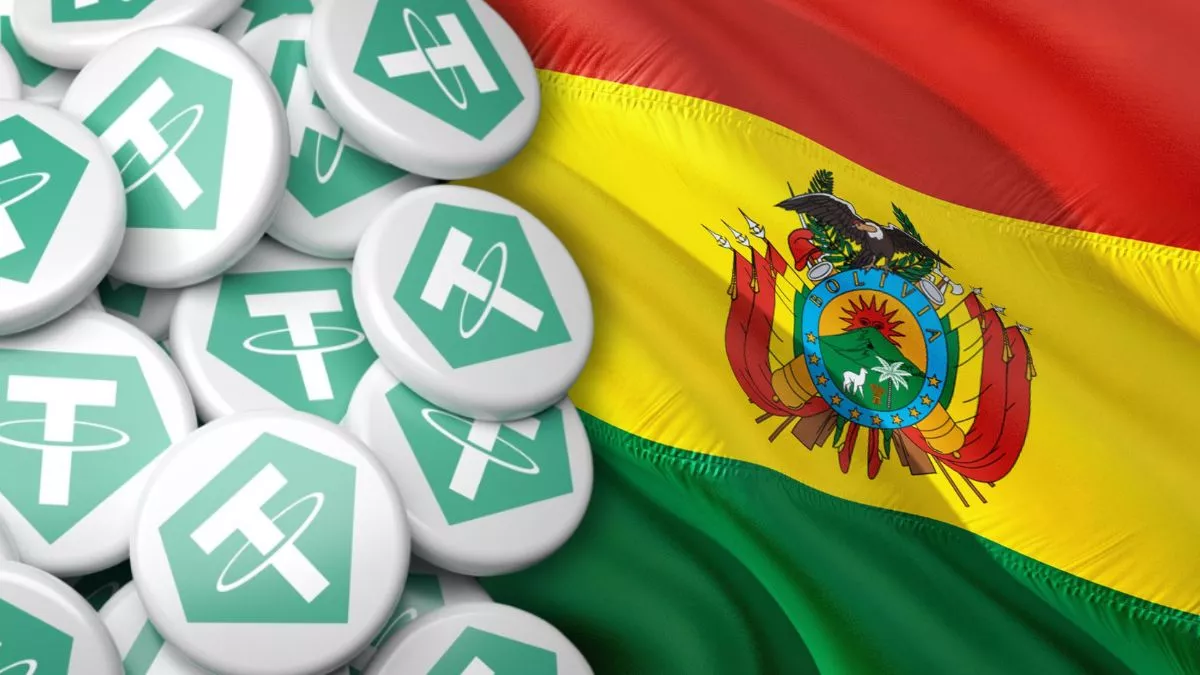
Bolivia Turns to Tether’s USDT as Dollar Shortages Deepen
Bolivia embraces USDT amid dollar scarcity, inflation, and soaring crypto adoption, reshaping its financial landscape.
Bolivia, long struggling with currency instability and shortages of U.S. dollars, is witnessing an unlikely savior in the form of Tether’s USDT stablecoin. Once confined to the fringes of crypto speculation, USDT is increasingly serving as the “digital dollar” that households, businesses, and even global corporations rely on in the Andean nation.
According to data from DefiLlama, Tether’s market capitalization has climbed to $172.3 billion, giving it a commanding 58.8% share of the global stablecoin sector. This dominance is being felt most acutely in emerging markets such as Bolivia, where the lack of reliable access to hard currency has fueled an extraordinary surge in stablecoin adoption.
The scale of this shift is striking. Bolivia’s central bank recently disclosed that crypto transactions in the country reached $430 million within a year of lifting its ban on digital assets in 2024. That figure represents a staggering 630% increase year-over-year. In the first half of 2025 alone, $294 million in crypto payments were recorded, compared to just $46.5 million a year earlier.
For many Bolivians, stablecoins now underpin everyday commerce. Japanese carmakers Toyota and Yamaha, along with China’s electric vehicle giant BYD, have begun accepting USDT as payment for vehicles in Bolivia. Tether CEO Paolo Ardoino hailed the development as proof that stablecoins are no longer confined to crypto-native communities. “USDT is becoming the digital dollar for hundreds of millions in emerging markets,” Ardoino remarked, underscoring the role of the token in bridging economic instability.
Bolivia’s macroeconomic backdrop explains this accelerated shift. The nation faces soaring inflation, dwindling foreign reserves, and severe shortages of physical dollars. Long queues at gas stations and an expanding black-market exchange rate—where the boliviano has lost nearly half its value this year—have left businesses and families desperate for alternatives. While the government maintains a stable official exchange rate, the gulf between official and parallel markets has forced many to turn to crypto rails, with USDT emerging as the default choice.
Still, economists urge caution. Former central bank governor Jose Gabriel Espinoza, speaking to Reuters, argued that the surge in crypto transactions is not a sign of economic health but rather “a reflection of the deteriorating purchasing power of households.” Stablecoin adoption, he warned, could mask structural weaknesses rather than resolve them.
For Tether, however, Bolivia represents validation. Ardoino has emphasized that USDT offers “digital dollar savings to the world” and pointed to a recent uptick in retail users, with nearly three times as many new holders as all competing stablecoins combined over the past three months.
Bolivia’s pivot mirrors a broader Latin American trend in which stablecoins are integrating into daily life faster than in Europe or North America. Yet regulation remains a dividing line. While Tether resists compliance with Europe’s MiCA framework, competitors such as Circle, issuer of USDC, have secured licenses to operate across the European Economic Area.
As Bolivia leans into crypto solutions, its embrace of USDT reveals both the promise and perils of stablecoins in fragile economies: a lifeline for daily transactions, but also a stark reminder of deepening structural crises.