
Bitcoin at $78,500: Custody Breakthroughs and a Sidechain Exploit Define a Volatile Week
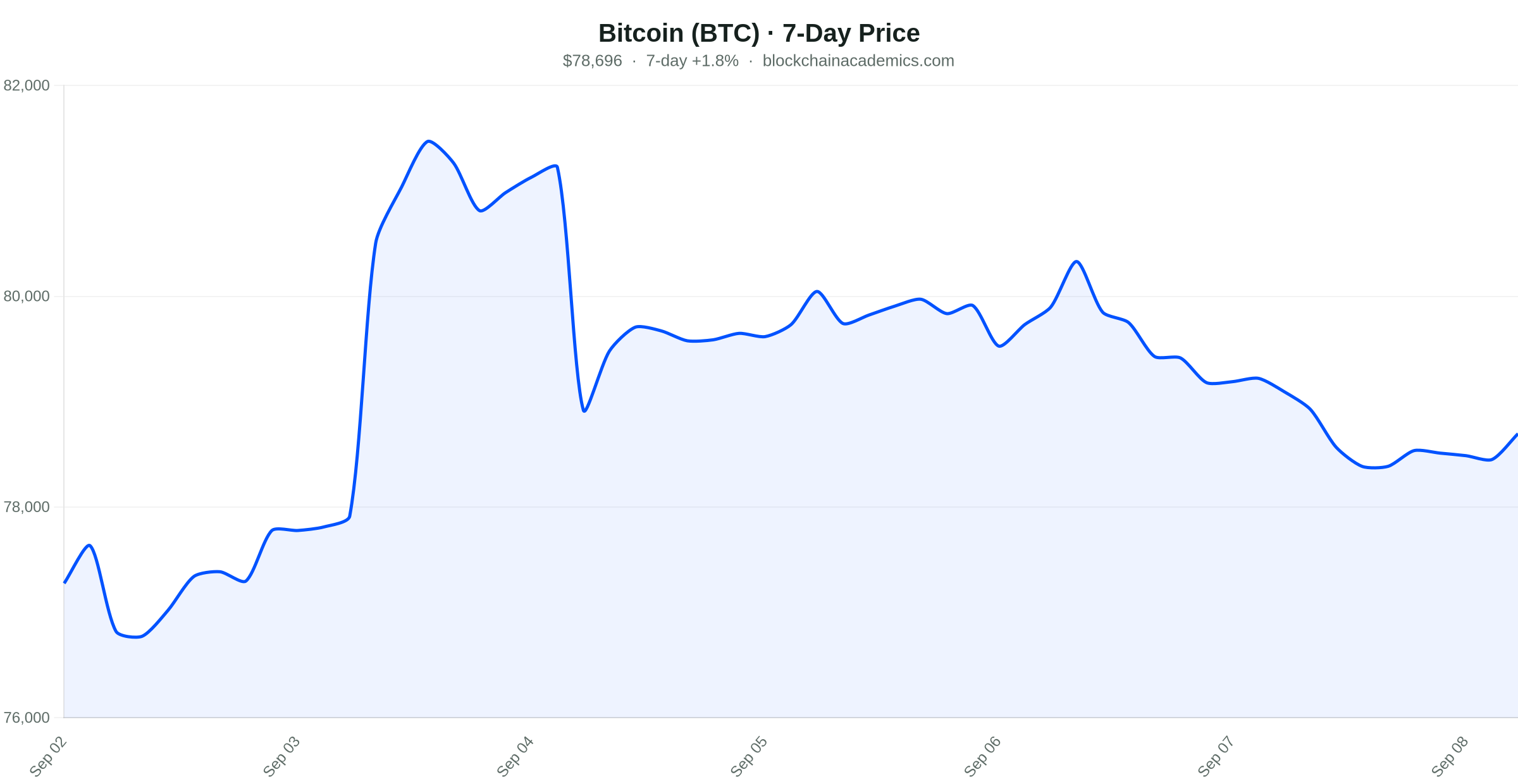
Bitcoin is trading at $78,539 as infrastructure developments, a critical Liquid Network sidechain exploit, and rising Fed rate hike odds create a complex week. CoinCorner and Block launch custody products while Bhutan offloads 96% of its Bitcoin holdings.
Bitcoin at $78,500: Custody Breakthroughs and a Sidechain Exploit Define a Volatile Week
Bitcoin is trading at $78,539, down 0.83% on the day, as a cluster of infrastructure developments, a significant sidechain exploit, and rising Fed rate hike odds create the most narratively complex week the market has seen in months.
The Exploit That Should Have Moved Markets More
The biggest story flying under the price radar: Liquid Network, Blockstream's Bitcoin sidechain designed for faster, confidential transactions, suffered a critical exploit that minted 4,000 unbacked LBTC tokens through a range proof caching flaw. Attackers used SideSwap's peg-out authorization to convert the fake LBTC into real bitcoin, draining real value from the system.
Blockstream recovered 3,400 BTC, but 598.5 BTC remains outstanding. At current prices, that shortfall sits around $47 million. The notional exposure at peak was closer to $400 million. That Bitcoin's spot price barely flinched is telling: markets are treating this as an isolated sidechain failure rather than a systemic mainnet risk. Compare that to Mt. Gox in 2014 or Bitfinex in 2016, both of which triggered 10-20% corrections. The muted reaction reflects how far institutional understanding of Bitcoin's layered architecture has matured.
Still, the exploit raises uncomfortable questions about confidential transaction systems. Range proofs, the cryptographic mechanism used to verify that a transaction amount is valid without revealing it, have long been flagged as a potential attack surface. This incident validates those concerns in the most expensive way possible.
Custody Gets Serious
Paradoxically, the same week brought two of the most significant custody product launches in recent memory.
CoinCorner and Anchorwatch rolled out a multisig Bitcoin custody vault backed by Lloyd's of London insurance. Multisig (multi-signature) custody requires multiple private key approvals before any transaction executes, making unilateral theft far harder. The Lloyd's backing gives institutional clients the compliance paper trail they need. Separately, Jack Dorsey's Block filed for a federal banking charter through Builders Bank, explicitly targeting Bitcoin custody services. A federal charter would subject Block to OCC oversight but also grant it the regulatory legitimacy that separates serious institutional custodians from the rest.
Both moves mirror the 2020-2021 cycle when Grayscale and Fidelity's institutional pushes normalized Bitcoin as a treasury asset. The difference now is that ARK Invest has filed for a tokenized venture fund share class, signaling that the integration of traditional finance rails with crypto custody is accelerating on multiple fronts simultaneously.
ARK Invest is so bullish on Bitcoin's potential that the company holds billions in Bitcoin in its strategic reserve.
Cathie Wood, CEO of ARK Invest
Strive Inc. added 1,375 BTC this week, pushing itself into the top five corporate Bitcoin holders by treasury size. CleanSpark reported 593 BTC mined in August, holding 13,703 BTC total. Corporate accumulation is not slowing.
The Macro Headwind Nobody Wants to Talk About
CME FedWatch now prices September 2026 rate hike odds at approximately 56%, up sharply following Fed Chair Kevin Warsh's Jackson Hole speech. Rate hikes are historically risk-off catalysts. Bitcoin's one-month realized volatility is already at historic lows, which Glassnode attributes to long-term holder dominance suppressing trading activity.
Bitcoin's one-month realized volatility is historically low, according to Glassnode, whose statistical analysis identifies long-term holder supply as the leading explanatory variable.
Glassnode
Low volatility reads bullish in some frameworks, bearish in others. When long-term holders dominate supply and trading volume collapses, price discovery stalls. The last time Bitcoin showed this pattern was late 2023, just before the ETF approval catalyst broke it out. The question is whether a comparable catalyst exists on the near horizon, or whether rising rate expectations become the pressure release valve.
Bhutan's government is clearly not waiting to find out. The sovereign nation transferred 400 BTC worth $31.78 million on September 7, cutting its holdings from 13,390 BTC to just 518 BTC. That is a 96% drawdown of a sovereign Bitcoin treasury in a matter of months. Whatever the fiscal rationale, the optics undercut the "nation-states are HODLing" narrative.
Altcoin Signals and Regulatory Noise
Polkadot surged 16.7% in 24 hours and 42.5% on the week, leading a rotation into older Layer-1 tokens. When legacy L1s outperform during macro uncertainty, it often reflects speculative positioning rather than fundamental re-rating. Zcash crossing $1,000 after reported whale accumulation campaigns carries similar energy: momentum-driven, fragile, and worth watching for reversal signs.
On the regulatory front, Senator Cynthia Lummis acknowledged the Clarity Act faces an uphill path. "It can still get through, but it'll need further compromise from Democrats," she said. Plattsburgh, New York is considering extending its existing crypto mining ban to cover AI data centers, a move that signals local governments are increasingly conflating energy-intensive compute regardless of its purpose. Neither development is catastrophic in isolation, but the regulatory environment remains friction-heavy.
The BTCB2 fork team securing the XBT ticker on smaller exchanges deserves a brief mention as a cautionary tale. XBT is the ISO 4217 currency code widely used by institutional platforms to denote Bitcoin. A fork appropriating that identifier creates exactly the kind of confusion that regulators and institutional compliance teams use to justify caution. It echoes the BCH-vs-BTC ticker wars of 2017-2018, and it ended badly for the fork.
The Bigger Picture
Bitcoin hashrate rebounded from a triple bottom at 850 million TH/s (terahashes per second), a network health signal that matters more than most price indicators. Crypto transaction volume across the Middle East and North Africa reached an estimated $350 billion in 2025-2026, up from $100 billion in 2022. Bernstein projects Bitcoin at $150,000 by mid-2027, though that call assumes macro conditions cooperate.
At $78,500, Bitcoin is neither breaking out nor breaking down. The custody infrastructure being built this week, by Block, CoinCorner, Anchorwatch, and others, is the kind of boring, durable work that tends to matter more than any single price candle. The Liquid exploit is a real scar on sidechain credibility. The Fed is a real headwind. Neither is fatal. The market knows this, which is precisely why volatility is historically low and nobody seems particularly panicked about any of it.