AWS Bets on USDC for AI Agent Payments, Partnering Coinbase Despite $394M Q1 Loss
AWS launched Bedrock AgentCore Payments, routing AI agent micropayments through Coinbase's x402 protocol on Solana and Base. The move comes despite Coinbase posting a $394M Q1 2026 loss, as stablecoins now drive 44% of its revenue.
AWS Bets on USDC for AI Agent Payments, Partnering Coinbase Despite $394M Q1 Loss
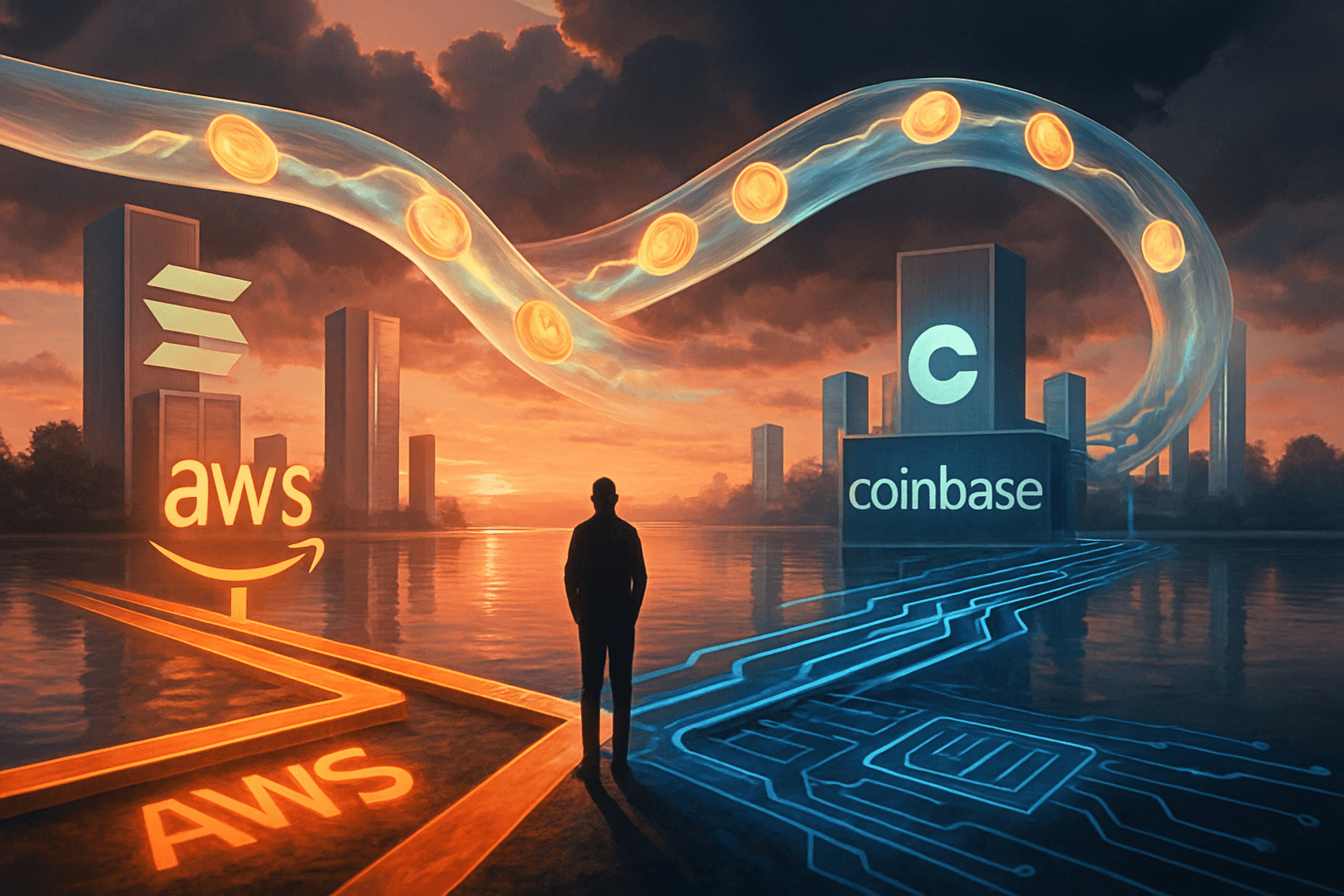
Amazon Web Services has launched a payment infrastructure system that lets AI agents autonomously transact in USDC, partnering with Coinbase and Stripe to build the underlying rails. The product, called Amazon Bedrock AgentCore Payments, routes micropayments through Coinbase's x402 protocol across the Solana and Base networks, marking one of the most concrete enterprise deployments of stablecoin infrastructure to date.
The timing is notable. Coinbase posted a $394 million net loss in Q1 2026, a figure that raised immediate questions about the company's near-term profitability. Yet buried inside that same earnings report is a structural shift that explains why AWS is calling on Coinbase at all: stablecoins and subscription services now account for 44% of Coinbase's total revenue. The exchange is no longer primarily a trading venue. It is becoming infrastructure.
What Bedrock AgentCore Payments Actually Does
Amazon Bedrock is AWS's managed platform for building applications using large language models. AgentCore is the layer that handles the operational needs of AI agents, covering memory, authentication, and tool access. The new payments module extends that stack to include financial transactions.
Under the system, developers building AI agents on Bedrock can fund those agents with USDC and allow them to make autonomous micropayments without human approval at each step. The x402 protocol, developed by Coinbase, handles the payment messaging layer. Settlements occur on either Base, Coinbase's own Ethereum Layer 2 network, or Solana. Developers choose between Coinbase and Stripe for the underlying wallet infrastructure, giving them optionality depending on their existing stack.
The use cases being discussed include AI agents that pay for API calls, data feeds, or computational resources on a per-use basis rather than through traditional subscription contracts. In theory, an agent could negotiate and pay for a weather data lookup, a legal database query, or a code execution environment, all within a single workflow, without a human signing off on each transaction. Stablecoins are well-suited for this because they carry no price volatility risk at the moment of settlement and can be programmatically controlled with spending limits and governance rules.
The Business Case for Coinbase
For Coinbase, the AWS partnership does several things at once. It validates Base as a serious enterprise payment network rather than just a consumer DeFi chain. It positions Coinbase's developer tooling, wallets, and x402 protocol inside one of the most widely used cloud platforms on earth. And it provides a revenue stream that does not depend on crypto market volatility.
That last point matters. Coinbase's Q1 2026 loss was driven in part by declining trading volumes and continued investment in infrastructure. The company is spending now to capture a position in what it believes will be a large and durable market. Whether that bet pays off depends on how quickly developers actually build agents that need payment rails, and whether USDC becomes the default settlement token for that activity.
Circle, which issues USDC, was scheduled to report earnings on May 11, 2026. Those results carry direct implications for USDC's circulation numbers and the fee revenue both Circle and Coinbase derive from the stablecoin's growth. Coinbase holds a revenue-sharing arrangement with Circle tied to USDC reserves, so any expansion in USDC supply flowing through enterprise channels translates into recurring income for Coinbase that does not require a single retail trader to log in.
Real Risks Behind the Headline
The counter-case deserves serious treatment. Autonomous AI agent payments are largely theoretical at scale. No one has demonstrated that the agentic economy will generate the transaction volume that would make this infrastructure meaningful to Coinbase's bottom line in the near term. The $394 million Q1 loss is a real number, and infrastructure partnerships do not immediately close that gap.
Regulatory risk is also present. USDC operates under Circle's money transmission licenses and is subject to evolving stablecoin legislation in the United States. The GENIUS Act and competing Senate proposals were still working through Congress as of May 2026. If stablecoin regulation tightens or imposes new reserve requirements, the economics of USDC-based payment rails could shift in ways that complicate enterprise deployments.
Competition is a third variable. Stripe is simultaneously a partner in this deal and a direct competitor for developer wallet infrastructure. Stripe has been building its own crypto payment products aggressively and has the advantage of deep existing relationships with enterprise software teams. Coinbase's differentiation here rests on its control of Base and its native crypto credibility, but Stripe is not a passive participant in this market.
What This Signals for the Broader Market
The AWS integration is the most significant institutional signal for stablecoin payment rails since Visa and Mastercard began settling transactions in USDC in 2021. The difference is that those card network integrations were essentially back-end treasury operations. This is a front-end deployment: USDC as the active medium of exchange inside a live production environment used by enterprise developers.
If Bedrock AgentCore Payments gains traction, it could establish a template that other cloud platforms follow. Microsoft Azure and Google Cloud both have competing AI agent frameworks. Neither has announced comparable stablecoin payment integrations. That gap may not last long if AWS demonstrates meaningful developer uptake.
For Coinbase, the strategic logic is coherent even if the path to profitability is not yet clear. The company is building toward a world where blockchain rails handle machine-to-machine payments at scale, and it wants Base and USDC to be the default layer. The Q1 loss reflects the cost of that ambition. Whether the AWS partnership accelerates the timeline or remains a promising pilot is the question the next several quarters will answer.